
The majority of contact lenses sold today are either soft lenses or rigid gas permeable (RGP) lenses. But there is another type of contact lens.
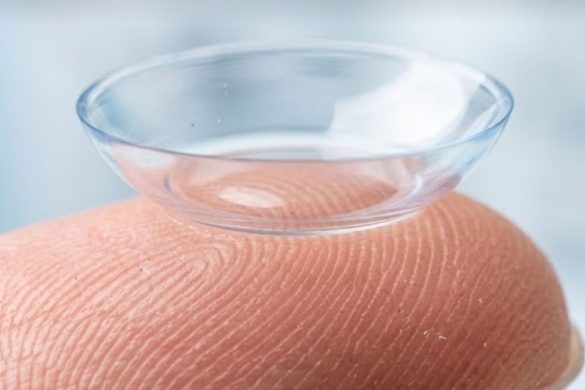
Hybrid contact lenses combine the features of both types. They have a rigid gas-permeable inner section surrounded by a soft outer skirt.
They’re most often prescribed for people with keratoconus, severe astigmatism, and other corneal conditions that can be difficult to correct with standard contact lenses.
We’re going to discuss exactly what hybrid contact lenses are and how they can help with these conditions.
What Are Hybrid Contact Lenses?
Hybrid contact lenses combine the technologies of both soft lenses and rigid gas permeable (RGP) lenses into one design. The center of the lens is hard, while the external material is soft, using either hydrogel or silicone hydrogel.
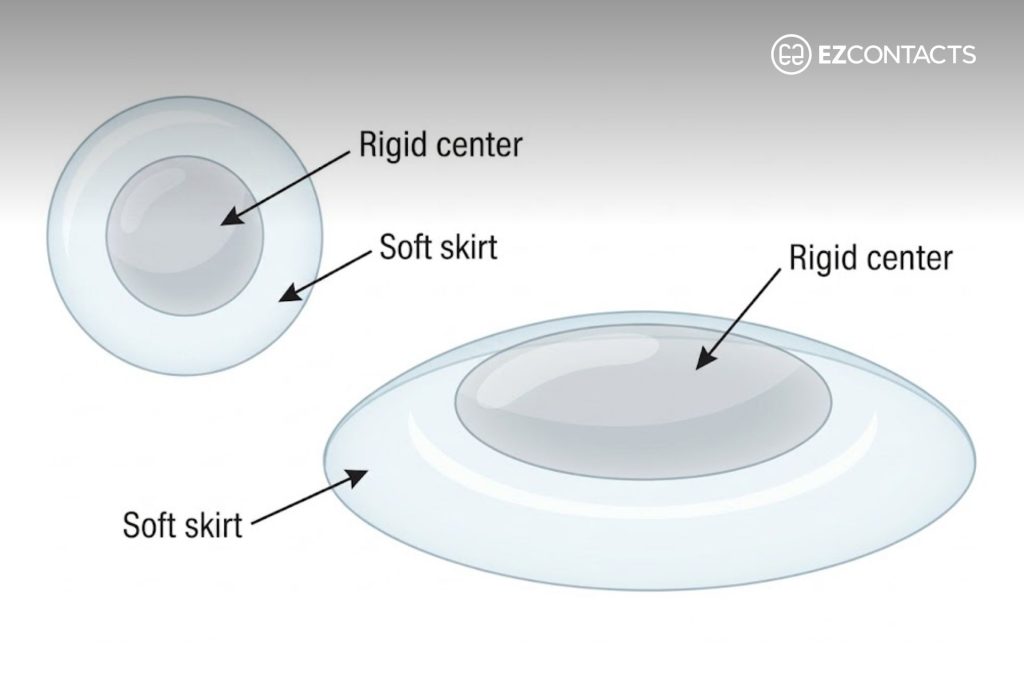
The rigid center is the part of the lens that delivers most of the optical performance. Unlike a soft contact lens, it doesn’t mold itself to every curve and imperfection on the eye’s surface. This means the lens is able to compensate for any irregularities in the cornea instead of simply following them.
The soft skirt of the lens has a different purpose. It’s primarily there for the comfort of the wearer as well as to keep the lens centered on the eye. The idea behind hybrid lenses is to combine the excellent visual clarity of an RGP lens with the comfort offered by a soft lens.
Modern hybrid lenses also use highly oxygen-permeable materials. Oxygen permeability is measured using a value called Dk, with higher numbers indicating that more oxygen can pass through the lens material. This is important because the cornea doesn’t contain blood vessels and gets most of its oxygen directly from the air.
For example, the UltraHealth lenses by SynergEyes have a rigid center with a Dk value of 130 and a silicone hydrogel skirt with a value of 84. For comparison, modern RGP lenses have Dk values ranging from around 30 to over 100.
Why Some Prescriptions Are Difficult to Correct
Most people who wear contacts have relatively smooth corneas even if they’re nearsighted, farsighted, or have mild astigmatism. Soft contact lenses typically work very well for these people.
But problems begin to arise when the shape of the cornea is irregular. In some patients, certain parts of the cornea may become steeper, flatter, scarred, or otherwise distorted.
When light enters the eye of a person with an irregular cornea, it can’t focus properly. The person can experience visual ghosting, glare, halos, double vision, or blurriness that can’t be fully corrected with ordinary glasses or soft contact lenses.
This is where hybrid lenses can help. Because the rigid center holds its shape as it sits on the eye, it creates a new refracting surface in front of the cornea. This has the potential to mask some of the irregularities underneath, something that can’t be done as effectively by soft lenses.
Keratoconus: The Most Common Reason For Hybrid Lenses
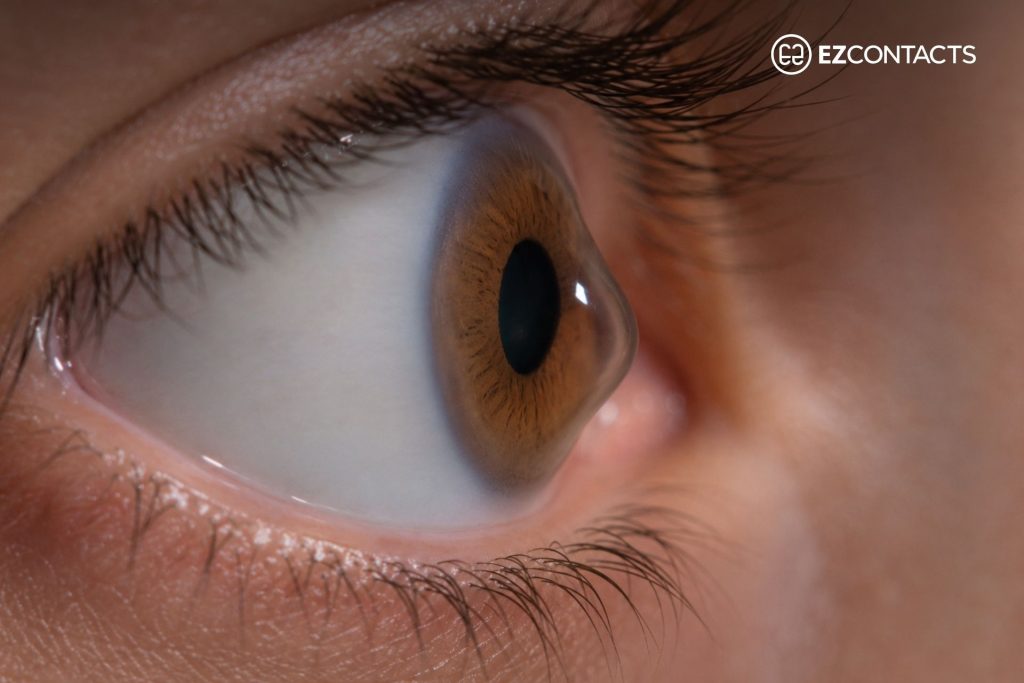
Keratoconus is one of the most common conditions for which hybrid lenses are prescribed. This condition causes the cornea to gradually thin and bulge forward into a cone-like shape. This distorts light as it enters the eye and increasingly affects vision.
Older studies estimate that keratoconus affects about 1 in every 2,000 people. But studies using advanced corneal imaging suggest it may be much more common than previously believed. A 2017 study put estimates at 1 in 375 people.
In the early stages of the condition, glasses or soft contact lenses may provide adequate vision. But as it progresses, most patients eventually need a lens that can compensate for the irregular shape of the cornea.
For decades, rigid gas permeable (RGP) lenses were the only non-surgical solution for patients with severe keratoconus. But hybrid lenses now offer an alternative.
Like RGP lenses, hybrid lenses use a rigid center to create a smoother optical surface in front of the eye. Instead of light passing through a cornea with an uneven cone-like shape, it passes through the smooth surface of the lens. This can significantly reduce the visual distortions caused by keratoconus and often provide much better vision than glasses or soft contact lenses.
Today, hybrid lenses are commonly prescribed for keratoconus patients who need the visual benefits of a rigid lens but are looking for an alternative to a traditional RGP design.
Hybrid Lenses for Severe Astigmatism
Hybrid lenses are also prescribed for certain cases of astigmatism. Lots of people with astigmatism wear soft toric lenses successfully. In fact, prescriptions for toric lenses now account for around 46% of all soft daily lenses, nearly double the rate seen in 2000.
But not all astigmatism is the same. People with high levels of astigmatism or irregular astigmatism often need more than a toric soft lens can provide. In these cases, the rigid center of a hybrid lens creates a smoother surface on the eye, reducing distortions that soft lenses aren’t able to correct.
Corneal Scarring and Post-Surgical Eyes
Scarring from infections, injuries, and particular eye diseases can permanently change the shape of the cornea. Some patients also develop corneal irregularities after procedures, including corneal transplants and radial keratotomy.
In the United States, there are now more than 49,000 corneal transplants performed each year. While these procedures can restore vision and preserve the health of the eye, many patients still require specialty contacts afterward because the cornea does not always heal into a perfectly smooth shape.
Hybrid lenses can be used to reduce the visual effects of scarring and post-surgical irregularities of the cornea. This can help patients achieve better visual clarity than they can with glasses or soft lenses.
Are Hybrid Lenses Better Than RGP Lenses?
It really depends on the patient. Rigid gas-permeable lenses are still widely prescribed and remain one of the most effective ways to correct irregular corneas.
Hybrid lenses weren’t designed to replace RGPs. Instead, they offer an alternative to fully rigid lenses. Some people try them and don’t like them, while others find them much more comfortable than RGPs because of their soft outer skirt.
In some cases, scleral lenses may be recommended instead. So it really comes down to your particular preferences as well as your eye health and prescription. But if you think you might do well with hybrids, it’s well worth speaking to your doctor about it at your next exam.
TL;DR
- Hybrid contact lenses combine a rigid gas permeable (RGP) center with a soft outer skirt.
- They’re most commonly prescribed for keratoconus, severe astigmatism, and other conditions that cause irregularities of the cornea.
- The rigid center creates a smoother optical surface over the cornea, reducing visual distortions.
- Modern hybrid lenses use oxygen-permeable materials that achieve the same, or sometimes greater, oxygen permeability than RGPs.
- Hybrid lenses aren’t designed to replace RGP lenses. They provide another option for patients who need the visual benefits of a rigid lens.