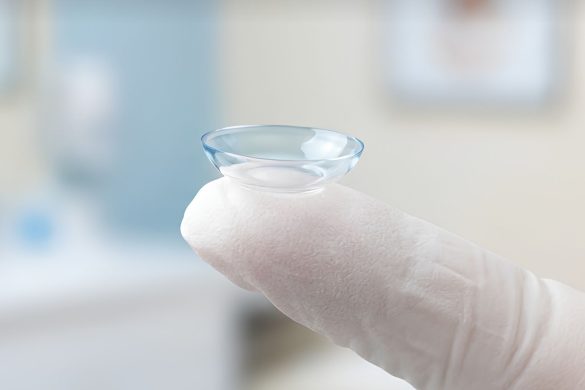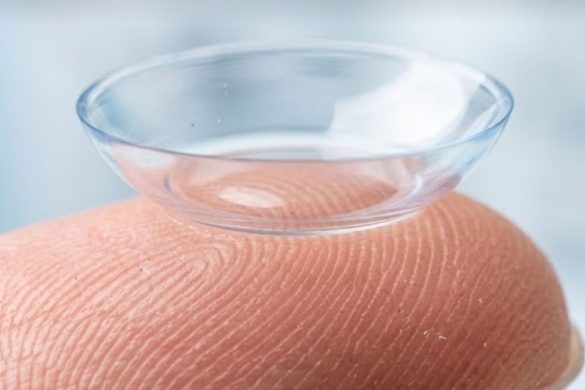
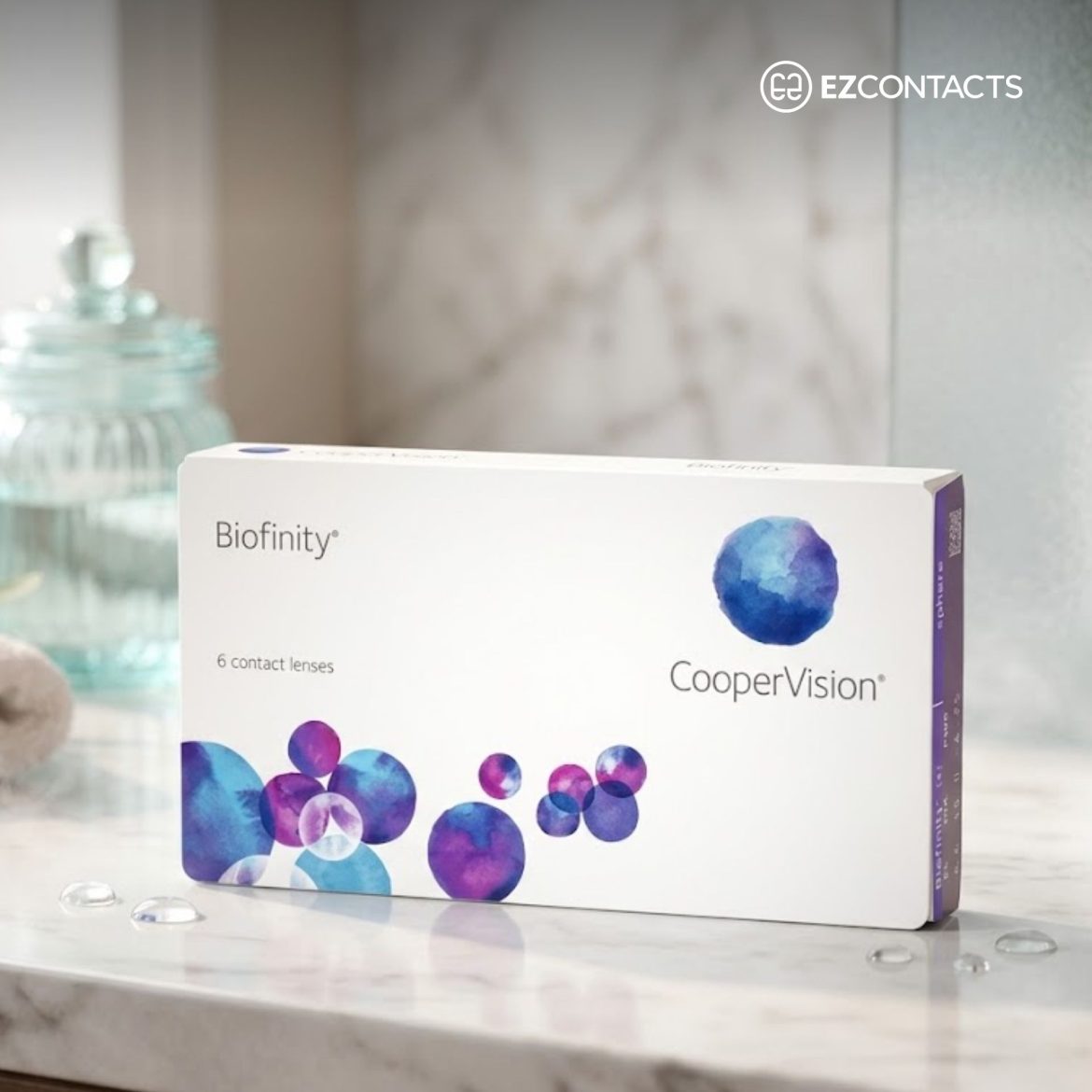
Comfilcon A is the material used in CooperVision’s Biofinity family of monthly contact lenses. Introduced in 2008, it’s a silicone hydrogel material designed to combine high oxygen transmission with high water content.
But what exactly are Comfilcon A contact lenses? And why have they become so popular among both doctors and contact lens users?
What Is Comfilcon A?
Comfilcon A is a silicone hydrogel contact lens material created by CooperVision for use in their Biofinity family of lenses.
Silicone hydrogel was developed to solve the problem that had plagued contact lenses for decades. Before silicone was introduced to traditional hydrogel lenses, designing contact lenses that allowed enough oxygen to reach the cornea was a huge challenge.
Traditional hydrogel lenses rely on the water within the lens to transport oxygen to the cornea. Silicone hydrogel allows oxygen to pass through the lens.
Oxygen permeability in contacts is measured with a unit known as “Dk.” Comfilcon A has a Dk value of 128. In terms of breathability, this puts it in the upper tier of the soft contact lens materials available today. For reference, most traditional hydrogel lenses have Dk values below 40. Even some modern silicone hydrogel lenses fall below 100.
However, that’s not quite what makes Comfilcon A special, since there are silicone hydrogel lenses with higher Dk values than that. What makes Comfilcon A contact lenses unique is that they combine the high oxygen transmission with a water content of 48%.
This is what has resulted in Biofinity lenses becoming so popular and widely prescribed over the last two decades.
Quick Look at the Features of Biofinity Lenses
- Wide prescription range: Biofinity and Biofinity XR offer sphere powers from +15.00D to -20.00D, suitable for around 99.9% of spherical prescriptions.
- High oxygen transmission and water content: Comfilcon A has a Dk value (oxygen permeability) of 128 with a water content of 48%. This is a combination that makes Biofinity a very competitive product more than 15 years after its launch.
- Aquaform Technology: This technology, patented by CooperVision, is designed to hold water within the lens material itself. It doesn’t depend on coatings or wetting agents on the surface of the lens like many other soft lenses.
- Aberration Neutralizing System™: For nearsightedness and farsightedness, CooperVision states that its patented design enhances vision performance by minimizing spherical aberrations. It also helps incoming light rays converge for better focus and sharper vision.
- Extended wear approval: Approved for up to 6 nights and 7 days of continuous wear for suitable patients.
Which Contact Lenses Use Comfilcon A?
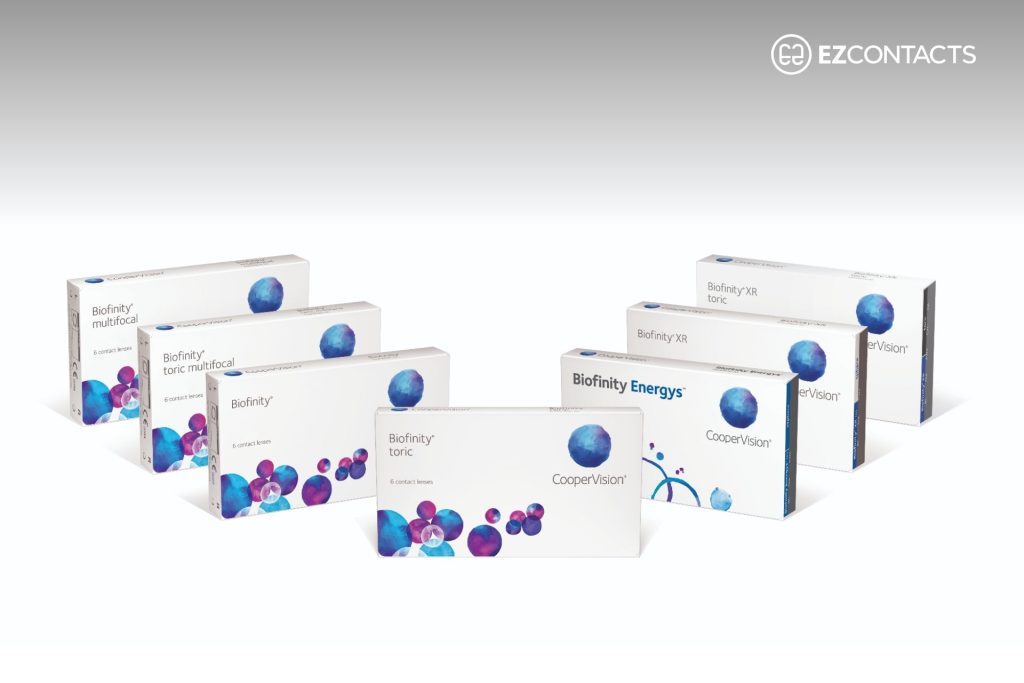
Comfilcon A is exclusively used by CooperVision for its Biofinity line of monthly contact lenses. This includes the following products:
- Biofinity: Standard spherical lenses designed to correct nearsightedness (myopia) and farsightedness (hyperopia).
- Biofinity Toric: For astigmatism, with a specialized lens design that helps keep the lens in position on the eye.
- Biofinity Multifocal: For people with presbyopia, correcting near, intermediate, and far distances simultaneously.
- Biofinity Toric Multifocal: Contacts that combine correction for both astigmatism and presbyopia in a single lens.
- Biofinity XR: Extended-range lenses for people with particularly strong prescriptions that fall outside the standard Biofinity range.
- Biofinity Toric XR: For people with astigmatism who also have higher or more complex prescriptions.
- Biofinity Energys: For people who spend a lot of their day looking at screens, featuring Digital Zone Optics tech designed to reduce eye strain.
The range of contact lens options is one reason doctors often choose to prescribe Biofinity lenses. It means patients can often stay with the same brand or family of lenses even if their prescription changes over time.
The Technology Behind Biofinity’s Water Retention
One of the challenges with silicone hydrogel lenses is that silicone naturally repels water. So even if a lens is very breathable, if it can’t stay hydrated, that’s a big problem. And it’s going to significantly affect the comfort of the wearer.
Many silicone hydrogel lenses rely on special surface treatments to make the lens more wettable. But Comfilcon A contact lenses were designed differently. CooperVision built water-attracting components, branded as “Aquaform,” into the actual lens material. This allows the lens to retain up to twice its dry weight in water.
Can Comfilcon A Contact Lenses Help With Dry Eyes?

Dry eye is one of the most common reasons people become dissatisfied with contact lenses. The best contact lens for dry eyes varies from person to person. However, many patients do report a good comfort level with Biofinity lenses.
A report titled “Effect of multipurpose care solutions upon physical dimensions of silicone hydrogel contact lenses,” which was published in the Journal of Biomedical Materials Research, found that Comfilcon A demonstrated strong resistance to dehydration under laboratory testing conditions.
That doesn’t mean Biofinity lenses will solve dry eye for every wearer. But it does help explain why the material has earned a reputation for staying comfortable for long periods.
So, Comfilcon A’s combination of high water retention and oxygen permeability could be worth a shot if you suffer from dry eye. If you have any questions about whether Comfilcon A is right for your eyes, be sure to talk to your eye doctor.
TL;DR
- Comfilcon A is the silicone hydrogel material used exclusively in CooperVision’s Biofinity contact lenses.
- Introduced in 2008, it combines a water content of 48% with a high oxygen permeability (Dk) of 128.
- Biofinity lenses are available for nearsightedness, farsightedness, astigmatism, presbyopia, and higher prescription ranges.
- Comfilcon A contact lenses are designed to provide both high oxygen transmission and strong water retention.
- Biofinity lenses are approved for up to six nights and seven days of extended wear, as long as your eye doctor has given you the go-ahead.
- More than 15 years after CooperVision launched its Comfilcon A contact lenses as the Biofinity family, they remain some of the most widely prescribed monthly contact lenses.