Can MiSight contact lenses really slow childhood myopia? That’s what the research says.
Clinical studies have found that MiSight lenses can significantly reduce myopia progression. They can also reduce the physical changes in the eye that cause a child’s prescription to become stronger over time.
So, how do these lenses work? And why are they becoming one of the most widely discussed tools in the management of childhood myopia?
What Are MiSight Contact Lenses?
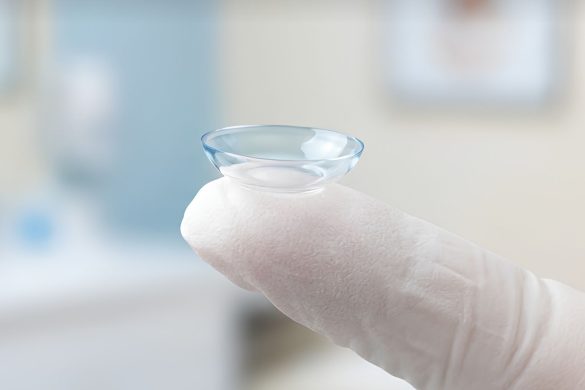
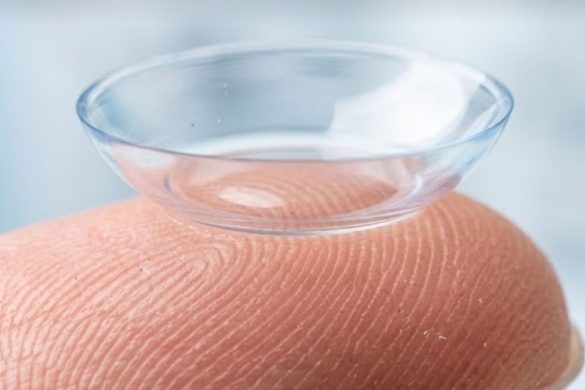
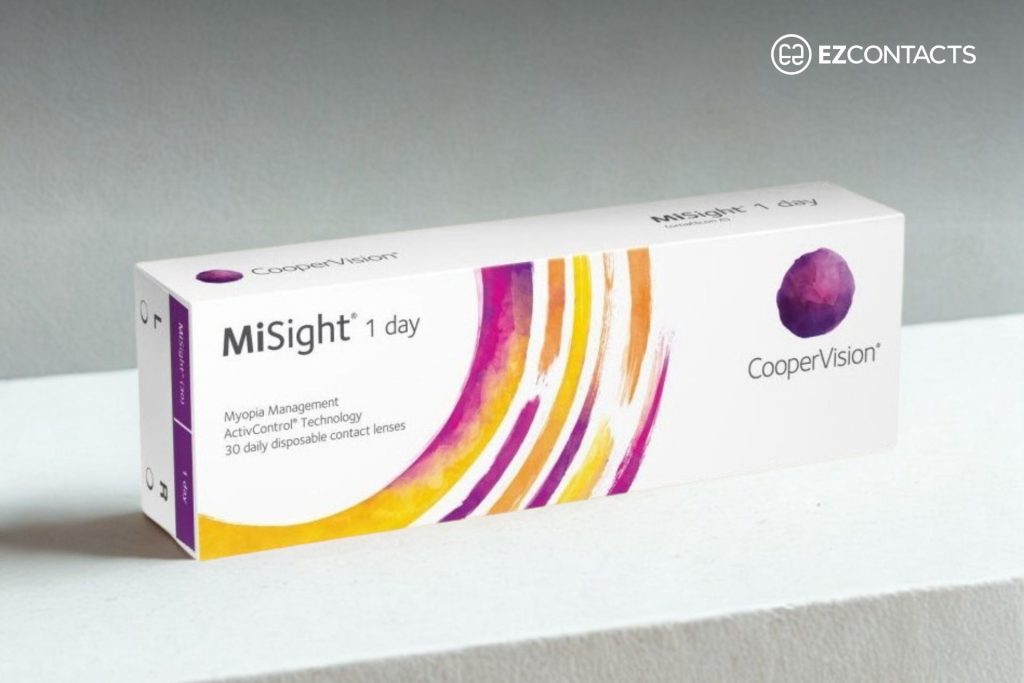
MiSight 1-day lenses are daily disposable soft contact lenses made by CooperVision. They look just like any other daily contact lens. They’re used in the same way, too. Kids wear a new pair each morning and throw them away at the end of the day.
But MiSight lenses have key differences from standard lenses. They use their patented ActivControl Technology, which creates alternating treatment and correction zones across the surface of the lens. This corrects distance vision. And at the same time, it creates something researchers call “myopic defocus.”
Scientists believe that as myopia develops, certain focus patterns on the retina can make the eye keep growing longer. The treatment zones in MiSight use a relative plus power of +2.00 diopters to alter how peripheral light reaches the retina. This creates a signal to slow the process down.
In simpler words, MiSight contact lenses have two jobs. The first is to simply correct myopia so kids can see clearly at school, when they play sports, and generally in their day-to-day life. Secondly, the lenses have a very specific design that helps slow the progression of childhood myopia.
This concept has become vital in modern myopia management. In 2019, the FDA approved MiSight for children who are between the ages of eight and 12 at the start of treatment. This makes them the first contact lenses in the United States to receive this indication.
The Clinical Trial That Changed Everything
MiSight got its FDA approval following a study called “A 3-year Randomized Clinical Trial of MiSight Lenses for Myopia Control.” This study was published in the journal Optometry and Vision Science. The study was a landmark three-year randomized controlled clinical trial led by Dr. Paul Chamberlain and colleagues.
It followed myopic children between the ages of eight and 12 across four countries. The test group wore MiSight 1-day lenses. The control group wore standard single-vision daily contact lenses.
The results were impressive. After three years, the kids wearing MiSight experienced 59% less myopia progression than the control group. On average, they accumulated 0.73 fewer diopters of myopia. The lenses also reduced axial elongation by 52%.
That 52% may be the most important number. When eye doctors discuss childhood myopia, they’re not only worried about the child’s prescription for their glasses. They’re mostly worried about the physical growth of the eye. This is because a longer eye is associated with a higher lifetime risk of serious eye conditions.
Another striking finding was that 41% of children wearing MiSight showed no meaningful progression of their myopia during the trial compared to the control group.
Why Slowing Myopia Matters
Childhood myopia is becoming increasingly common around the world. Researchers estimate that nearly half of the global population could be myopic by 2050.
Because it’s so common, it would be easy for parents to view myopia in their kids as a minor problem. You can just get them glasses and have the prescription changed every couple of years. But doctors are increasingly viewing myopia as more than just a vision problem.
As myopia becomes more severe, the risk of future eye disease rises. High levels of myopia are associated with increased risks of retinal detachment, glaucoma, cataracts, and myopic macular degeneration.
This makes the search for effective myopia management strategies very important. The goal isn’t simply to reduce dependence on glasses. It’s also to slow the growth of the eyes during childhood as they’re still developing.
Even small reductions in myopia progression can lead to meaningful drops in future eye health risks.
What Happens When Kids Stop Wearing MiSight?
One concern often raised about myopia treatments is the possibility of a rebound effect. In other words, if treatment slows myopia for several years, will the eyes simply “catch up” when treatment stops?
Long-term data from MiSight indicates this is not the case. In their research, CooperVision continued tracking participants for up to seven years. Children who wore MiSight contact lenses throughout the study accumulated less than one diopter of total progression on average over six years.
Researchers also found no evidence of a rebound effect when treatment stopped. Instead of accelerating rapidly, eye growth returned to age-appropriate progression rates.
Are MiSight Contact Lenses Safe for Children?

For many parents, safety is understandably a big concern.
MiSight contact lenses have accumulated a strong safety record throughout clinical testing. Across more than 653 combined wearer-years in clinical studies, researchers reported zero cases of serious ocular adverse events. There were also zero cases of microbial keratitis, a potentially serious corneal infection.
Researchers also found that kids as young as eight years old were capable of learning proper lens handling and wear routines. This is one reason many eye care professionals now feel comfortable recommending contact lenses at younger ages than in the past.
More Than Just Vision Correction

Research has found that kids who switch from glasses to contact lenses often report improvements in self-perception, social acceptance, and confidence during sports and physical activities.
Contact lenses provide a wider field of view than glasses. They also eliminate concerns like the frames slipping during sports or getting in the way of certain activities.
Of course, every kid is different. Not every child is ready for contact lenses, and not every child prefers them. Still, many families find it very appealing to combine vision correction and myopia management in one daily disposable lens.
If you have any questions or concerns about your child’s readiness for contact lenses, reach out to your child’s eye doctor.
TL;DR
- MiSight 1 day is the first FDA-approved contact lens designed to slow the progression of childhood myopia.
- A three-year clinical trial found a 59% reduction in myopia progression.
- The lenses reduced axial eye growth by 52%, a very important measure of long-term eye health.
- 41% of children wearing MiSight showed no significant progression of their myopia during the study.
- Seven-year follow-up data found no evidence of a rebound effect after the treatment stopped.
- Clinical studies reported zero serious ocular adverse events across more than 653 combined total years of use. This means that all evidence points to MiSight contact lenses being safe for kids.