If you wear glasses or contact lenses, you’ve seen diopter numbers before! They’re the pluses and minuses on prescriptions, such as -2.00 or +1.50.
Most people know that bigger numbers mean thicker or stronger glasses. But you may still be asking, what is a diopter exactly? And what’s it measuring?
Once you fully understand how this all works, your prescription will make a lot more sense. Let’s get into it!
What Is a Diopter?
A diopter is a unit used to measure the strength/power of glasses and contact lenses. What it’s actually telling you is how much a lens is bending light. That bending of light is what enables glasses and contacts to correct blurry vision.
The more correction your eyes need, the higher the diopter number will be.
Why Do Lenses Need to Bend Light?
Human eyes work a lot like a camera. Light enters through the front of the eye, and it hits the retina at the back.
When light reaches the retina in exactly the right position, the brain can properly interpret the image that the eye is seeing. But sometimes, the eye focuses light in the wrong place.
Here’s what happens when you have the following conditions:
- Myopia (nearsightedness): Light focuses in front of the retina instead of directly on it, making distant objects harder to see.
- Hyperopia (farsightedness): Light focuses behind the retina, so nearby objects will be out of focus.
- Astigmatism: Light bends unevenly as it enters the eye, meaning your vision will be distorted at multiple distances.
The Surprisingly Simple Math Behind Diopters
This is the part that sounds intimidating, but isn’t so hard to understand once you picture what’s happening.
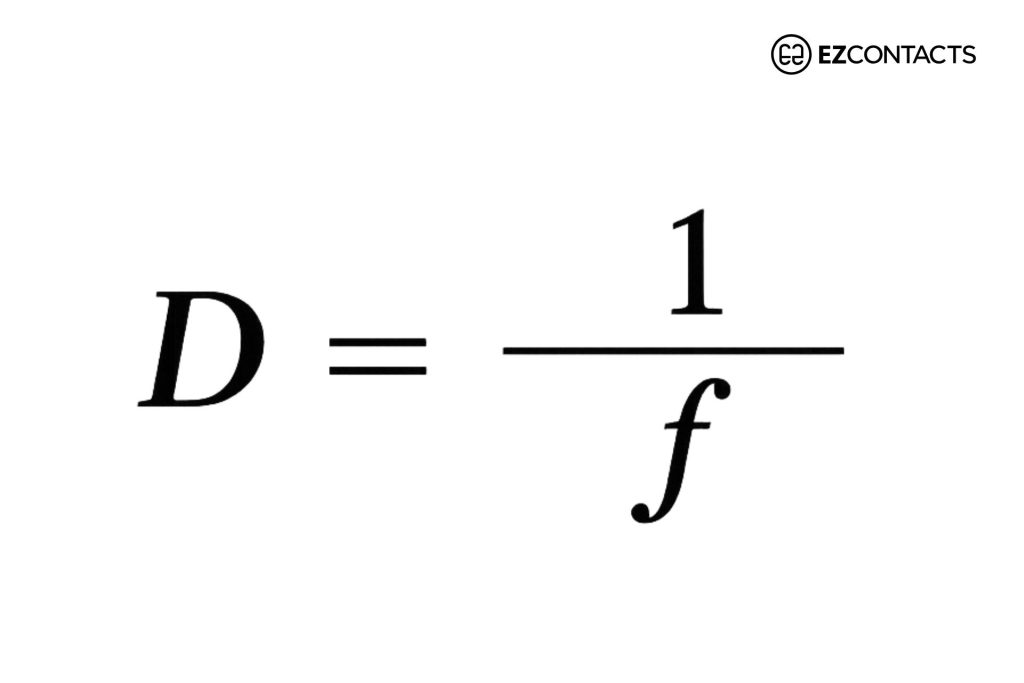
A diopter is based on something called focal length. This is the distance between a lens and the point where light comes into focus. The relationship is expressed with a formula where “D” stands for diopters and “f” stands for focal length measured in meters.
I think the best way to explain it is with this analogy:
Imagine two balls rolling down two different sides of the same hill. One side has a gentle slope, so the ball travels farther before getting to the bottom. The other side is steeper, so the ball reaches the bottom having traveled a shorter distance.
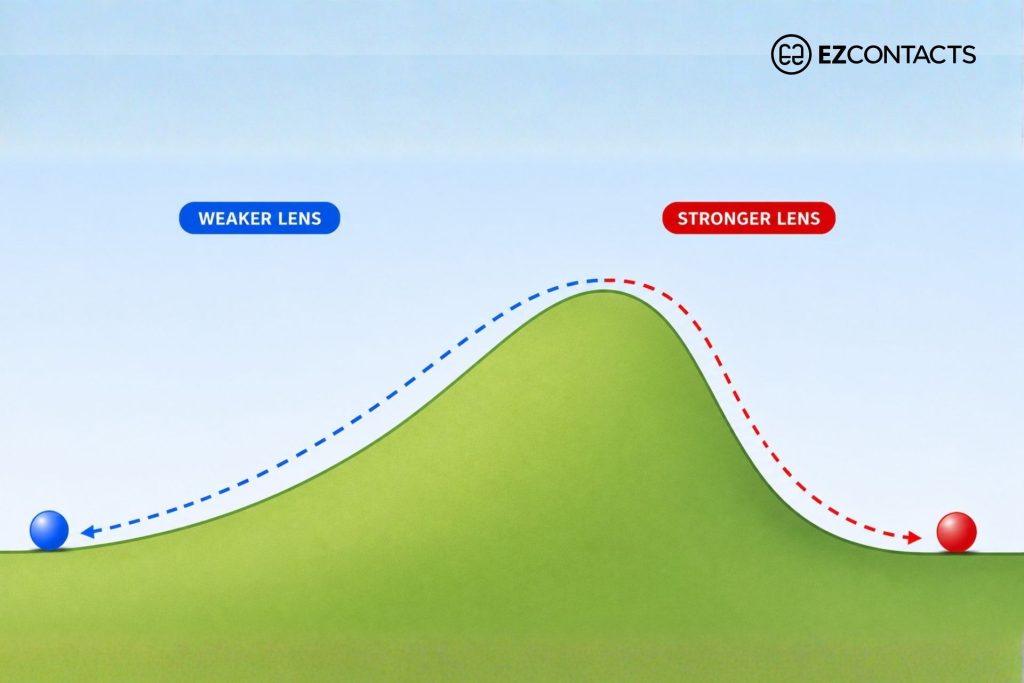
In this analogy, the slopes are lenses of two different strengths, and the balls represent light. A weaker lens bends light gradually, while a stronger lens bends it more aggressively.
- A 1-diopter lens focuses light at 1 meter
- A 2-diopter lens focuses light at 0.5 meters
- A 4-diopter lens focuses light at 0.25 meters
Notice the pattern? As the diopter number increases, the focusing distance gets shorter. This is also why high prescriptions have much thicker or more powerful lenses.
Why Some Prescriptions Are Negative and Some Are Positive
A lot of people wonder why some prescriptions have a minus sign while others have a plus sign.
Well, negative prescriptions are used to correct myopia (also called nearsightedness).
If you have myopia, your eye focuses light in front of the retina instead of directly on it. As mentioned previously, this makes distant objects look blurry because the image comes into focus too early.
To fix this, glasses or contact lenses need to spread the light out slightly before it reaches the eye. That pushes the focus point farther back so the light can land correctly on the retina.
This type of lens is called a concave lens. It curves inward and uses negative diopter numbers.
Positive prescriptions, on the other hand, are used to correct hyperopia (farsightedness). This condition is corrected with a lens that’s thicker in the center and becomes thinner toward the edges. The thick center bends incoming light rays inward.
The farther the number moves away from zero, the stronger the correction becomes. So someone with a prescription of -8.00 will have much blurrier distance vision than someone with -1.00. And someone with a prescription of +8.00 will have much blurrier near vision than someone with +1.00.
What Counts as a “Strong” Prescription?
There’s no official number where a prescription suddenly becomes “bad,” but optometrists generally group prescriptions into ranges.
For nearsightedness (minus prescriptions):
- -0.50 to -3.00 is usually considered mild
- -3.00 to -6.00 is moderate
- Above -6.00 is usually considered high myopia
For farsightedness (plus prescriptions):
- +0.25 to +2.00 is considered mild
- +2.25 to +5.00 is moderate
- Above +5.00 is usually considered high hyperopia
This doesn’t necessarily mean someone with a stronger prescription sees worse overall. It just means their eyes need more optical correction to focus properly.
Someone with a high prescription can still have perfectly healthy eyes and excellent corrected vision.
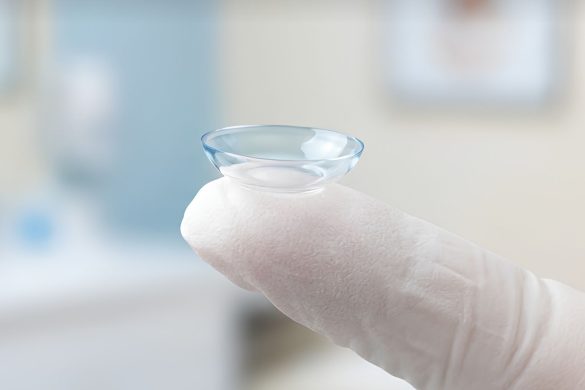
Why Contact Lens Prescriptions Are Different From Glasses
It’s normal for your contact lens prescription to be a little different from your glasses prescription.
Glasses sit around 12 millimeters away from your eyes, while contact lenses are right on the eye. Even though that discrepancy is small, it still makes a difference, especially for stronger prescriptions.
So you should never assume your glasses prescription and contact lens prescription are interchangeable.
What About Reading Glasses?
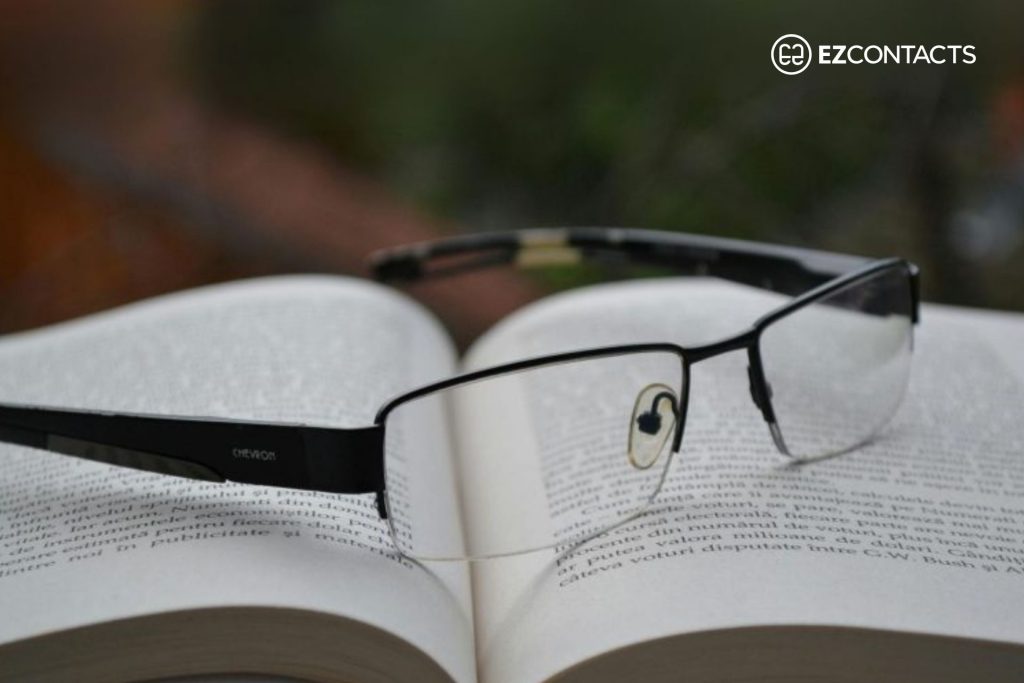
Those +1.00 and +2.50 numbers on over-the-counter reading glasses are diopters, too.
As we age, the lens inside our eyes becomes less flexible. This condition is called presbyopia, and it makes nearby objects harder to focus on.
Reading glasses add positive diopter power to help us see close-up text and objects in focus. It’s not uncommon for people to need stronger reading glasses as we age. So the diopter number on reading glasses often increases as we get older.
The Human Eye Is Already Extremely Powerful
Here’s a fun fact most people don’t know. Your eyes already have incredible optical power, with an average of 60 diopters of focusing power naturally built in. So your glasses prescription is only a small top-up to what you already have!
TL;DR
- A diopter is a unit of measurement. It measures how much a lens bends light in order to focus your vision.
- Higher diopter numbers mean a stronger prescription.
- Minus prescriptions correct nearsightedness, while plus prescriptions correct farsightedness.
- Contact lens prescriptions can be different from glasses prescriptions. This is because glasses sit about 12 millimeters away from your eyes.
- The human eye already has about 60 diopters of focusing power built in.