Have you just started wearing monovision contact lenses… and you hate them? Maybe you’re about ready to throw in the towel. Well, if it’s any comfort, what you’re feeling isn’t that uncommon!
Monovisions do take a while to get used to. This comes down to their design; one eye is being corrected for distance vision and the other for near vision. This is not what your brain is used to.
In this post, we’re going to discuss why monovision contacts might be driving you crazy. We’ll also talk about how long it takes to get used to them, potential problems, and what to do if you think monos just aren’t right for you.
What Are Monovision Contacts For?
Monovision contact lenses are most often prescribed for a condition called presbyopia. It affects almost everyone as they get older. In fact, over 128 million Americans have it, including nearly 90% of people over the age of 45.
It usually starts with mild symptoms. For example, you might notice you’re finding it more difficult to read your phone or a restaurant menu.
As we age, the lens in our eye (called the crystalline lens) naturally becomes less flexible. Because the lens is slightly more rigid, your eyes have a harder time focusing on nearby objects.
How Exactly Do Monovision Contacts Work?
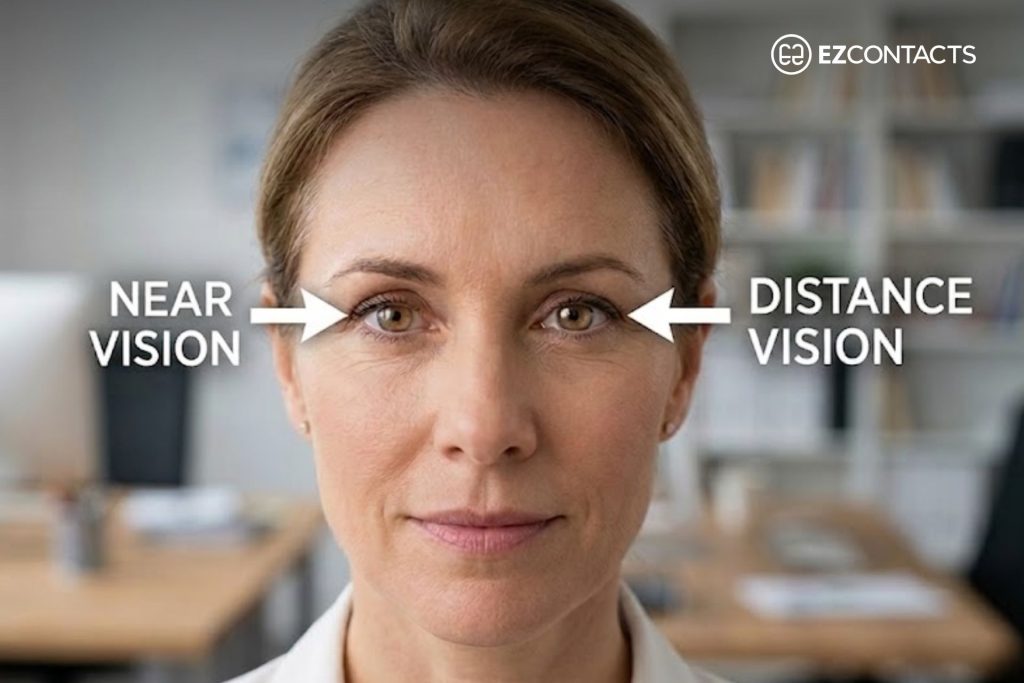
Monovision contacts work by splitting the workload between each eye. Instead of giving both eyes the same prescription, your eye doctor intentionally corrects each eye with a different prescription.
Usually, your dominant eye is fitted for distance vision, while your non-dominant eye is fitted for nearby tasks like reading your phone. This works because your brain is already used to combining slightly different images from each eye into one picture of the world around you.
With time, your brain learns to automatically lean on the eye that offers the clearest focus for what you’re looking at. This process is known as suppression.
Why Monovision Contacts Can Feel So Strange
A lot of people expect monovision contacts to feel like regular contacts, just with better reading vision. Instead, they can create some really unusual sensations in the beginning.
Monos completely changes the way your eyes work together. As we talked about above, your brain needs time to learn to suppress the blurry images and focus on the clear images.
During this period of adjustment, some people describe:
- Feeling mentally fatigued
- Trouble judging distance
- Mild dizziness or disorientation
- Blur when switching between different distances
- Experiencing a constant degree of blurriness
- Eye strain or headaches
This doesn’t always mean there’s something wrong with the lenses. You might just need to give them more time.
Will I Lose Depth Perception?
Monos don’t make you lose depth perception entirely, but they do put a limit on your ability to some extent.
Normally, both eyes work together at the same focal distance. Your brain compares the small differences between what they see, and it uses that information to help calculate depth and distance.
When you wear monovision contacts, each eye has a different focal distance. So depth perception can become less accurate in certain situations.
People tend to notice it most when doing things like parking, going downstairs, pouring drinks, or playing sports. As your brain adapts to this new way of doing things, you should notice your depth perception improve.
Is It Safe To Drive While Wearing Monovision Contacts?
For most people, driving with monovision contacts is completely safe… once your brain adjusts. But early on, it can be a challenge.
Think about how much your eyes do while driving. You’re always glancing between the road, oncoming traffic, your mirrors, and the dashboard.
Night driving is where things can get unsafe for some people when still adjusting. Low light amplifies glare and halos, and blurriness can be more intense.

Because of this, it’s best to avoid night driving while you are still acclimating to your new lenses. With a little patience, most people fully adapt and feel fine driving at any hour.
That said, it’s worth noting that some people never feel 100% comfortable driving in the dark with monos.
How Long Is the Adjustment Period?
For most people, it takes:
- Anywhere from a few days to two weeks for basic adaptation
- About a month for your brain to fully get used to them
The first few days are the hardest. Your brain is trying to learn an entirely new way of processing visual information.
Some people report moments where everything seems to suddenly “click,” but then it goes back to feeling strange again. This back-and-forth is normal in the early days.
What If I Still Hate Them?
Not everyone gets used to monovision contacts. Some people’s eyes are too sensitive to the change. Or, their job, hobbies, and driving habits demand perfect depth perception from both eyes at once.
If you still feel miserable after giving them a proper chance, it’s time to speak to your doctor. There are a few things that can be done.
Adjustments to your prescription
Sometimes, the prescription difference between your two eyes is simply too much. Reducing the difference in strength can make monos feel more natural, but it may make your near vision less powerful.
Modified monovision
Another option for people who find the prescription difference too much for them is something called modified monovision.
One is corrected for distance vision, and the other with a multifocal lens. This can give people better depth perception, but still improves near vision.
Multifocal contacts
Some people who can’t get along with monovision contacts find multifocals easier to tolerate.
Instead of giving different jobs to each eye, multifocal lenses have multiple prescription zones contained in the same lens. Basically, both eyes work together for all distances.
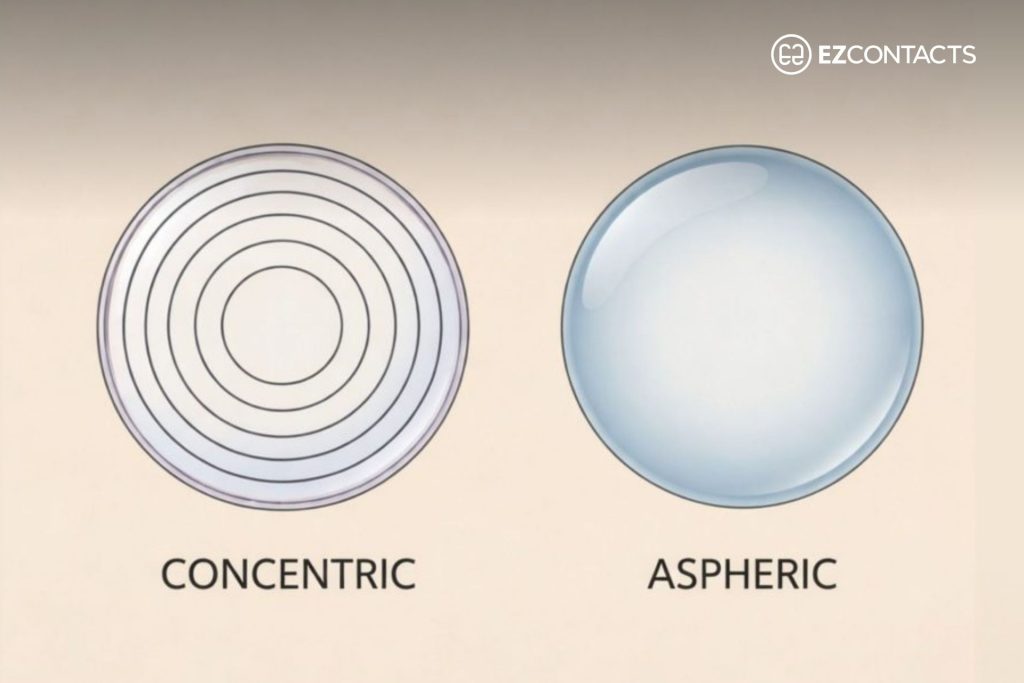
As shown in the above diagram, multifocals use either concentric rings or an aspheric design that spreads power from the center out.
Tips To Make Adjustment Easier
Getting used to monovision contacts mostly requires time, but there are a few things you can do:
- Wear them consistently
- If you can help it, avoid frequently switching back and forth between monos and glasses
- Do take breaks if your eyes feel very fatigued
- Use decent lighting for reading and using screens
Giving yourself time and consistency is the best thing you can do to help your brain adapt faster.
When To Call Your Eye Doctor
Mild symptoms are to be expected at first. But persistent dizziness, bad headaches, double vision, or nausea might mean your prescription needs to be changed.
Schedule an appointment with your eye doctor if things still aren’t working for you after the adjustment period.
TL;DR
- Monovision contacts correct one eye for distance and the other for near vision.
- Your brain has to learn a whole new way of processing visual information.
- Most people start adapting within a few days, but it takes around a month to fully settle in.
- Driving at night and depth perception are the main things people complain about early on.
- Some people never fully adapt to monovision and do better with multifocal lenses instead.
- Call your eye doctor if you experience symptoms such as bad headaches, persistent dizziness, nausea, or double vision. These symptoms could mean that you need to change your prescription.