Does your eye prescription look like a confusing blur of letters? If you’ve just gotten your first prescription, there are probably lots of questions running through your mind.
What are all those acronyms? What are those numbers? Why are there pluses and minuses next to the numbers?
If you’re feeling lost, I’m here to help. I’ll walk you through how to read your eye prescription so you can better understand your eyesight.
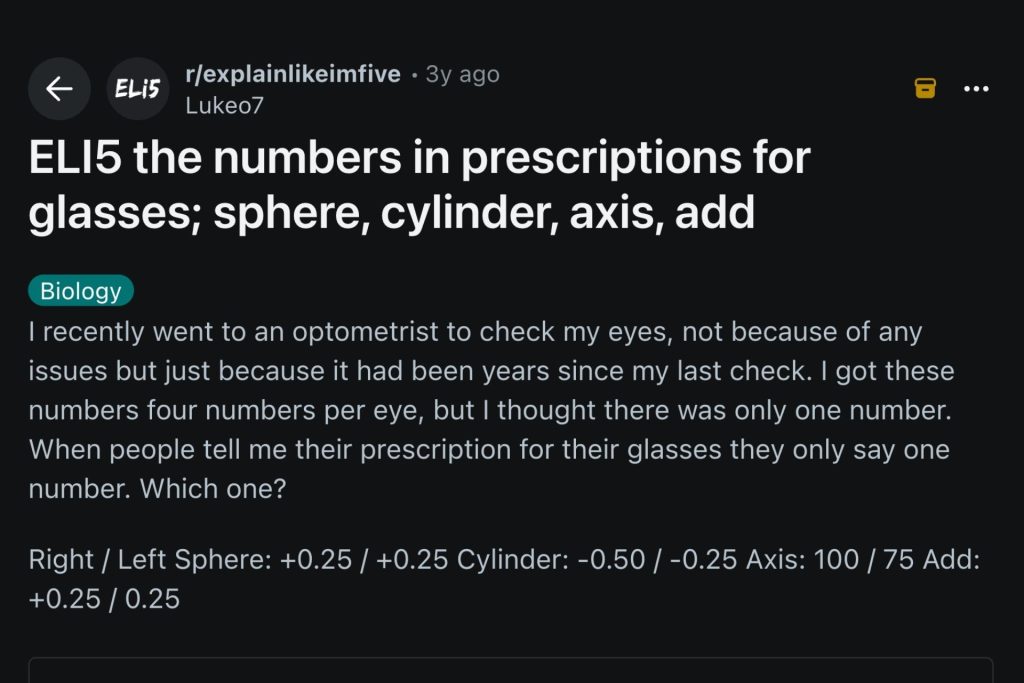
If your eye prescription is confusing you, don’t worry; you’re not alone. Over on Reddit, you’ll find many threads featuring Redditors who are confused about their prescription. On the ‘Explain Like I’m Five’ subreddit, one user shared:
“I recently went to an optometrist to check my eyes, not because of any issues but just because it had been years since my last check. I got these numbers four numbers per eye, but I thought there was only one number. When people tell me their prescription for their glasses they only say one number. Which one?
Right / Left Sphere: +0.25 / +0.25 Cylinder: -0.50 / -0.25 Axis: 100 / 75 Add: +0.25 / 0.25.”
Reddit Screenshot
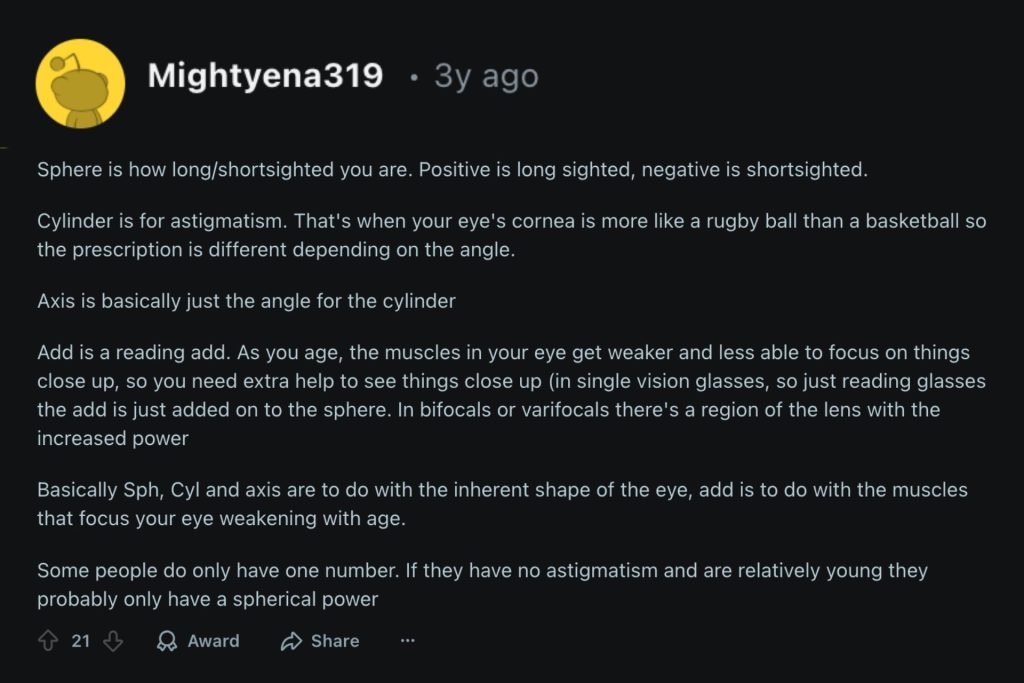
Another user responded:
“Basically Sph, Cyl and axis are to do with the inherent shape of the eye, add is to do with the muscles that focus your eye weakening with age.
Some people do only have one number. If they have no astigmatism and are relatively young they probably only have a spherical power.”
Reddit Screenshot
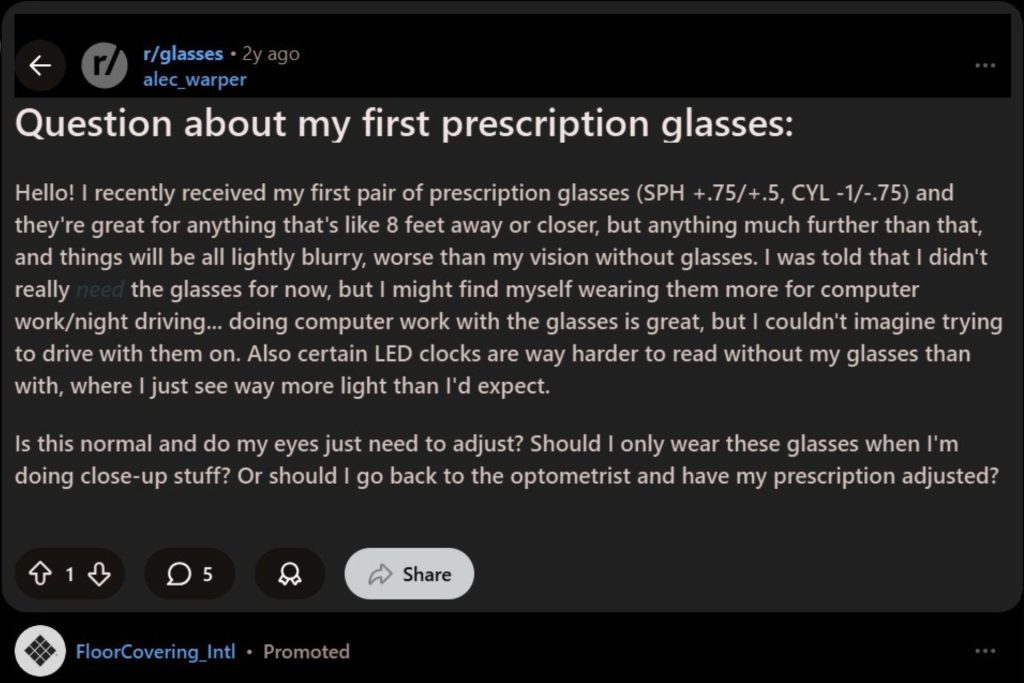
Another commenter had some questions about their first eye prescription. They wrote:
“Hello! I recently received my first pair of prescription glasses (SPH +.75/+.5, CYL -1/-.75) and they’re great for anything that’s like 8 feet away or closer, but anything much further than that, and things will be all lightly blurry, worse than my vision without glasses. I was told that I didn’t really need the glasses for now, but I might find myself wearing them more for computer work/night driving… doing computer work with the glasses is great, but I couldn’t imagine trying to drive with them on. Also certain LED clocks are way harder to read without my glasses than with, where I just see way more light than I’d expect.
Is this normal and do my eyes just need to adjust? Should I only wear these glasses when I’m doing close-up stuff? Or should I go back to the optometrist and have my prescription adjusted?”
Reddit Screenshot
A user reassured them that this was all normal and part of getting adjusted to new glasses:
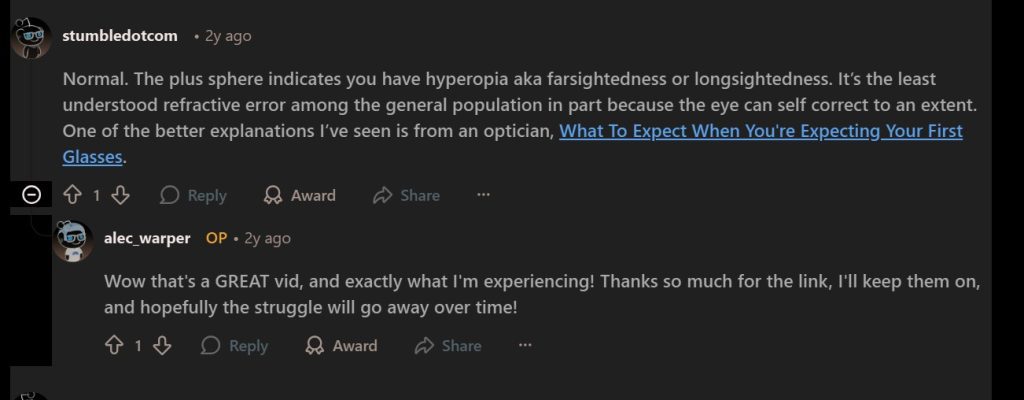
“Normal. The plus sphere indicates you have hyperopia aka farsightedness or longsightedness. It’s the least understood refractive error among the general population in part because the eye can self correct to an extent.”
Reddit Screenshot
As you can see, it’s perfectly normal to be confused by your eye prescription. I’ll break it all down bit by bit for you.
What Do the Acronyms Mean on an Eye Prescription?
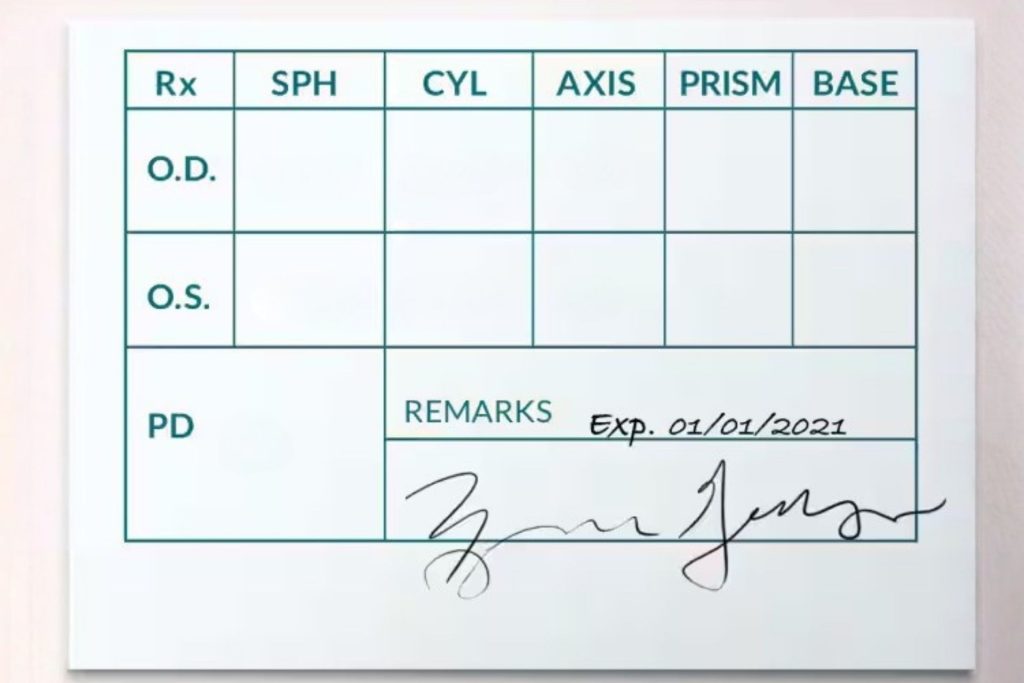
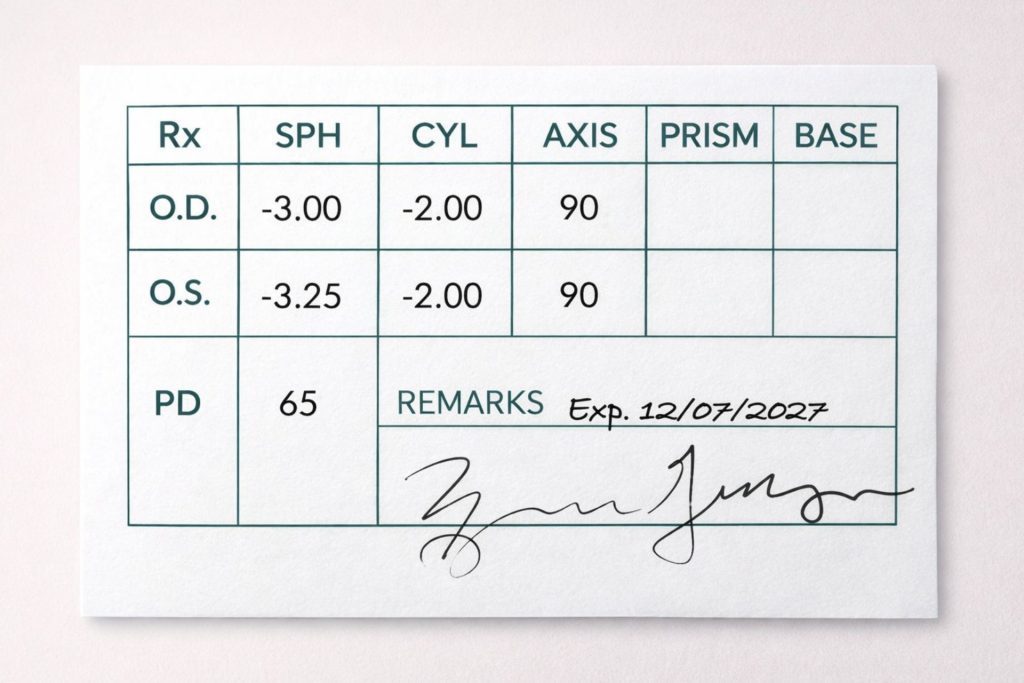
Blank Prescription for Glasses
Now, let’s discuss how to read your eye prescription. When you look at your prescription, you’ll notice that there are lots of different acronyms. I’ll walk you through what they mean.
OD
OD stands for Oculus Dexter. This is the Latin term for ‘right eye.’ OD will always be in the top row of the prescription.
OS
OS stands for Oculus Sinister. This is the Latin term for ‘left eye.’ OS will always be in the bottom row of the prescription.
OU
OU stands for Oculus Uterque. This is the Latin term for ‘both eyes.’ You’ll see this if your prescriptions for your left and right eyes are identical.
SPH
SPH stands for ‘sphere.’ This number indicates the amount of lens power needed to correct your nearsightedness or farsightedness.
CYL
CYL stands for ‘cylinder.’ This is used for astigmatic prescriptions. It indicates the lens power needed to correct astigmatism.
Axis
Axis is also used on astigmatic prescriptions. It indicates the angle at which astigmatism correction is applied to a lens, from 1 to 180 degrees.
Prism
Prism glasses help those with double vision or eye misalignment. The lens power of these glasses is measured in prism diopters (a unit of measurement of the prism’s refractive power).
When the doctor places the prism, they’ll place the thickest edge in a specific direction based on your prescription. There are four acronyms used to notate the orientation:
BI
This stands for ‘base in,’ meaning the thickest edge is on the inner edge of the lens toward the nose.
BO
BO stands for ‘base out,’ meaning the thickest edge is on the outer part of the lens, toward the ear.
BU
This stands for ‘base up,’ and it means the thickest edge is at the top edge of the lens.
BD
BD stands for base down, meaning the thickest edge is at the bottom of the lens.
NV
NV stands for near vision and refers to the additional lens power required for reading or close-up tasks. It’s used in multifocal and bifocal prescriptions to treat presbyopia.
Add
This stands for addition, and it’s often used interchangeably with near vision.
DV
DV stands for distance vision, and it indicates the lens power needed to correct your vision for objects far away.
PD
PD stands for pupillary distance, and it’s the measurement of the distance between the centers of your pupils. This is a very important measurement, as it helps ensure the lens’s optical centers are aligned with your pupils.
EXP
You’ll also see EXP or ‘expiration date’ written on your prescription. Eye prescriptions are typically valid for one to two years, depending on state laws. Once your prescription expires, you’ll need to renew it by getting an eye exam.
Numbers on an Eye Prescription
Numbers on an Eye Prescription
Now that you know about some of the most common acronyms on an eye prescription, let’s discuss what exactly all those numbers mean.
Diopters
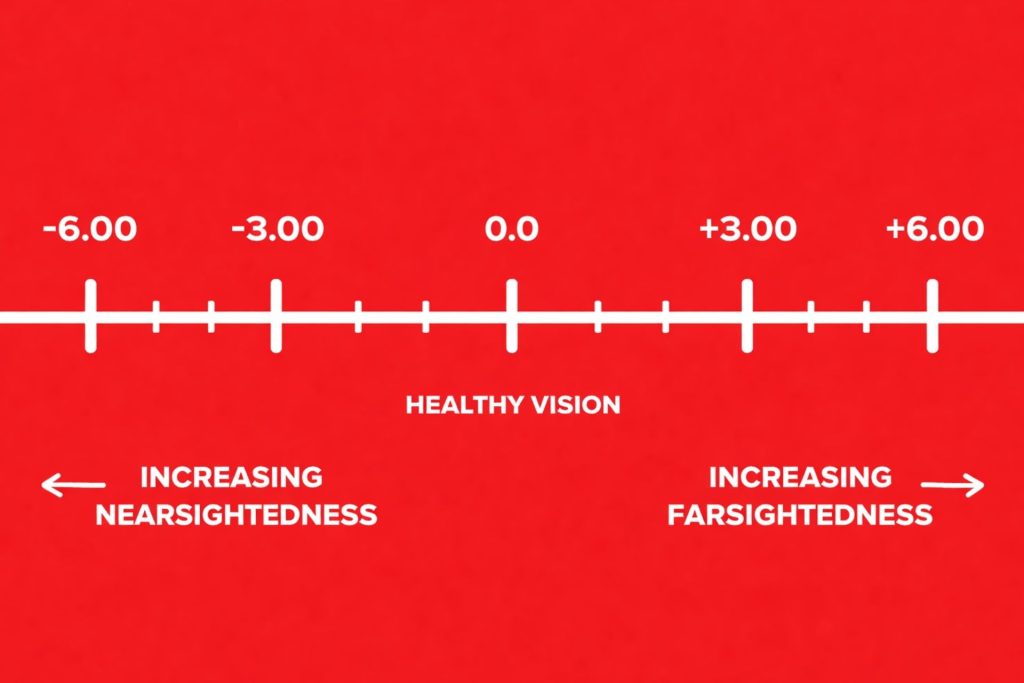
As mentioned earlier, a diopter is a unit of measurement that measures the refractive power of a lens. You’ll see a larger number in your SPH column if your prescription is higher. You’ll see a smaller number if your prescription is lower.
These numbers proceed in either direction on a number line, and they can be positive or negative based on the refractive error in your eye. If you don’t need any vision correction, you’d see 0 diopters.
Negative Numbers
Negative numbers indicate myopia (nearsightedness). This means you can see things up close but struggle to see things far away. For example, someone with -2.00 diopters of myopia could have trouble reading words on a whiteboard.
Positive Numbers
Positive numbers indicate that you have hyperopia (farsightedness). You can see things far away but struggle to see things up close. For instance, if you had +2.00 diopters of hyperopia, you could have trouble reading a book that’s very close to your face.
Eye Prescription Chart Example
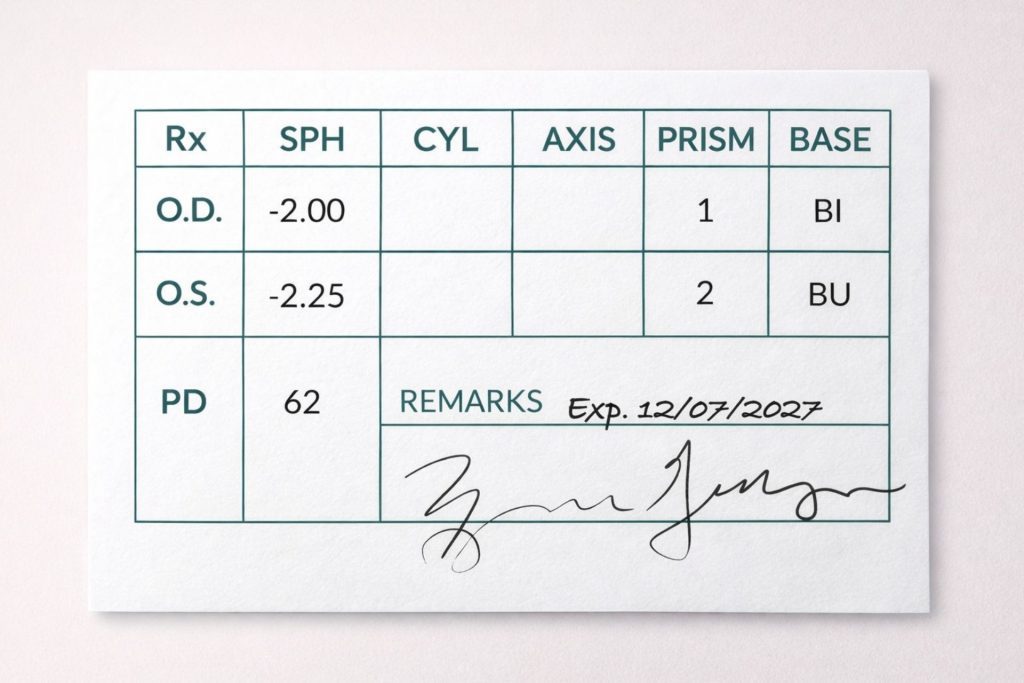
Let’s put it all together and look at two examples of eye prescription charts. Can you spot the difference between them?
Here’s number one:
Glasses Prescription Example
And here’s number two:
Glasses Prescription Example
As you can see, the person in the first example is nearsighted and also has a prism correction in their prescription.
The second person is also nearsighted, and they have astigmatism.
What to Know About Contact Lens Prescriptions
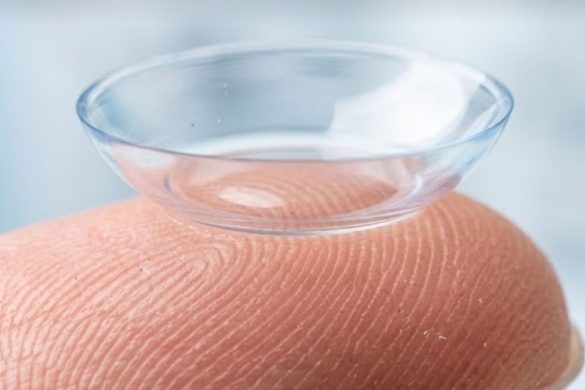
Contact lens prescriptions differ from glasses prescriptions in a few ways. Since contacts sit right on your eyes, the lens power needed could be slightly different. Your eye doctor will also typically include a specific brand on your prescription.
In addition, there are two other acronyms included on this prescription. They are:
BC
BC stands for ‘base curve.’ This measures the curvature of your contact lenses. It’s measured in millimeters and always falls between 8 and 10.
DIA
DIA stands for ‘diameter.’ This is the width of the contact lens in millimeters. Most contact lenses are between 13 and 15 millimeters wide.
Is Your Eye Prescription ‘Bad?’
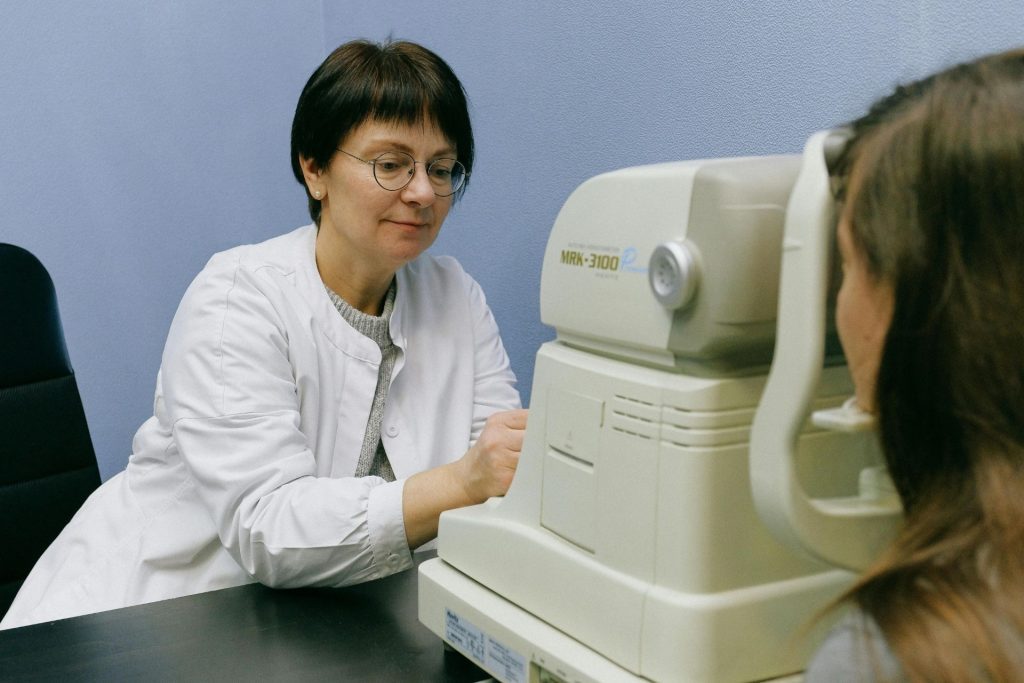
Eye Doctor Giving an Eye Exam
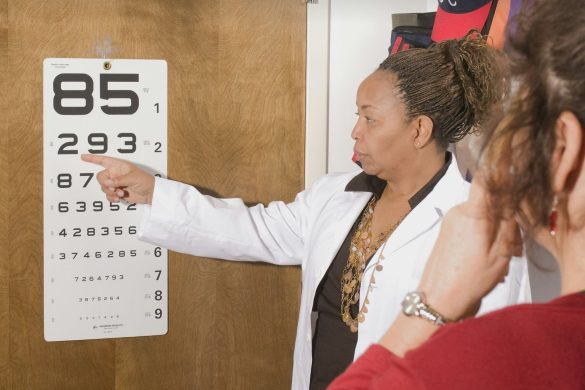
If your prescription has high numbers, you may be wondering whether your eye prescription is “bad.” And the answer is there’s really no such thing as a bad eye prescription! Your eyesight isn’t “good” or “bad.” You might just need a stronger prescription.
What Counts as a Strong Eye Prescription?
If you have hyperopia, an eye prescription over +5.25 diopters is typically considered strong. And if you have myopia, a prescription of over -5.00 diopters is considered strong. These scales vary from institution to institution, though.
Can Your Prescription Change Over Time?
Small, gradual changes over time are normal as you age. When you hit your forties, you may develop presbyopia, which is the natural, age-related loss of the eye’s ability to focus on nearby objects. When that happens, you may want to consider getting reading glasses or switching toprogressive glasses.
This is why it’s a good idea to get annual eye exams. Your doctor will be able to monitor your eye health and catch any changes to your prescription.
You Have a Right to Your Eye Prescription
Two Eye Doctors Discussing a Chart
According to the Federal Trade Commission (FTC), eyecare providers are legally required to give you a copy of your prescription for glasses or contact lenses. For a glasses prescription, your eye doctor should give it to you right after the exam. For contact prescriptions, they need to give you a copy after your fitting is complete.
Your eye doctor can’t make you pay an extra fee for your prescription. You also don’t have to purchase eyewear from the doctor’s office to get your prescription.
Once you have your prescription, you’ll be free to shop for eyewear anywhere you like! You’ll typically find more styles of eyewear at online retailers, and often at better prices, too.
TL;DR
Many people get confused when they go to read their eye prescription. On Reddit, users asked numerous questions about their prescriptions.
An eye prescription contains a variety of acronyms. OD stands for ‘Oculus Dexter,’ which is the Latin term for the right eye. OS stands for ‘Oculus Sinister,’ which is the Latin term for the left eye. OU stands for ‘Oculus Uterque,’ which is the Latin term for both eyes.
SPH stands for ‘sphere,’ which indicates the lens power needed to correct a refractive error.
CYL and Axis are both used on prescriptions for astigmatism. CYL stands for ‘cylinder,’ and it indicates the lens power needed to correct astigmatism. Axis indicates the angle at which astigmatism correction is placed on a lens.
Prism is used for people who have double vision. Base indicates where the prism power should be placed in the lens.
NV stands for near vision, and DV stands for distant vision.
Lens power is measured in diopters. Negative numbers indicate myopia, and positive numbers indicate hyperopia.
A contact lens prescription has two other acronyms: BC and DIA. BC stands for ‘base curve’ and measures the curvature of the lens. DIA stands for ‘diameter’ and measures the width of the lens.
Eye prescriptions aren’t ‘bad’ or ‘good.’ Some are simply stronger than others.
Your prescription can change over time, particularly when you get over 40.
According to the FTC, your doctor must give you your prescription after your appointment. You can then use your prescription to shop around and get better deals on eyewear.
I’m a Florida-based lifestyle and content creator who writes about the latest in eyewear, from smart lenses to sustainable frames. I have a Bachelor’s degree from Fairleigh Dickinson University and a Master’s Degree from the University of Edinburgh. I’ve previously worked for Gemini Literary Magazine, Featured, Brainfall, Shareably, and The Feed. When I’m not writing, you’ll find me exploring museums, hiking new trails, or soaking up the sun at the beach (always with great sunglasses, of course).