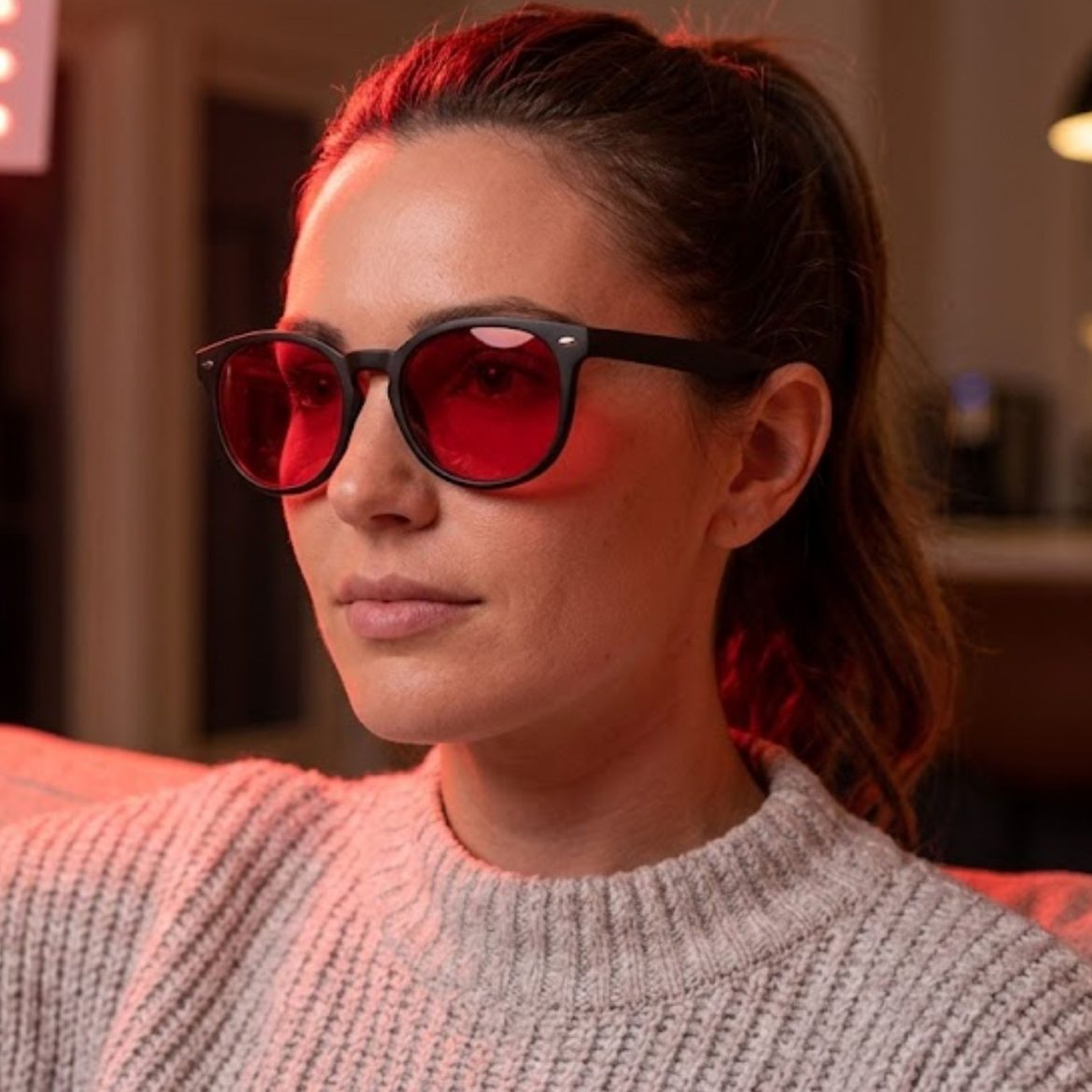
Are you thinking of trying red light glasses? You may be wondering how exactly they work.
People sometimes confuse them with blue light glasses. However, they serve a different purpose.
So what are they, do they actually work, and when should you use them? Let’s get into it!
At a Glance
This guide goes over what to know about red light glasses. We discuss what the science says about them and how they can be used as a tool for winding down in the evening.
What Are Red Light Glasses?
Red light glasses have lenses that block out shorter wavelengths of light, specifically blue and green light.
So while blue light glasses filter out the blue end of the light spectrum, red light glasses go even further.
Because they eliminate blue and green light entirely, the only wavelengths left to pass through to your eyes are the longer, warmer red and orange wavelengths. This is where the glasses get their name and also why the lenses have a deep amber or red tint.
How They Work

Our bodies rely on light cues to regulate our internal clocks. Exposure to bright light, especially blue and green wavelengths, tells your brain that it’s time to be alert. This is useful during the day when you need to be productive, but it can work against you at night.
The whole point of red light glasses is to limit the specific wavelengths that keep your brain active. By filtering out the light from indoor lamps and digital screens, they’re designed to provide a helping hand to your body’s natural wind-down process in the evening.
But Do Red Light Glasses Really Work?
This is where things get a little less concrete. There’s some research out there that says they have a positive impact on sleep and the body’s response to artificial light at nighttime. But this research isn’t unanimous, and the sample sizes of the studies are small.
A 2017 study gave 14 people who suffered from insomnia two different types of glasses: either amber lenses that blocked short-wavelength light or clear placebo glasses.
The participants wore the glasses for two hours before bed for seven nights. Compared to the placebo lens group, participants wearing amber lenses gained around 30 minutes of sleep. They also reported improvements in overall sleep quality and lower insomnia severity scores.
An earlier 2009 randomized trial found similar results. Twenty adults wore amber lenses or control lenses for three hours before bed. The amber-lens group reported an improvement in the quality of their sleep and a more positive mood compared to the control group.
A 2018 study tested Eye Shield Soft Red Safety Glasses on 15 recreational athletes. The participants wore the glasses for three hours before bed for seven nights and wore clear glasses during the control period.
Reports from the participants themselves were positive:
- They reported falling asleep seven minutes faster on average.
- They rated their sleep quality 0.6 points higher on a 10-point scale.
- They reported feeling more alert the following morning.
But these findings were all “reported” by the participants. When the researchers reviewed the data from the participants’ wrist activity monitors, they found no significant difference in sleep onset, total sleep time, sleep efficiency, or nighttime wakefulness.
What does all this research mean?
Mostly, it means more research needs to be done. The existing trials have all had small sample sizes, and many of the findings are just what the participants reported feeling.
For example, the 2018 study revealed a gap between participants’ perceptions and the objective data. So this could mean that people simply think the glasses work, when in reality, they don’t impact objective things like how long it takes to fall asleep.
The placebo effect may be doing a lot of heavy lifting. When you put on a bright red pair of glasses before bed, you’re giving yourself a psychological cue that it’s time to sleep. And you may genuinely feel like you got a better night’s sleep, just because you wore glasses that are specifically supposed to help with that.
While the scientific community is still undecided on red light glasses, there’s no denying that there are people out there who say they work for them. So if you think they may work for you, they could be worth giving a try.
When Red Light Glasses Make Sense
Red light glasses aren’t designed to be worn all day. They’re supposed to be worn in the evening and may help in the following situations or activities.
Evening Screen Use
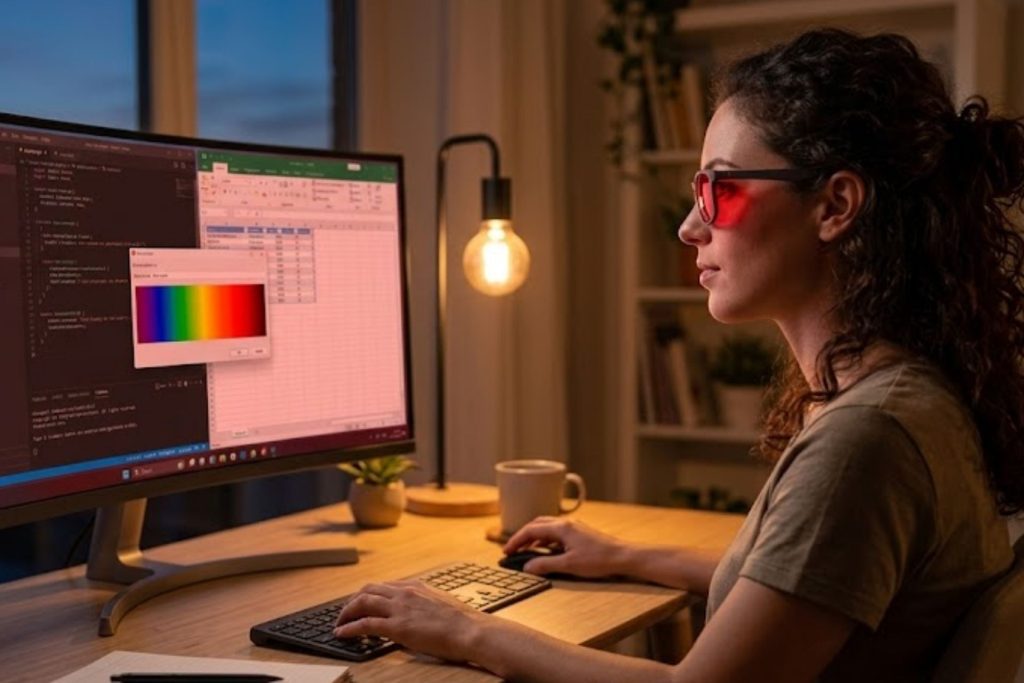
Do you often spend time on your phone, laptop, or TV at night? Red light glasses are designed to limit the impact of that light exposure.
Screens emit a high amount of blue light, which can delay your ability to fall asleep. Wearing red light glasses while using screens in the evening can be one way to limit your blue light exposure.
Nighttime Lighting
Indoor lighting like lamps and ceiling lighting produces blue light, which can affect your body’s natural circadian rhythm. Wearing red light glasses in your home for a couple of hours before bed will help reduce this exposure to blue light.
Shift Work or Irregular Schedules
If you don’t work the typical nine-to-five job, managing light exposure is more important. For example, if you finish work at 7 am and need to get to sleep when the sun is already up, red light glasses could help.
You could use red light glasses to create a boundary between when you’re supposed to be alert and when you should be winding down.
Travel and Jet Lag
Time zone changes can throw off your internal clock. Some people use red light glasses to deal with the effects of jet lag. The idea is that the glasses help tell their brain it’s time to sleep even when their body clock is telling them they should be awake.
What Red Light Glasses Don’t Do
There are some misunderstandings around red light glasses to clear up.
For one, these glasses don’t correct vision. If you need prescription lenses for conditions like nearsightedness, farsightedness, or astigmatism, red light glasses won’t help with this.
Red light glasses also don’t cure eye conditions. They can reduce discomfort from bright screens or lights. However, they aren’t a treatment for dry eye, eye strain, or other medical issues.
They also don’t need to be worn all day. In fact, it’s best to just wear them in the evening. Daytime light exposure helps create a stable sleep cycle.
Red Light Glasses vs. Blue Light Glasses
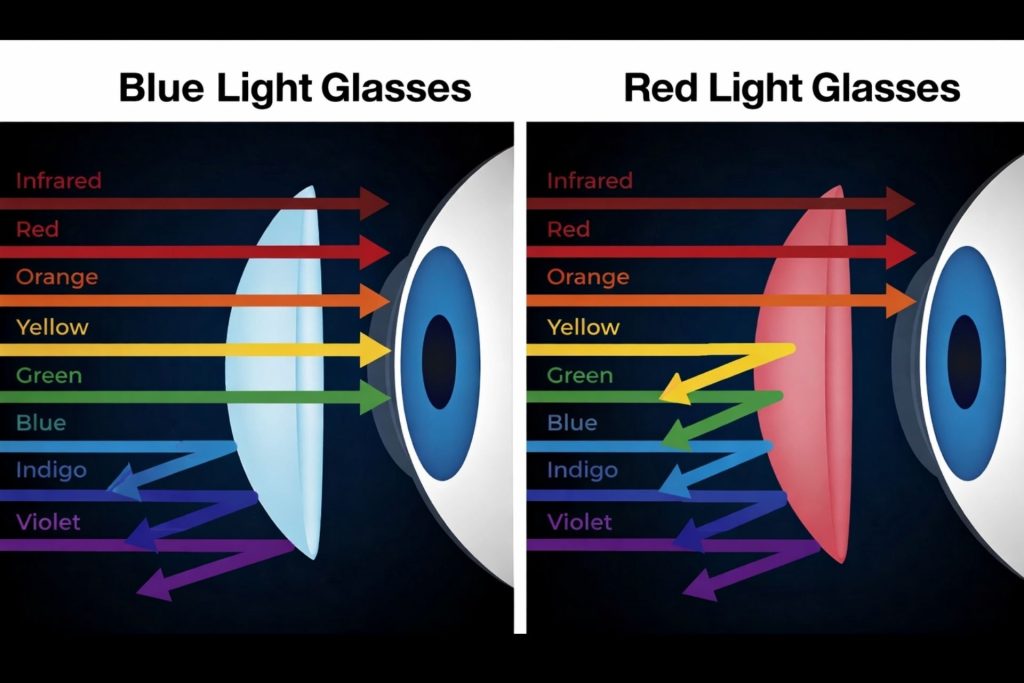
Red light and blue light glasses are often compared, but they’re not the same thing.
Blue light glasses filter out a portion of blue light while keeping colors looking relatively natural. They’re designed for extended use during the day, and they’re often marketed towards people who spend long hours on screens.
Red light glasses block a wider range of light and are meant for use in the evening. The strong tint makes them less practical for tasks that require accurate color perception.
Are Red Light Glasses Comfortable To Wear?
The biggest thing to adjust to is the tint. The red or amber color changes how everything looks and can be very weird at first.
Your depth perception is also likely to be affected, and that’s another reason red light glasses are designed to be used when watching TV or scrolling on your phone. They’re not supposed to be used for tasks like driving where it’s important to have your natural color and depth perception.
The frames themselves are no different from normal glasses. So in this sense, you shouldn’t find them any more uncomfortable to wear than your usual glasses.
Red Light Glasses as Part of Your Routine
While red light glasses aren’t a magic tool for good sleep, many people find them effective. Because they help create a boundary between your “active” hours and your “rest” hours, they work best when combined with other sleep-hygiene habits:
Here are a few tips to try:
- Prioritize a consistent bedtime: Sticking to a regular bedtime helps maintain your body’s internal clock, so it knows when it’s time to sleep.
- Seek out natural light in the morning: The best way to sleep well at night is to be alert during the day. Getting natural sunlight in the morning helps reset your circadian rhythm and will make the contrast of red light glasses in the evening more effective.
- Give yourself “wind-down” time: Use the hour before bed to stop any high-stimulation activities like digital screen use. Instead, try something like reading a book or listening to a podcast. Wearing the glasses as you do this serves as a physical signal to your brain that the day is over.
- Optimize your sleep environment: Make your bedroom cool, dark, and quiet. Try to avoid using your bedroom for things like working or watching TV. The idea is that you can program your brain to know that the bedroom is the place where you sleep, making the process of falling asleep easier.
FAQs
Are red light glasses better than blue light glasses?
It’s not that one is better than the other, just that they are different. Blue light glasses filter out a small fraction of blue light so that your vision still looks as natural as possible. They can be worn for long periods, like when you’re working on a computer.
Red light glasses block a much wider spectrum of light and have a heavy tint. They’re specifically designed to be worn in the evening before sleep and can help some people with their pre-bedtime routines.
Can you drive while wearing red light glasses?
No, it’s not safe to wear red light glasses when driving. The lenses completely distort the way you see colors and can have a small impact on your depth perception too. This can be particularly dangerous when driving. Red light glasses should be reserved for relaxing at home, reading, or watching TV in the evening.
Have red light glasses been proven to work?
The scientific community is still unsure whether red light glasses have a significant impact on sleep or overall well-being. While some small studies have found that people report getting better sleep after wearing them, other studies have found little-to-no impact.
In one study, the data from wrist-worn tracking devices didn’t support the benefits that the participants self-reported.
The success that some people have with red light glasses may come down to the placebo effect and the fact that wearing them acts as a psychological cue that it’s time to unplug and wind down.
TL;DR
- Red light glasses have dark amber or red-tinted lenses that are designed to block out all blue and green light, only letting red wavelengths through to the eyes.
- They’re different to blue light glasses, as they filter out a wider range of wavelengths.
- You’re generally only supposed to wear red light glasses in the evening. They’re designed to help reduce exposure to short light wavelengths from artificial sources at night. It’s usually best not to wear red light glasses during the day unless you work night shifts.
- The research into red light glasses is mixed. Some studies have shown promising results, but there actually hasn’t been that much research done on the topic. Some evidence suggests red light glasses are more effective as a psychological cue that it’s time to rest, rather than a proven tool for getting a good night’s sleep.
- There’s no downside to using red light glasses in the evening. So if you think they may help you, use them alongside other good sleep hygiene habits. This includes keeping a consistent bedtime and limiting the time you spend using screens late at night.