Most contact lenses come in a set range of prescriptions and sizes. Your eye doctor gives you the numbers you need, and you can choose a lens that matches those specifications.
Custom contact lenses are different. They’re made to fit your specific eyes, and they can be an option when standard lenses don’t provide the right prescription, fit, or vision.
But who actually needs custom contact lenses? And are they worth the extra money and effort needed to get them fitted?
At a Glance
- Custom contact lenses can be made for prescriptions and eye shapes that standard lenses can’t accommodate.
- They can help with high prescriptions, high astigmatism, keratoconus, and other conditions that cause the cornea to be irregular.
- Custom lenses include made-to-order soft lenses, RGPs, hybrid lenses, and scleral lenses.
- Getting the fit right can take several fittings and adjustments.
- They’re worth considering when standard glasses or contacts aren’t giving you clear or comfortable vision.
What Are Custom Contact Lenses?
Custom contact lenses include a wide variety of lenses. But basically, any lens is “custom” if you can’t buy it off-the-shelf with your existing prescription. They have to be specially made to fit your eyes and your prescription.
Custom lenses can include:
- Made-to-order soft lenses
- Rigid gas permeable (RGP) lenses
- Scleral lenses
- Hybrid lenses
- Ortho-K lenses
Who Needs Custom Lenses?
There are a few reasons people might find custom lenses to be the best option.
People with high prescriptions
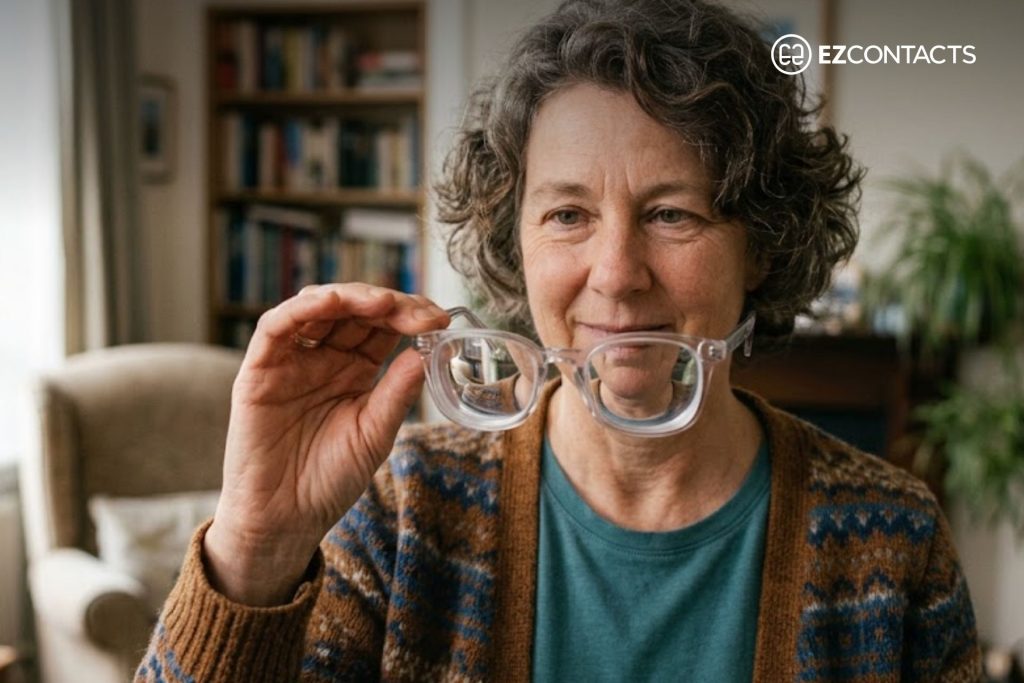
Sometimes, a prescription isn’t available in a standard lens. This can happen with very high myopia or hyperopia. It can also happen when a person needs an unusual combination of prescription parameters.
Instead of choosing the closest option, a made-to-order lens is made to your exact prescription and measurements.
There are some standard lenses that are designed for this, like CooperVision’s Biofinity XR. Between the standard Biofinity and Biofinity XR versions, the family covers spherical powers from +15.00D to -20.00D.
But sometimes a person needs a lens with a prescription that’s even higher.
People with keratoconus or an irregular cornea
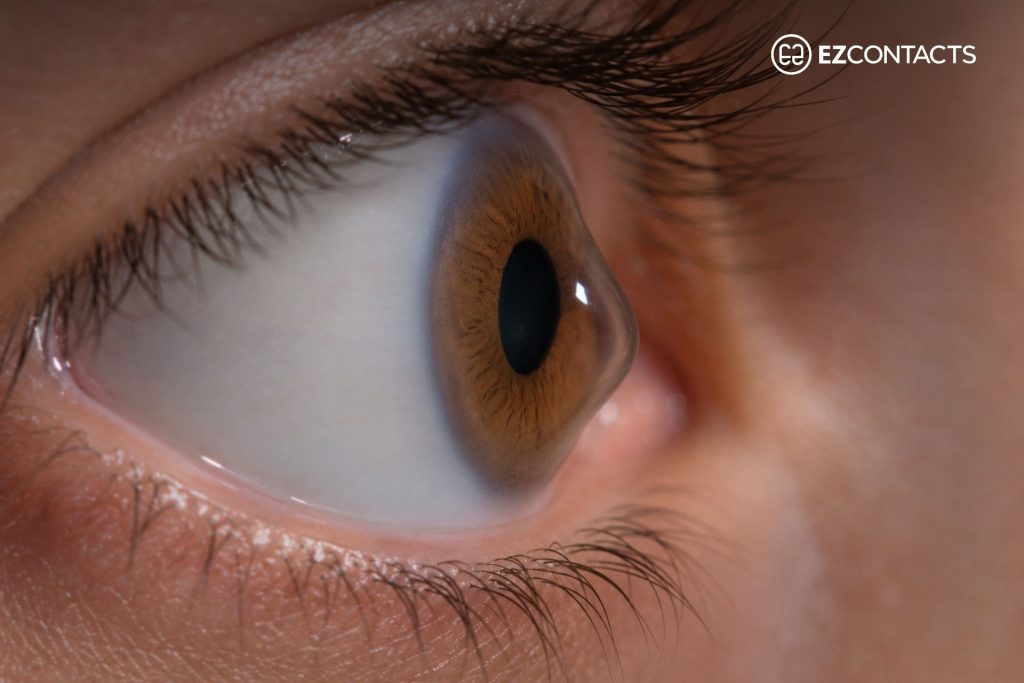
Keratoconus causes the cornea to become thinner and change shape. Other conditions, injuries, and some types of eye surgery can also leave the cornea with an irregular surface.
That creates a problem for standard soft contacts. A soft lens will follow the shape of an irregular cornea. If that surface is irregular, the lens might not be able to fully correct the eye.
Rigid gas permeable (RGP) lenses are frequently prescribed in this case. These lenses provide a rigid, smooth surface over the cornea.
But there are other options too, like hybrid lenses, which use a rigid center combined with a soft outer skirt. Some people find these lenses provide better correction and comfort.
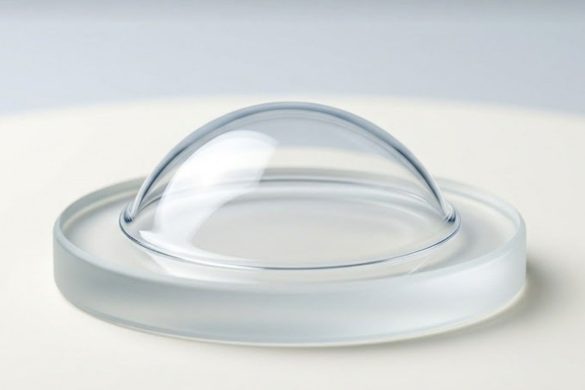
There are also scleral lenses. These lenses vault over the cornea and only touch the white part of the eye, called the sclera. Scleral lenses have a lot of good press online from people who feel their lives have been transformed.
A Redditor called vicespi23 made an entire post about their success story on the r/Keratoconus subreddit. They titled the post, “If you’re on the fence about scleral lenses… this might be the sign you need.”
In part of their post, they wrote:
“My vision is the best it has been in over 10 years. The first time I put them in, I couldn’t believe what I was seeing. I started noticing details I had forgotten even existed. I could see the texture of things, tiny imperfections on my skin, leaves on trees, signs in the distance—everything looked so crisp and alive.”
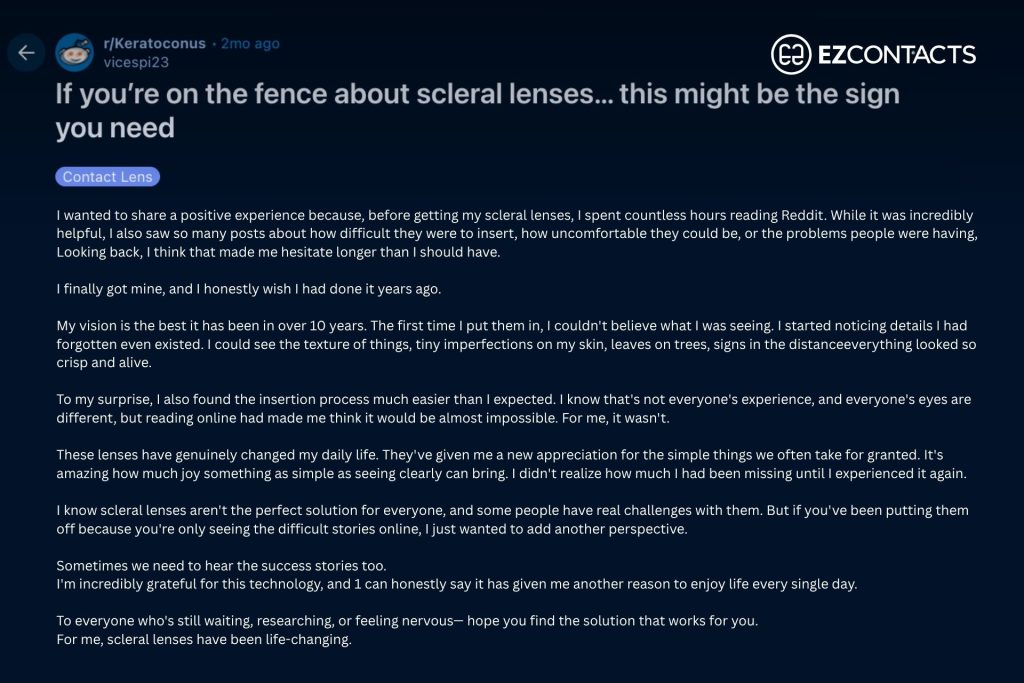
But they also talk about the challenges that some people face. Some people can struggle with inserting scleral lenses, so they might not be for everyone. However, if you can get the technique figured out, they can have amazing results.
People whose corneas have changed after surgery or injury
Procedures like LASIK or LASEK reshape the cornea to correct vision, and most of the time it works just like it’s supposed to. But there can be complications like overcorrection, corneal haze, or results where the eye’s surface is left with an irregular shape.
This post from r/lasik shows how frustrating post-surgical complications can be:
“Hi,
It has been 2 months 21 days since I got LASEK surgery. My vision is far from good. Left eye is overcorrected +3.0 with higher-order aberrations and trace haze (confirmed with the doctor). I can see 20/60 with horrible double vision. My right eye is 20/25 with double vision. When I use two eyes, there is an obvious ghost vision under every letter […]
Should I just live with my poor vision by only using my right eye instead of getting expensive scleral lense?”
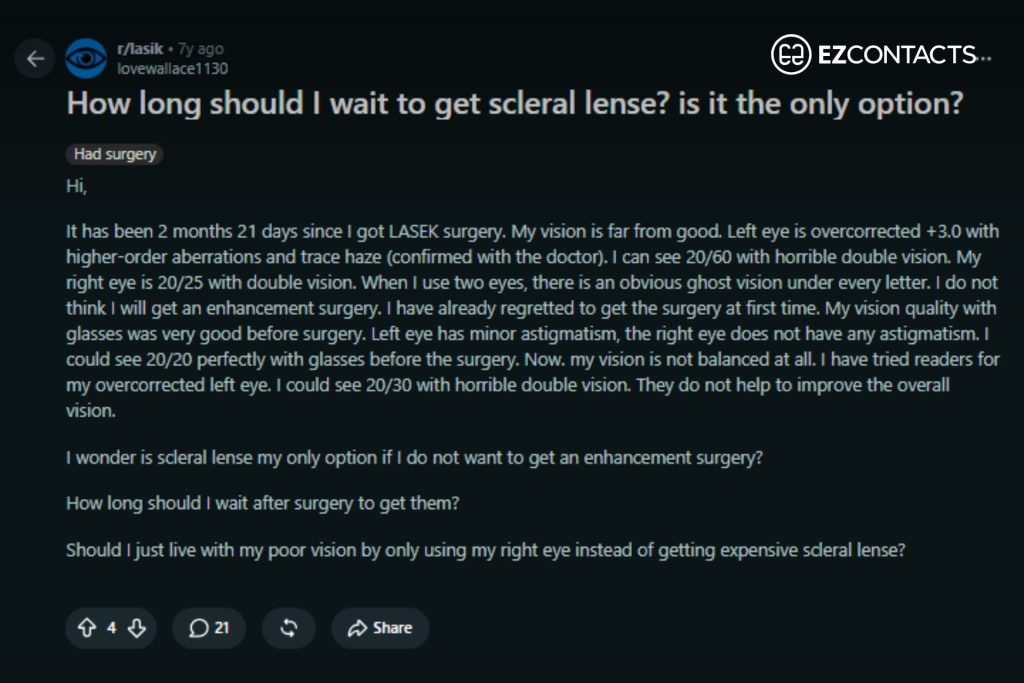
This experience shows why custom specialty lenses sometimes become necessary when refractive surgery doesn’t go as planned. Standard soft contacts can fail in situations like this, because they can’t correct for the way light scatters off an irregular corneal surface.
Eye doctors usually recommend waiting three to six months after surgery. This lets the cornea heal and stabilize before mapping for custom lenses.
People who can’t get a good fit with standard contacts
With custom lenses, doctors can change things like the diameter, curves, or edge design. This can create a much better fit for the wearer and improve both their vision and the comfort of the lens.
But it’s important to know that getting this fit right can take several appointments. Many comments in the r/Keratoconus subreddit have talked about lenses like hybrids and sclerals requiring quite a few fittings.
One Redditor who wears a hybrid lens explained:
“Have used a hybrid in an eye for over a year, no complaints but had to go back 3 or 4 times at first to get the correct fit.”
Another person recommended switching to a doctor who specializes in keratoconus lens fittings. They went as far as to say:
“If ur doc just did a couple fittings, I would say try again w someone else. The first thing the dr should say is that it will likely take a few visits to ensure proper fit.”
This is because each fitting for a custom lens gives your doctor more information about how the lens sits on your eye. Adjustments can then be made to improve the fit, vision, or comfort.
Are Custom Contact Lenses Worth It?
This depends on what you mean by “worth it.” Financially, the cost can be a lot for some. They’re not always covered by insurance. And even if they are, there can be out-of-pocket costs that run into hundreds of dollars, or even thousands for scleral lenses.
Then you have to factor in the corneal mapping, multiple trial appointments, and the learning curve for daily care and insertion.
If standard lenses or eyeglasses are able to give you good enough vision, you may decide custom lenses aren’t worth it.
But sometimes, mass-produced lenses just can’t cut it. If someone is dealing with severe keratoconus, a very high prescription, or post-surgical complications, custom lenses can become a medical necessity rather than a luxury.
So whether they are “worth it” for you really depends on how severe your vision issues are and how committed you are to the journey that is custom lenses.
FAQs
Can custom contact lenses be made for just one eye?
Yes! Each eye can be fitted separately for a different prescription, corneal shape, or eye condition.
How long do custom contact lenses take to make?
This depends on the type of lens you choose and how many adjustments need to be made. But you can expect there to be multiple appointments before the fit is right. So it can be several weeks before the final product is actually in your hands.
How are custom contact lenses fitted?
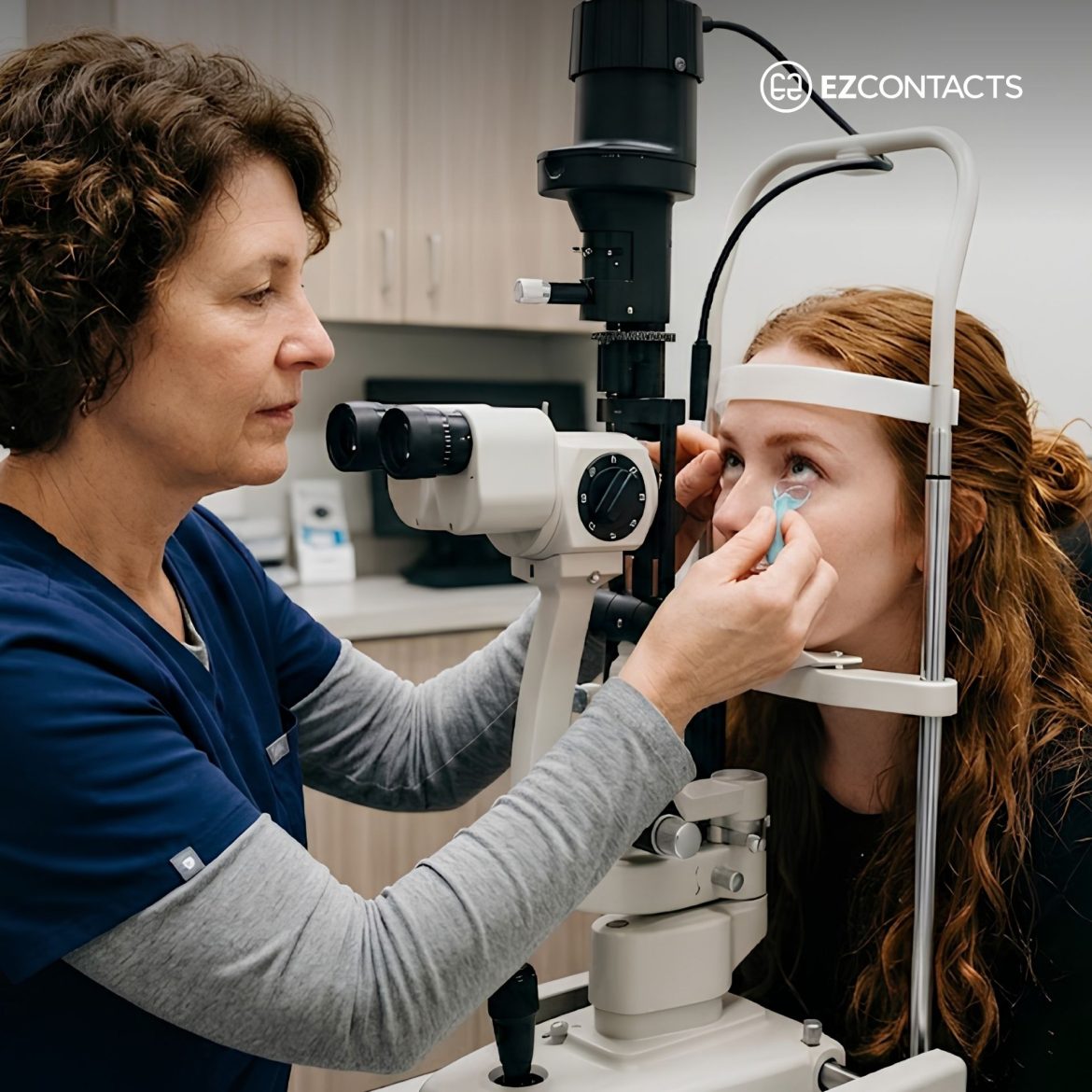
Fittings for custom contacts involve corneal topography mapping to measure the exact shape of your eye. Your doctor then uses trial lenses to check how well the lens sits on your eye, how it moves, and whether you have clear vision and good comfort. The lens design can then be adjusted until the fit is right.
Are custom contact lenses comfortable right away?
Not necessarily. It takes time for the eye to get used to any custom lens. Plus, sclerals have a very specific insertion routine that a lot of people find challenging in the beginning. But if the custom fitting has been done right, comfort often improves once your eyes adjust.