
Both trifocal and progressive glasses are designed to help with near, intermediate, and distance vision, all in the same pair of glasses. But the two designs are very different.
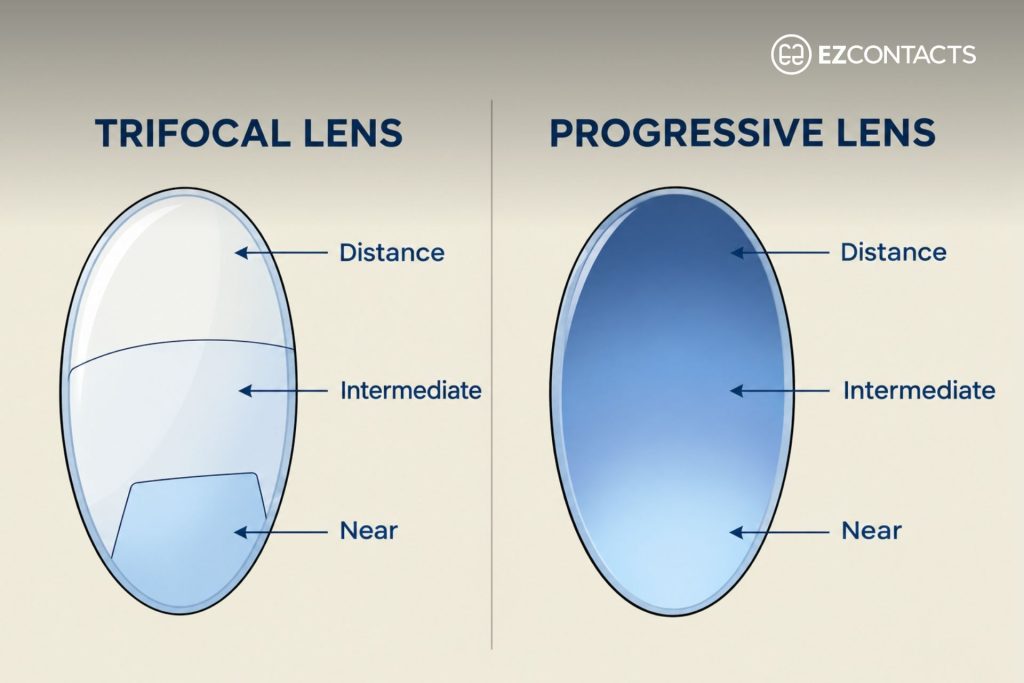
Trifocal glasses combine three different prescriptions into each of the two lenses, with each prescription or “zone” divided by a line that can be seen on the lens. Progressive glasses have lenses that gradually (or progressively) transition from near to far without any visible lines.
Progressive glasses are essentially the modern alternative to trifocal glasses. Here’s a complete deep dive into what makes them different.
At a Glance:
- Trifocal glasses use three different lenses combined together, with a zone for distance, intermediate, and near vision. The zones are separated by two horizontal lines that are visible to other people.
- Progressive glasses have lenses that gradually transition in strength and have no visible dividing lines.
- Both types of glasses can correct presbyopia, a condition people get as they age that makes reading and looking at things up close more difficult.
- Progressive glasses are more commonly prescribed today. Since progressives grew in popularity a few decades ago, trifocal glasses have become quite rare.
What Are Trifocal Glasses?
Trifocals are a type of multifocal glasses. That means they correct for more than one distance, as opposed to single-vision glasses, which only help you focus on one distance.
The most common reason for being prescribed multifocal glasses is presbyopia. This is a condition that affects everyone eventually as they get older, but some people experience it more severely or at a younger age.
As the name suggests, trifocal glasses correct for three sight scenarios: near, intermediate, and distance. To do this, three different sections of glass or plastic are combined to form each lens. The design means you (and anyone looking at you) will be able to see two horizontal lines on the lenses where the different zones join up.
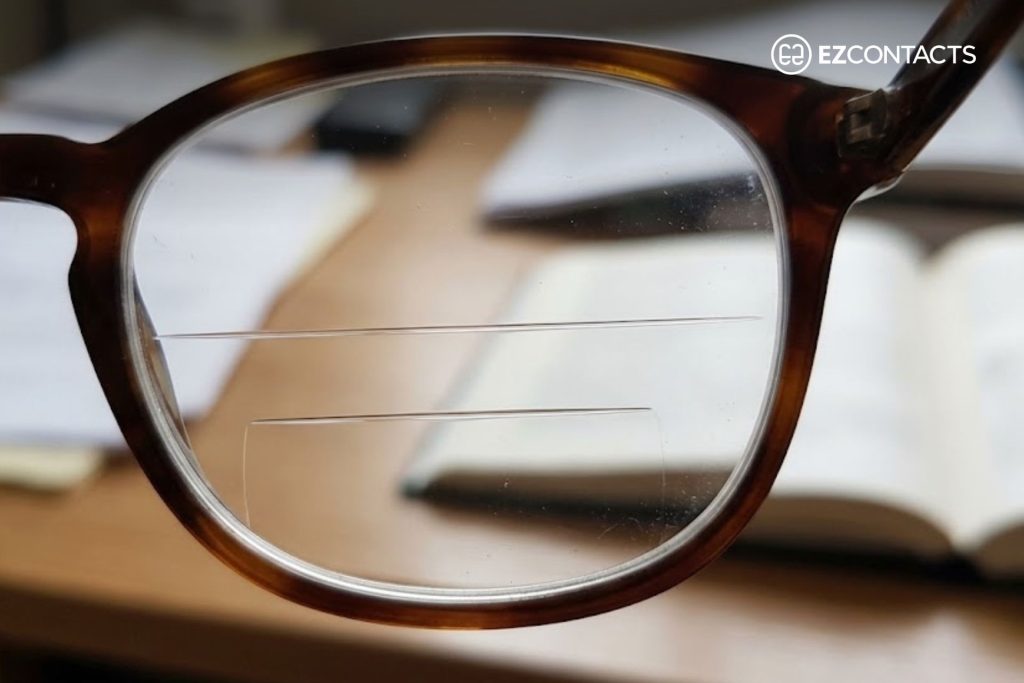
The three zones are usually positioned like this:
- The top: Corrects distance vision for when you’re driving, walking around, or watching TV.
- The middle: Corrects intermediate distance for things like working on a computer or looking at the dashboard in your car.
- The bottom: Corrects near vision for reading a book, checking your phone, or anything else close up.
What Are Progressive Glasses?
Progressive glasses are a more modern type of multifocal than traditional trifocal or bifocal glasses. They combine near, intermediate, and distance correction into one piece of glass or plastic. This means the prescription changes gradually from the top of the lens to the bottom, and you don’t see those two horizontal lines.
Progressives were created as an alternative to bifocal and trifocal glasses, with the first commercially successful lens hitting the shelves in 1959.
In the beginning, people were a bit skeptical of progressive glasses because early versions didn’t work all that well for some people. But during the 1990s and 2000s, new technology meant that the popularity of progressive glasses exploded, and they’re now the preferred option.
In the US, around 85% of multifocal prescriptions are now progressive lenses. Bifocals make up around 15% of sales, while trifocals now make up 1% or less of the market share.
This makes trifocals a very niche product. So it’s actually pretty likely your local optometrist won’t even have a trifocal lens available to prescribe to you.
Just to clear up any confusion, some people still refer to progressive glasses as “bifocal” or (more rarely) “trifocal” glasses. But they mean very different things in the world of eyeglasses: whether the lens has two (bi-) or three (tri-) lens areas.
Because the prescription power in the lenses progressively changes across the lens, you get a more gradual transition between different distances. People tend to find this less visually jarring than the older trifocal glasses.
Another big reason people like them is that they don’t have those two very obvious lines in the lenses. So people will just assume you’re wearing standard single-vision glasses, and you don’t have to announce to the world that you’re wearing multifocal glasses.
It still takes time to get used to progressive glasses, just like it does with trifocal glasses. You’ll have to learn how best to position your eyes and head to get the clearest vision. Some people find their vision seems a bit strange in the beginning too, and they notice some blurriness in their peripheral vision. But the majority of people adapt quite quickly.
Trifocals vs. Progressives: A Quick Summary
Here’s a round-up of all the key differences between the two types of glasses.
| Feature | Trifocal glasses | Progressive glasses |
| Vision correction | Three discrete zones/sections for distance, intermediate, and near vision | Gradual changes between distance, intermediate, and near vision |
| Visible lines | Two visible lines separate the three zones | No visible lines on the lenses—they look like standard single-vision glasses |
| Transition between powers | Abrupt transitions between the prescription zones, which can result in image jump | Gradual transitions between prescriptions |
| Image jump | Can happen when moving between the different zones | Avoids the abrupt image jump associated with bifocals and trifocals |
| Peripheral vision | Usually gives the wearer less distorted peripheral vision | Peripheral vision might look blurred or distorted for some people |
| Adjustment | Both trifocals and progressives take practice to get used to. Some people adapt in a few days, whereas it takes others a few weeks. | |
Which Is Best?
Progressive glasses are certainly the more common option today. Trifocals are now so rare that most optometrists don’t even offer them as an option.
Even a few decades ago, trifocals weren’t that popular. A lot of people would just settle with wearing bifocals and put up without having any intermediate vision. That’s because of those pesky lines on the lenses!
The technological advancements in progressive lenses mean that this is now the preferred lens choice for both optometrists and patients.
Research has shown that as long as the progressive glasses are fitted properly, people find they work better for them. In one large study done in the mid-90s, 85% of people preferred progressive glasses over their old bifocal or trifocal glasses.
So, I think we have a clear winner here. But if you have a special circumstance where you think trifocals would work better for you, check with your optometrist before your appointment to see if they’re actually available as an option there.
Frequently Asked Questions About Trifocal Glasses
Are progressive glasses or trifocal glasses easier to get used to?
There’s no concrete evidence to suggest either one is “easier” to get used to. But we do know that both trifocals and progressives have an adjustment period. The research says that most people adapt in less than two weeks, but some people adapt quicker, and it takes other people longer.
Are trifocal and progressive glasses both used for presbyopia?
Yes, both of these types of glasses can correct presbyopia. But progressive glasses are a more modern option and are more commonly prescribed today.