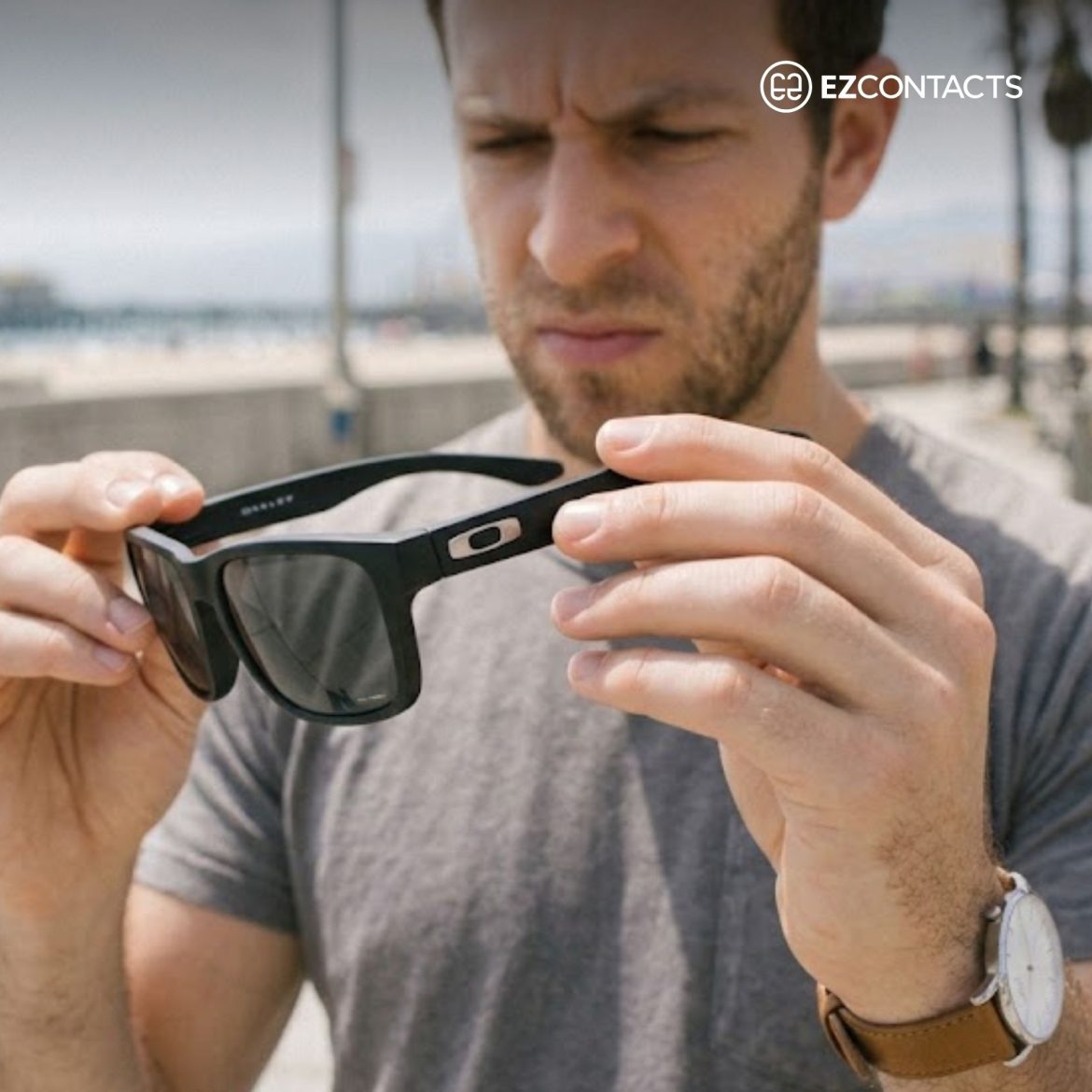
Buying Oakley sunglasses online can feel like you’re taking a risk. How can you know if they’re real?
There are plenty of counterfeit Oakleys around, and some fakes can be pretty convincing. But there are a few ways to make sure your Oakleys are authentic.
Here’s how to tell if Oakleys are real.
At a Glance
- Check the model code on the left temple and make sure it matches the exact sunglasses you have.
- You can check things like packaging and the overall quality, but remember that accessories and little details can vary between products, even if they’re the same model and color.
- Although you should raise your eyebrow if you spot a pair of Oakleys on sale for $20, a discounted price isn’t proof that Oakleys are counterfeit. Especially if you buy from a reputable retailer.
- If you’re still unsure, Oakley Customer Care can verify your sunglasses from photos and purchase details. You can also walk into any Oakley store or an authorized distributor and have them check your glasses in person.
How To Tell If Oakleys Are Real: Check the Model Code
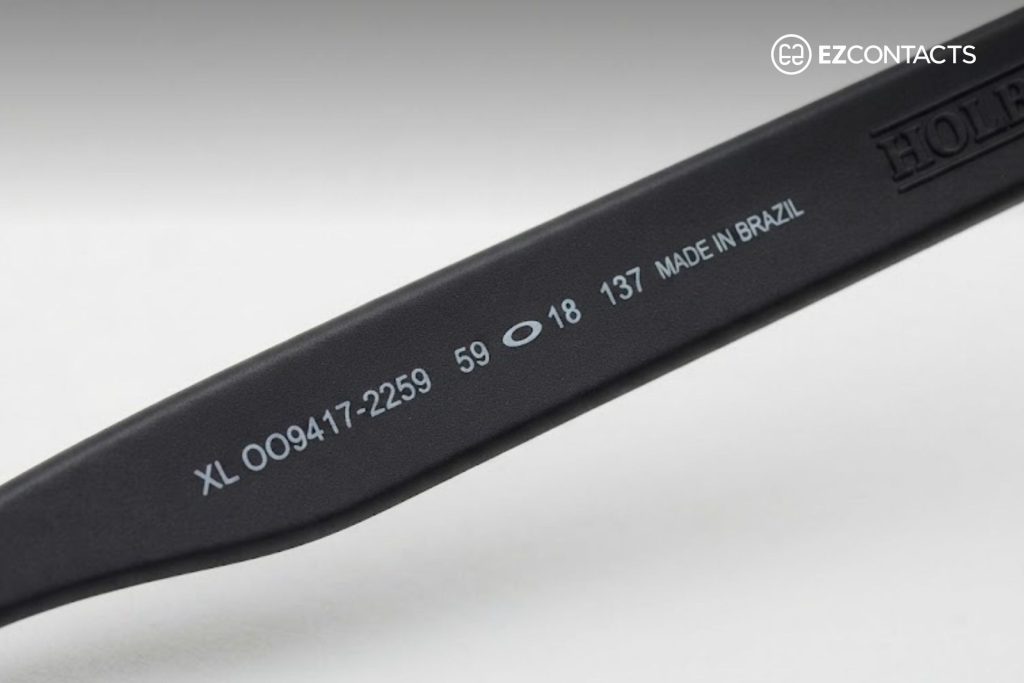
When authenticating your Oakleys, begin by looking at the model code. Oakley puts the model code on the frame’s left temple. It should start with one of the four following acronyms: OO, OX, OY, or OJ. The code after it contains four or five digits with no spaces.
Usually, the model code is separated from the color code by a dash.
It will look something like this:
OO9417-2259
- OO9417 = model code
- 2259 = color code
Sometimes there are sizing numbers next to the model and color codes too. In the example pictured above, you can see the glasses are XL-sized and measure 59-18-137. But some frames don’t have this.
You can also see the frame was “made in Brazil.” But not every pair of Oakleys has something like this written next to the model code. This can vary between models.
Once you’ve found the code, search for it on Google or on the Oakley site and compare the results with your sunglasses. The result should match the frame you bought.
In this case, the codes are describing a Holbrook XL Polished Black Frame with Prizm Grey lenses.
Keep in mind: A matching model code is a useful authenticity check, but it isn’t proof by itself that a pair of Oakleys is genuine.
Counterfeiters can copy authentic model and color codes. It’s best to check several details before deciding whether a pair is real.
Know That There Are Different Logos
If you’ve looked at a few different pairs of Oakleys, you may have noticed that the logo doesn’t always look exactly the same.
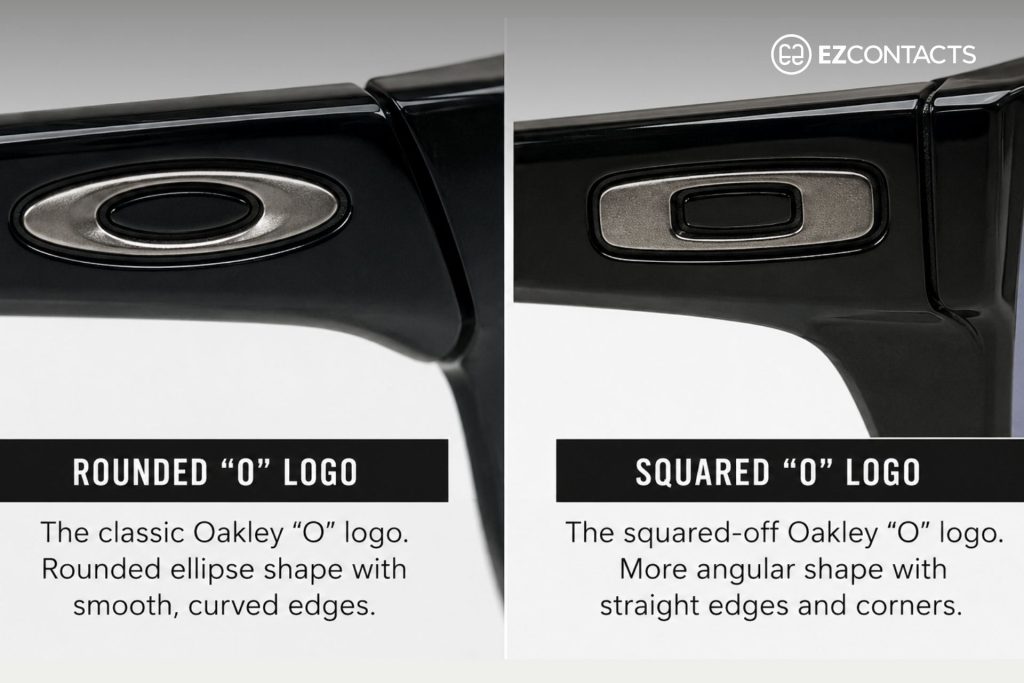
Some frames have the familiar rounded Oakley “O.” Others have a squared-off version of the O. Both can appear on genuine Oakley sunglasses.
The oval “Ellipse”
Introduced in the early 1990s, the oval icon became Oakley’s identity for high-performance athletic frames.
The square O
Introduced in the mid-2000s, Oakley’s square logo became associated with lifestyle frames such as the Gascan. The design reflected Oakley’s expansion beyond performance eyewear into streetwear and everyday fashion.
Even within the round and square versions, there can still be differences to the logo depending on the model. So the logo on your pair of Oakleys might not look exactly like either of the logos pictured above.
The same applies to where the logo appears. Depending on the model, you might find it on the temple, lens, or another part of the frame.
Physical Details and Finishing
Real Oakleys use premium materials and manufacturing methods. Here are some physical details to watch out for:
- Lens etchings: The only time you should see an “O” etched on the lens of your Oakleys is when you buy a prescription pair directly from Oakley or an authorized retailer. However, genuine non-Rx lenses do often have tech labels etched on the bottom edge like “PRIZM,” “POLARIZED,” or “PRIZM P.”
- ‘Sticky’ stickers: Pay attention to any stickers on the lenses. Real Oakleys use static-cling film, not actual stickers.
- Rough seams: Authentic Oakleys are molded under intense pressure, leaving completely smooth seams. Counterfeits usually have sharp, raised plastic lines along the edges of the frame and arms.
- Earsocks and rubber grips: Oakley uses a patented rubber called Unobtanium on their sports frames. It feels soft and actually gets grippier when you sweat. Fakes will likely use cheap plastic or hard rubber that feels stiff and easily slides off.
- Lens clarity and distortion: Looking through genuine Plutonite lenses feels completely clear across your entire field of view. Check to see if you notice any warping or if the lenses strain your eyes in any way.
- Misspellings: Counterfeiters miss small details all the time. Double-check any text on the glasses and look for typos like “Oakly” or “Oakey.”
Don’t Immediately Freak Out About Small Discrepancies
Oakley has been making glasses for over 45 years and has made hundreds of different models. There are lots of small details that vary from frame to frame.
There can be differences in what accessories come in the box and even small differences between two pairs of glasses of the same model. This can be because one was manufactured in a different country or at a different time.
In a discussion on Reddit, I found an Oakley customer who was worried they had purchased a fake pair of sunglasses because they saw a tiny square on the inside of the arm. They were expecting to see the Oakley O next to the model code, like in this image below.
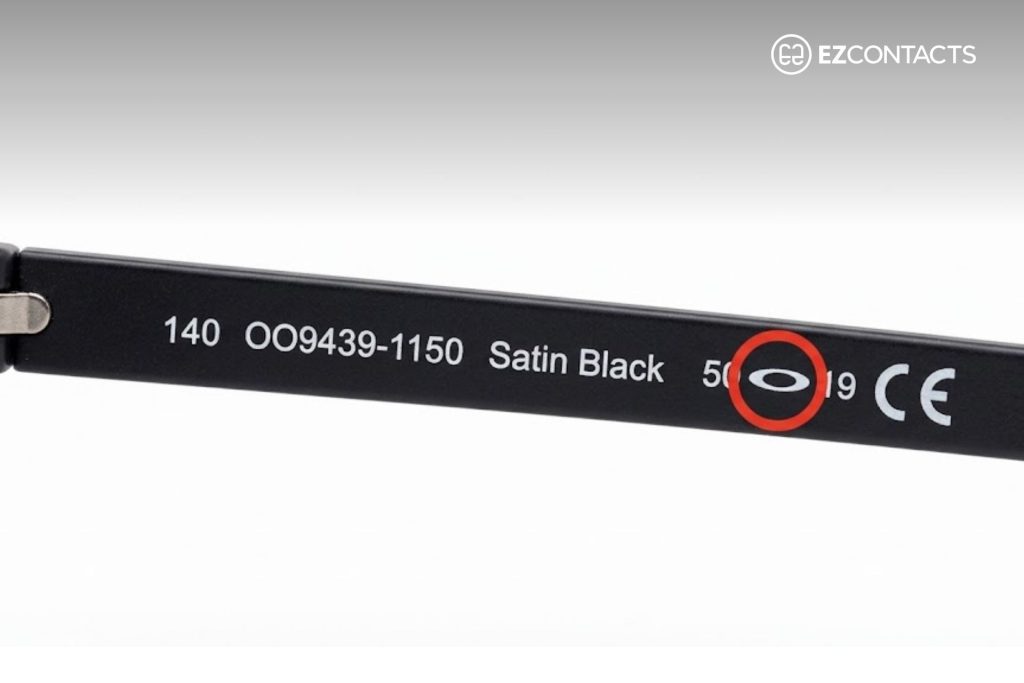
But on their glasses, they saw a “suspicious” square marking on the temple, like in the image below.
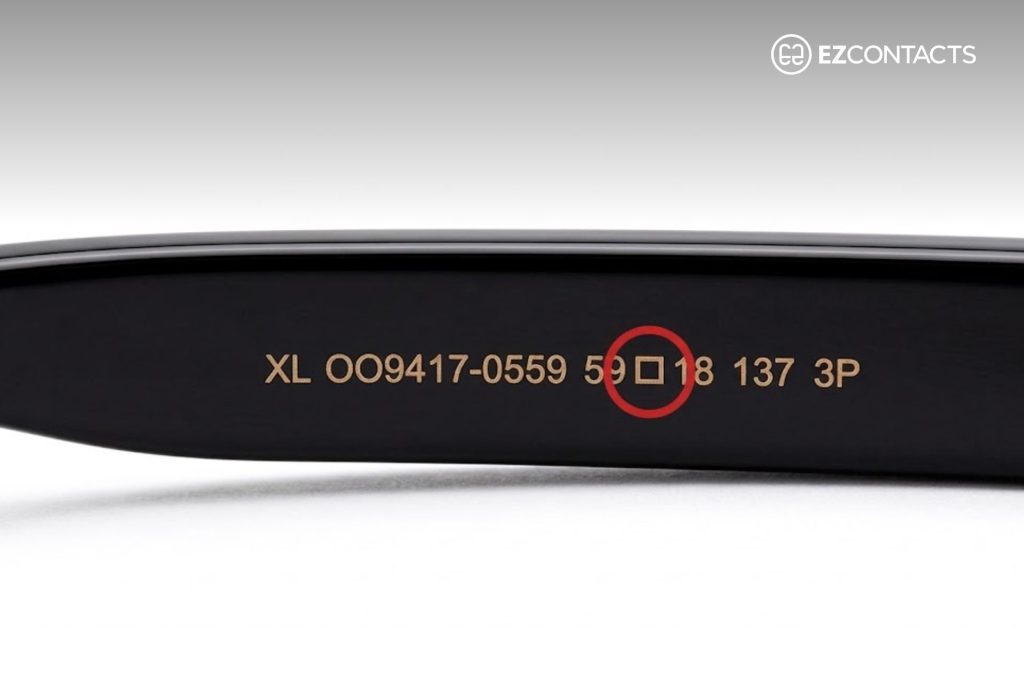
So does that ☐ marking in place of the little Oakley Ellipse logo mean this Redditor bought a pair of fakes?
No, it doesn’t.
That tiny square is a conventional symbol known as the “boxing system” icon. In the eyewear world, it’s the universal separator used by manufacturers all over the world to separate the lens width from the bridge size.
So when you see something like “59 ☐ 18,” it’s just telling you that the frame has a 59 mm lens width and an 18 mm bridge.
But then why do so many pairs of Oakleys have the signature Oakley O in that spot instead?
The answer is simpler than you think. It’s not a mark of authenticity or a secret sizing code. It’s just Oakley being Oakley: they love to customize their frames.
But this custom icon isn’t present on every pair of Oakleys. So as long as the code checks out and you bought your glasses from a reputable retailer, you should feel confident with your purchase, whether there’s an Oakley O or a square marking on the temple.
Still Not Sure? Ask Oakley
If you’ve checked the model code and compared your sunglasses but you’re still unsure, you can ask Oakley themselves to solve the mystery.
Oakley recommends contacting Customer Care with clear images of the product and details about where it was purchased. Their team can then tell you whether the sunglasses are genuine. Oakley also recommends visiting one of its stores or an authorized Oakley dealer where you can confirm authenticity.
FAQs About Real Oakley Sunglasses
Do real Oakleys have a model code?
Yes. Oakleys have a model code on the left temple which starts with the acronym OO, OX, OY, or OJ. The model code contains four or five digits with no spaces.
Do real Oakleys have an Oakley logo on the lenses?
Not every Oakley lens has the same marking. Oakley Authentic Prescription lenses have a laser-etched ellipse logo as proof of authenticity. But other Oakley lenses can have different markings or no markings at all.