If you need to fix a problem with your glasses frames, it helps to know the parts of eyewear by name. Or maybe you need to describe a problem with the way your glasses fit on your face. Whatever your reason, knowing the names of the parts that make up your glasses can help you shop and repair with confidence.
We’ve put together a quick glasses anatomy guide covering the main components of most frames.
At a Glance
- The lenses are the clear or tinted pieces that correct your vision and match your prescription.
- The rims hold the lenses in place, with the bridge going over your nose to connect the two lenses.
- Some frames have nose pads, which can be adjusted to fit your individual facial structure. Some glasses use bridges without any nose pads, though.
- The temples are sometimes called the “arms.” They sit against the sides of your head and rest over your ears.
- Hinges connect the temples to the front of the frame and let you fold your glasses so you can put them in a case.
What Are the Different Parts of Glasses?
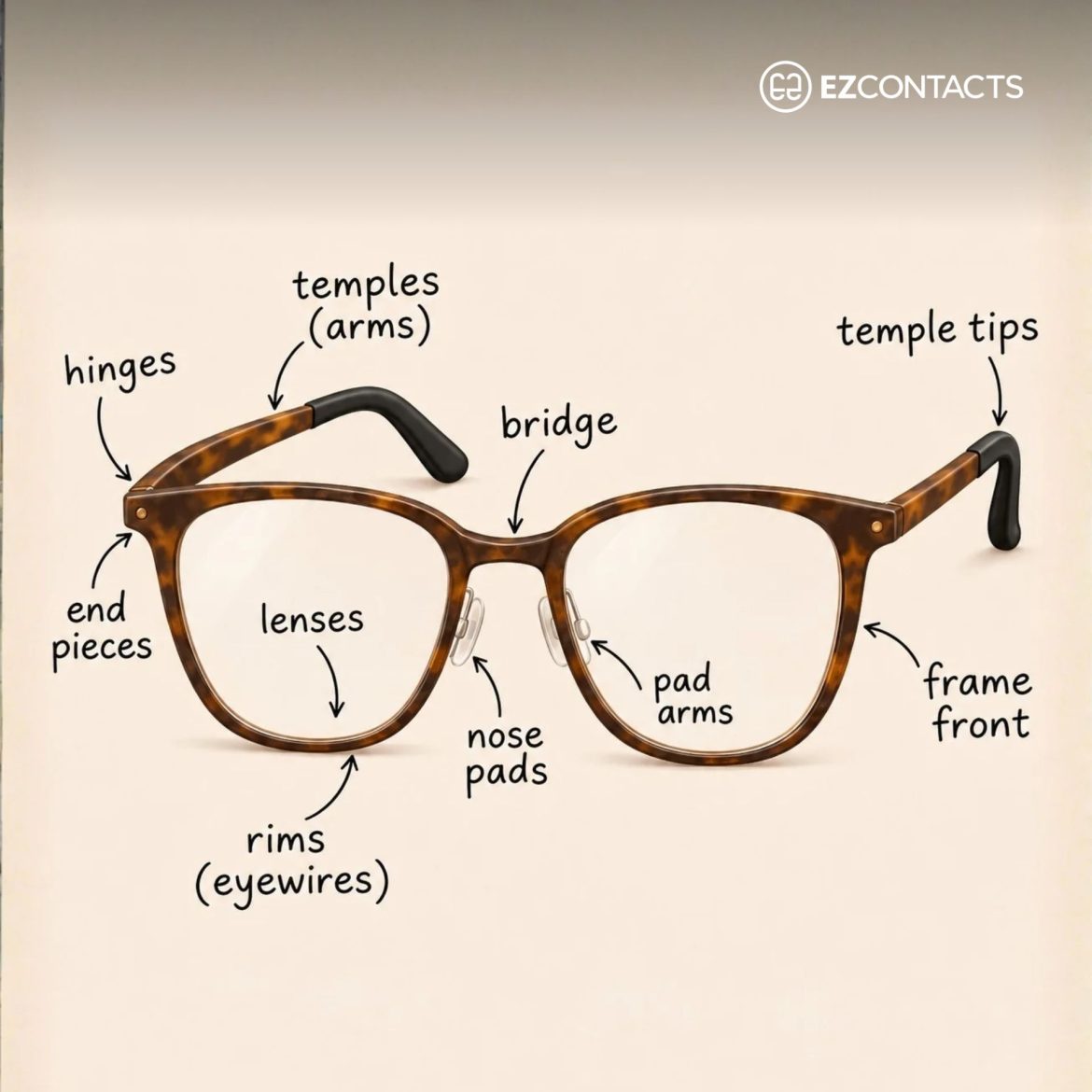
Here’s what each of the parts of eyewear does and where you’ll find it. If you’re more of a visual learner, check out the diagrams further down!
Lenses
The lenses are the transparent or tinted pieces of glass, plastic, polycarbonate, or other material that sit in front of your eyes. They’re the part of the glasses that actually correct your vision and are made to fit your prescription.
Frame
This describes the entire front section. The frame holds the glasses together and connects to the temples on either side. It includes the rims, bridge, and end pieces.
Rims (eyewires)
The rims are what surround the lenses to hold them in place. People occasionally call them “eyewires,” usually when the frame is metal.
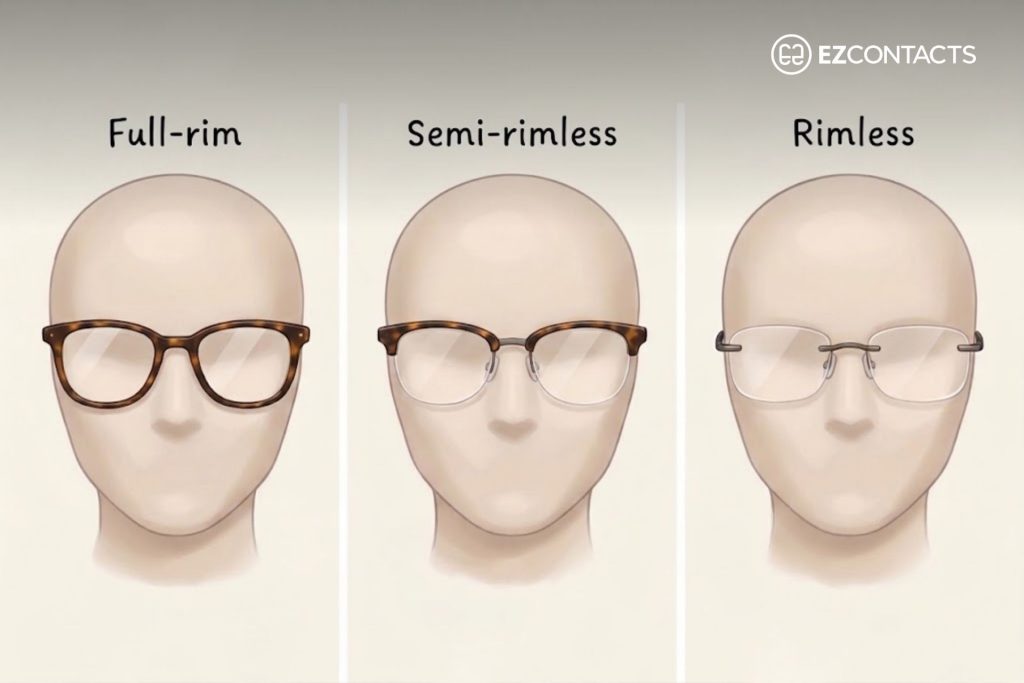
On full-rim glasses, the lenses have a rim running all the way around them. Semi-rimless frames typically attach to the top part of each lens. Rimless glasses have temples and bridges that attach straight to the lenses themselves.
Bridge
This is what connects the two lenses and goes over your nose to support the frame. There are a few different types of bridges, including saddle bridges, keyhole bridges, and bridges with adjustable nose pads.
Nose pads and pad arms
Not every frame has nose pads, so you can disregard this section if your glasses don’t have this part. Their job is to support the weight of your glasses and stop the frame from slipping down your nose.
They’re attached to the frame with small metal pieces called pad arms (sometimes “guard arms”). You can adjust the pad arms to change the fit. This helps you customize the frame more precisely. If you don’t want to try to do so yourself, most glasses stores will adjust them for you.
End pieces
The end pieces are the outermost parts of the frame front, located where each hinge and temple attaches.
Hinges
The hinges connect the end pieces to the temples. They’re what let you fold the glasses when you take them off so you can put them away in a case.
Some glasses have sophisticated “spring hinges,” which give the frames a bit of extra flexibility when you open and close them. They let the temples open slightly outward and can stop you from breaking the glasses if you open the hinge too far.
Temples (arms)
The temples are the long pieces that sit against the side of your head and rest over your ears. A lot of people just call them the arms of their glasses, but either word is fine.
Different frames can have different temple lengths, and the shape can vary a little too, which is one reason some frames might feel more comfortable to you.
Temple tips
The temple tips are simply the end parts of the temples that curve down behind your ears.
Some frames have extra molded pieces that go over the actual temples, with the aim of making the frame more comfortable to wear. These can be called temple grips or cushions. Some frames don’t have these extra pieces, but that doesn’t automatically mean the frame won’t be comfortable.
Do All Glasses Have the Same Parts?
Not quite. Some parts of eyewear vary by frame style. Usually, the biggest differences in the parts of eyewear are the rims and bridges.
Different types of rims
The rims are what go around the lenses and hold them in place over your eyes. Most glasses fit into one of these three categories:
- Full-rim glasses: This means the frame completely surrounds each lens.
- Semi-rimless glasses: The frame only connects with the lenses at the top. The bottom is rimless or has a thin nylon cord that’s mostly invisible.
- Rimless glasses: These glasses don’t have any rims. So instead, the bridge and temples attach directly to the lenses. This type of frame is a bit more uncommon today than the other two, but it’s recently been making a comeback as part of Y2K fashion.
Different types of bridges
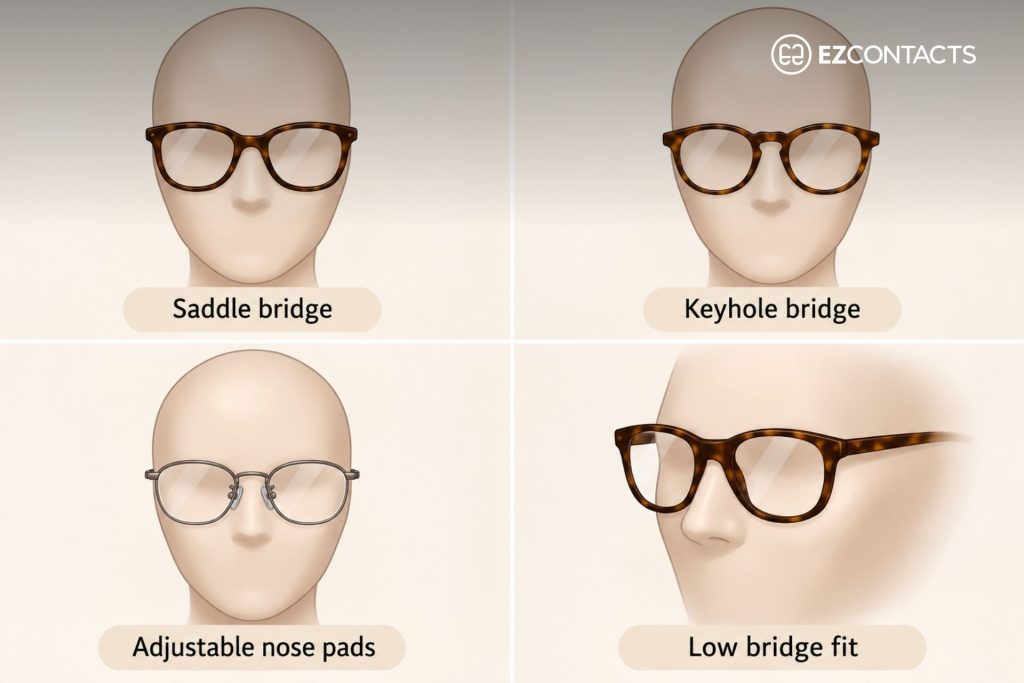
The bridge is what goes over your nose and connects the two lenses. You’ll come across quite a few different kinds of bridges when you’re shopping for glasses:
- Saddle bridge: It gets its name because it curves over your nose like a miniature saddle. The aim of the design is to spread the weight of the frame across a wider area of your nose to reduce pressure.
- Keyhole bridge: This has a small opening between the bridge and the top of your nose. Keyhole bridges get their name because they look like old-fashioned keyholes.
- Adjustable nose pads: Frames with nose pads have additional parts attached near the bridge that make contact with your nose. Nose pads allow for a more customized fit since an optician can adjust the position so they perfectly fit your nose.
- Low bridge fit: Some people also call this design “Asian fit.” Low bridge fit designs have specially positioned nose pads or a modified bridge shape so that the frame fits the face properly and doesn’t touch the cheeks. The design can be helpful for anyone who has a lower nose bridge.
FAQs
What are the arms of glasses called?
The arms are technically called temples. They start from the hinges, and the ends go over your ears to keep the glasses in place.
What are the plastic ends of glasses arms called?
Temple tips are the ends of the temples or arms. You can buy temple tips to go over your glasses if you think it will make them more comfortable or you’ve lost one.