
Are you thinking about getting contacts for presbyopia? You might have heard of both ‘multifocal’ contact lenses and ‘bifocal’ lenses.
The names often get used interchangeably, which can be confusing!
So what’s the actual difference between them? And which one should you choose?
What Are Bifocal Contact Lenses?
Bifocal contact lenses are designed to correct your near and distance vision at the same time.
The idea comes from the original design of bifocal glasses, which have lenses that are split into a top and bottom section. One section is for distance vision, and the other section is for tasks like reading.

The design for bifocal contacts uses the same concept, with the lens split into two zones for your two different prescriptions. Your eye uses one or the other depending on where you’re looking.
The top section of the lens is used for distance viewing, and the bottom section is used for near vision tasks. These types of lenses are called alternating or translating contacts.
The downsides of bifocal contacts
The problem with bifocal lenses is that the lens needs to stay in a very specific position on your eye. But contact lenses naturally move slightly when you blink, so they don’t always stay perfectly lined up with your eye.
It’s for this reason that true bifocal contacts are not prescribed very often today. However, people might still say “bifocal contacts” when they’re actually referring to multifocal contacts.
What Are Multifocal Contact Lenses?
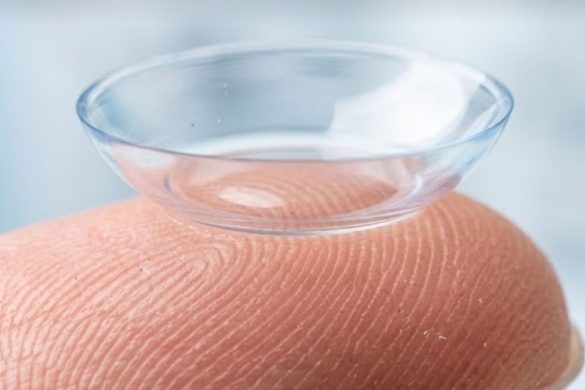
Multifocal lenses aren’t split up into two sections like bifocals. Instead, they integrate multiple prescriptions over the surface of the lens.
This lets you see at near, intermediate, and distance ranges without having to look through a specific area of the lens. When you look through multifocal lenses, your brain selects the prescription it needs depending on what you’re looking at.
This design doesn’t rely on the lens staying perfectly still like bifocals. It also gives you a smooth transition between distances. This is why multifocal contact lenses are now most commonly prescribed for presbyopia.
How Exactly Do Multifocal Contact Lenses Work?
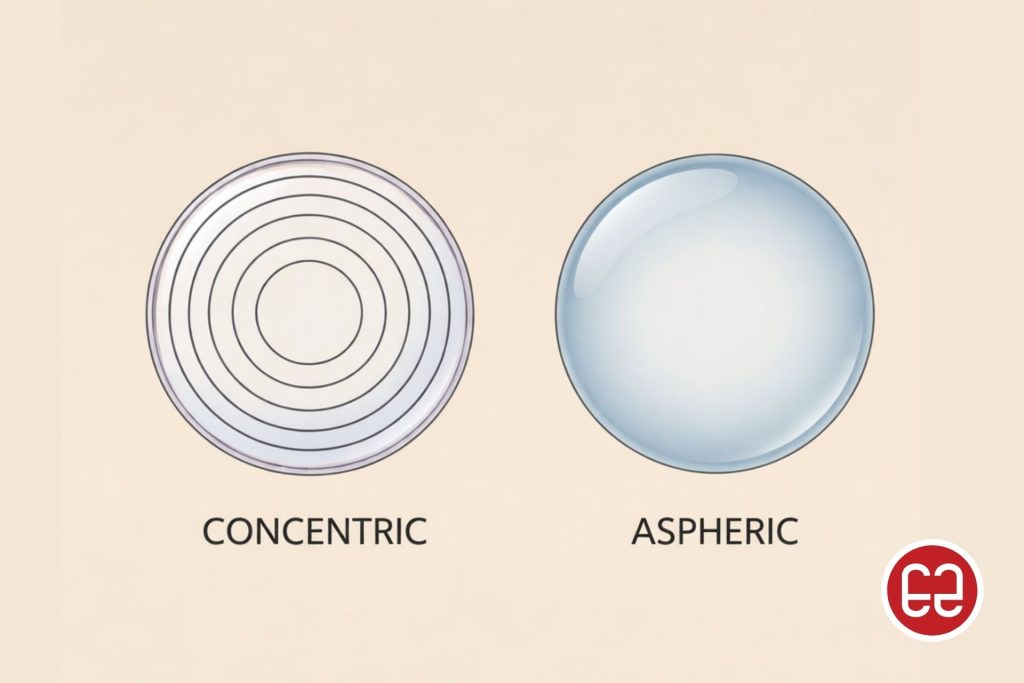
Multifocal lenses work by blending different focusing powers across the whole surface of the lens. There are two main multifocal designs.
Concentric
These lenses use a ‘bullseye’ pattern. They have concentric rings that alternate between near and distance prescriptions. There’s usually a larger ring in the center of the lens for distance viewing.
Aspheric
This design is a bit more sophisticated, since there aren’t any distinct rings. Instead, the lens gradually changes power from the center to the edges. Most people prefer the smooth transition and report that they find it resembles natural sight more closely.
For both designs, your eyes and your brain are working together to choose the right focus based on what you’re looking at. This means there’s an adjustment period as your brain gets used to things. Most people adapt to it within a couple of weeks.
What Does the Adjustment Period Feel Like?
Multifocal lenses are now the standard-prescribed option for presbyopia, and there’s a good reason for that. But they do take some time to get used to.
At first, you might notice:
- Poorer vision at night or in lower light
- Needing a few seconds to switch focus
- Overlap of near and distance before your vision settles
This happens because your brain is getting used to filtering out what it doesn’t need and focusing your eyes on what you’re actually looking at. Most people adapt to it in about 7 to 14 days.
Tips to Adapt to the Adjustment Period
There are a few things you can do to make the transition easier and help your eyes adjust faster.
- Gradually increase wear: Start with a few hours a day instead of immediately wearing them all day.
- Try to wear the contacts every day: This helps your brain adapt more quickly and prevents your progress from slipping.
- Work up to a full day: Most contact lenses are typically worn for around 8–16 hours per day once you’re fully comfortable.
- Focus on different distances throughout the day: Switch between near, intermediate, and distance objects to help train your brain.
- Use good lighting: It’s easier for your eyes to find the right focus in well-lit environments.
- Give it at least 1–2 weeks: Most people notice an improvement in this time.
- Follow up if you’re still having issues: If things still haven’t improved after a couple of weeks, you should book an appointment with your eye care professional so they can fix the problem.
When Bifocal Lenses Might Still Be Used
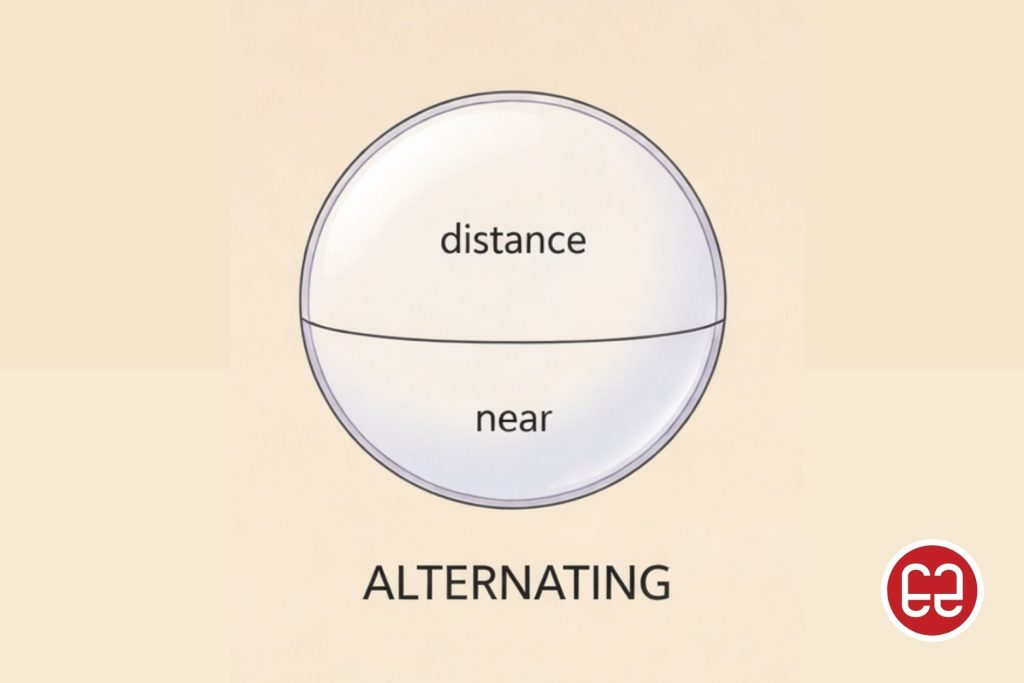
True bifocals (also called alternating lenses) are less commonly prescribed. But they’re not completely obsolete.
You might be prescribed true bifocals if:
- You don’t adapt well to multifocal contacts
- You find multifocals don’t give you enough clarity
- The lens can be stabilized on your eye and won’t shift around
That said, most people won’t be prescribed these kinds of contacts. Multifocals are almost always the better option.
Are There Any Cons for Multifocal Contacts?
Multifocal lenses work great for most people, but they aren’t perfect.
Some people find that things don’t look quite as crisp as they did when they wore standard contacts. Multifocals spread light across different parts of the lens instead of focusing it to one place. This can result in slight fuzziness for some, especially in low light.
It’s quite rare, but some people can also notice halos and glare at night, too. This can be more noticeable when looking at headlights and streetlights.
As mentioned, there’s an adjustment at the start. This is usually just temporary, but some effects can linger for longer for some people. If they’re too noticeable, your lens type or prescription can usually be adjusted by your eye care professional.
TL;DR
- Bifocal contact lenses have two separate zones for near and distance vision.
- Multifocals have multiple prescriptions across the lens to cover near, intermediate, and distance vision, without distinct zones.
- Most modern contact lenses for presbyopia are multifocal.
- People often say “bifocal contacts” when they actually mean multifocal lenses. This is where a lot of the confusion comes from.
- It typically takes around 7 to 14 days to get used to multifocal contacts.
- Your eye doctor will advise you on the best type of lenses for you.