How far can the human eye see? This sounds like a simple question that should have one numerical answer. But the truth is much more interesting!
In theory, the human eye can actually see infinitely. In fact, your eyes can see so far that you can even see into the past!
You may be wondering, how does that work? Let’s break it all down and discuss how far the human eye can see.
How Far Can You Actually See? The Surprising Truth
Some people assume our eyes have a “range limit,” a bit like a flashlight does. But the truth is that your eyes have no limit at all.
To understand how far you can see, you first have to change the way you think about the way your eyes work.
It’s easy to think about our eyes as flashlights, sending out “beams of vision” to objects that enable us to see them. If that were true, our vision would eventually run into a limit.
But our eyes are receivers. Their job is to detect whatever light can reach them, no matter how far away the source is.
If a tiny particle of light (called a photon) travels for a billion years across the vacuum of space and finally reaches your eye, you’ll see it.
Why Can’t I See My House From a Different State?
If our vision is infinite, why can’t we see everything? Well, there are three main problems that we face on Earth.
The Earth is round
This is the most boring reason, but the most important when discussing how far you can see on planet Earth. On flat ground, the Earth curves away from you. At around the three-mile mark, objects disappear under the horizon.
The “diluted” light problem
Imagine dropping a single drop of red food coloring into a glass of water. It’s bright red. Now, put that same single drop into a swimming pool. It spreads out so much that the water still looks clear.
Light does the same thing. As it travels away from a star or a candle, it spreads out. Eventually, it’s so “thin” that there aren’t enough light particles reaching your eye for your brain to notice.
The atmosphere
Our atmosphere is filled with so much dust, smog, and moisture that it can be like trying to look through a dirty window. The farther away something is, the more atmosphere the light has to travel through.
Let’s Get Into the Numbers
If our line of sight is unobstructed, how far can we actually go?
- A candle flame: On a pitch-black night with a perfectly clear view, you could see a single candle flickering from about 30 miles away.
- The sun: Our closest star is 93 million miles away. Its light reaches us after only an eight-minute journey.
- The stars: When you look up at the night sky, most of the stars you see are between 10 and 1,000 light-years away. That’s the equivalent of 60 trillion to 6,000 trillion miles.
- The Andromeda Galaxy: On a very clear night, you can see a faint, fuzzy smudge in the sky. That’s a galaxy containing a trillion stars. It’s about 2.5 million light-years away or 15 quintillion miles! In case you were wondering, that number looks like this written out: 15,000,000,000,000,000,000.
Distance vs Detail
So, why can’t we see farther than Andromeda? Well, it’s important to remember that it’s not because your eyes can’t see any farther. It’s because any objects beyond the Andromeda Galaxy are simply too dim to detect.
As light travels, it spreads out over a larger area and becomes weaker. By the time it reaches Earth, the light from more distant objects is too faint for the human eye to pick up.
Your eyes also have a limit to how much detail they can pick out. At a certain point, objects become so small that they blur into a single dot of light.
Your eyesight determines how much detail you see, too. Conditions like myopia make distant objects appear blurrier. Glasses or contacts can sharpen the image, but they don’t actually extend your range of vision. The light was already there, but by wearing glasses or contacts, you’re seeing it in focus.
Are You Really Seeing Into the Past?
Yes! You can think of your eyes like little time machines. Even though light travels incredibly fast (186,000 miles per second), it still takes time for it to reach your eyes. When you look at something very distant, you aren’t seeing it as it is now; you’re seeing it as it was when the light first left.
- The moon: You see the moon as it was 1.3 seconds ago.
- The sun: You’re seeing the sun as it was eight minutes ago. If it suddenly disappeared, you’d still see it in the sky for nearly 10 minutes before the world went dark.
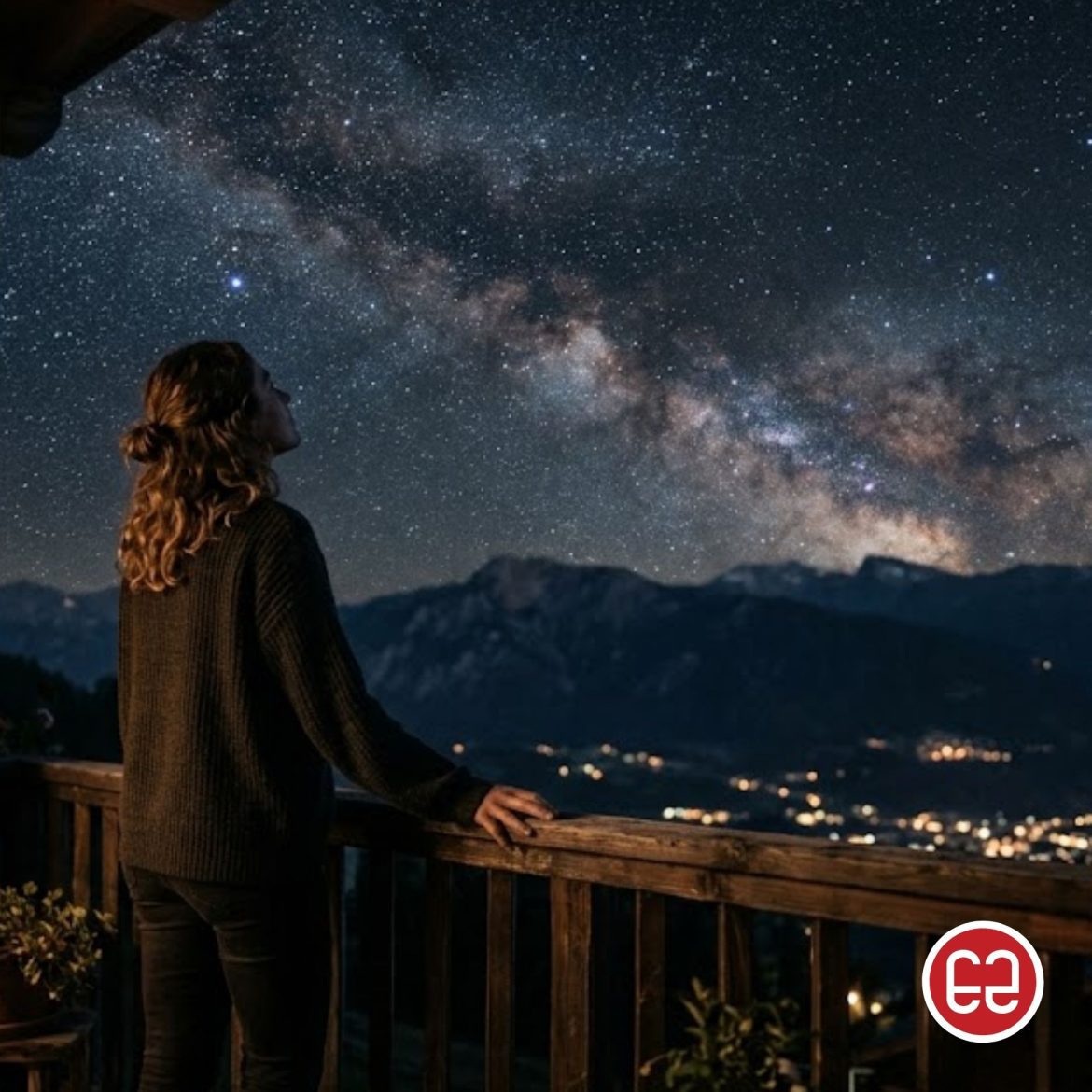
- The stars: When you look at the star Betelgeuse, you’re looking 640 years into the past. You’re seeing light that began its journey to Earth during the Middle Ages!
This means you can think of the night sky as a live history book. Some of the stars you see tonight might have already exploded or died out. But because they’re so far away, the news of their death hasn’t yet reached your eyes.
Spooky or cool? You decide.
TL;DR
- There’s actually no limit to how far the human eye can see. Your eyes will pick up any light that can reach them.
- Very distant objects in space (like stars) eventually become too faint to see. This is because their light gets spread out and eventually isn’t strong enough for the human eye to detect.
- On flat ground, the Earth’s horizon means you can only see about three miles into the distance.
- It takes time for light to reach your eyes. So when you look up at the stars, you’re literally seeing into the past!