authenticity of designer glasses

Loading

You ordered and paid for name brand eyeglasses or sunglasses. How can you be sure they’re authentic?

Given how often eyeglasses and sunglasses purported to be name brands are actually knockoffs, you’ll want to know how to spot the fakes.

Let’s start with how the glasses are described.

Some sellers are “sneaky honest” in the way they describe the item. Look to sniff-out such tactics when descriptions say “inspired by [brand name]” or the like. For sure, don’t let the word “replica” slip past you. Also, look for misspellings, perhaps subtle ones: Pradda, or Guci, for instance.


FacebookTwitterPinterestEmail
EZContacts Giveaway

Enter the EZ Giveaway

by Barry Feldman

Loading

We’re celebrating our cool new blog, EZOnTheEyes. And we’re celebrating you, our great customers.

We’re doing it with a fun and EZ giveaway.

Join us for your chance to win $100!

You’ll be asked three questions. The answers are easily found on the blog…

Here, here, and here.

Whether you get the answers right or not you’ll automatically be entered in our giveaway that runs through April 1, 2019. Immediately after, three winners will be drawn.

Tell your friends. And anytime you have feedback or ideas for our blog, just let us know.

Thank you. Good luck in the drawing. Here’s to seeing well, looking good and buying smart.

FacebookTwitterPinterestEmail

Loading

As I watched what came down the runway during the four weeks of fashion month—from New York to London to Milan to Paris—I was amazed at how often the looks included trendy eyewear. While we fashion folks are introduced to new things every fall and spring, some eyewear trends continue to pop up.

Whether it’s introducing a new trend or reminding us that an old trend is here to stay for another season, runway shows serve as an idea of what’s to come.

I rounded up the best of the best from the four weeks of fashion month to show you some exciting eyewear trends.

FacebookTwitterPinterestEmail
BLUE LIGHT

Loading

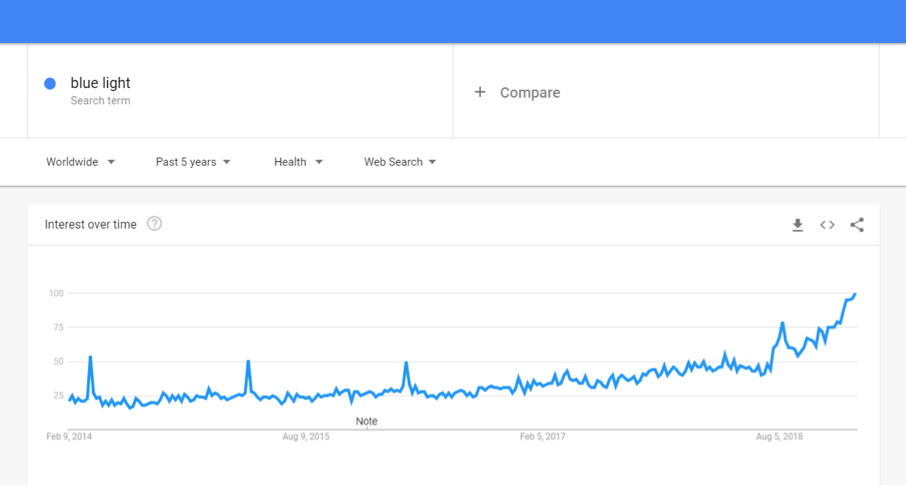
There appears to be a growing interest in “blue light.” As you see in the Google Trends graph below, search volume for the term has climbed steadily for years.

According to a 2018 Pew Research survey, in 2014, only 55% of Americans owned a smartphone. In 2018, the number reached 77%. The same survey reveals from 2013 to 2018 ownership of tablets in the U.S. rose from 34% to 53%.

You can see a correlation between ownership of digital devices and a curiosity about blue light.

FacebookTwitterPinterestEmail
ASTIGMATISM

What is Astigmatism?

by Michael Healy

Loading

Let’s start by clearing up the semantics. The eye issue that commonly causes blurry vision is called “astigmatism.” You do not have “a stigmatism.”

Astigmatism occurs when light enters the eye, and the cornea, the front cover of the eye, cannot properly focus the light on the retina, or the back of the eye. This can occur when the cornea is misshapen. As a result, light focuses on multiple points around, in front of, and behind the retina, causing blurry vision.

Almost everyone has astigmatism, however, for many, it has no effect on their vision and they do not need any sort of treatment. For many others, astigmatism happens in tandem with near—or far-sightedness—also known as myopia and hyperopia, respectively. If gone untreated, the results of astigmatism could be a lazy eye, headaches, and fatigue.

FacebookTwitterPinterestEmail