One day, you may go to read a book and find that the text is a bit blurry. Don’t worry, though. This is completely natural!
Just think about how much our eyes do for us. We spend our whole lives processing information through our eyes. We squint and stare and read everything from novels to text messages to restaurant menus.
All that wear and tear takes its toll. As you age, your eyes naturally start to lose some of their elasticity.
This is where readers come in. Reading glasses come in a variety of strengths. The reading glasses strength you’ll need typically depends on your age and your unique eyes. Let’s dive in to help you find the right pair!
After you turn 40, you may start experiencing signs of presbyopia. This is a common condition where your eyes lose the ability to focus on nearby words and objects over time. It typically develops between the ages of 40 and 65, and it usually gets more severe over time.
One of the first signs you might need reading glasses is if you have to hold objects farther from you to see them. You might also notice that text that was once easy to read is getting fuzzier.
In addition, you might start getting headaches from reading, and you could also experience eye strain. You may also feel tired after reading due to the strain.
You want reading to be an enjoyable experience, not one that leaves you exhausted and with a pounding head. That’s why reading glasses can be such a good tool as you age.
How Do Reading Glasses Work?
When it comes time to pick out reading glasses, you may find yourself asking a lot of questions. What do all those numbers mean? How do you know which glasses are right for you?
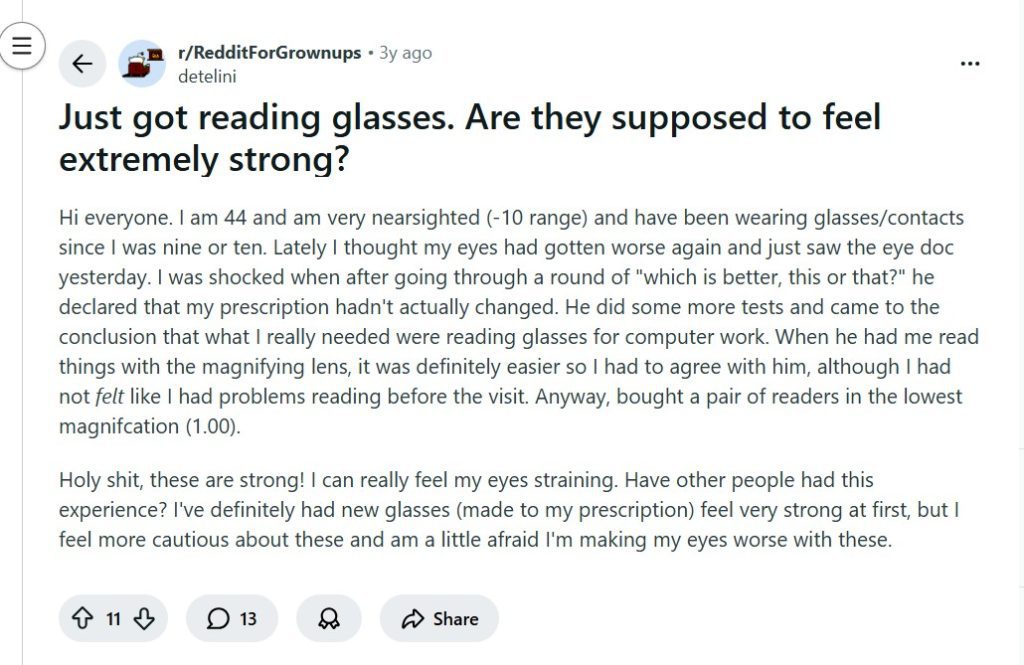
If you’re confused about all this, you’re not alone. Over on Reddit, many people have shared their confusion when it comes to reading glasses. A Redditor named Detelini said their optometrist recommended reading glasses, and they were shocked about how strong they were. They asked if this was a normal experience:
“Just got reading glasses. Are they supposed to feel extremely strong?
Hi everyone. I am 44 and am very nearsighted (-10 range) and have been wearing glasses/contacts since I was nine or ten. Lately I thought my eyes had gotten worse again and just saw the eye doc yesterday. I was shocked when after going through a round of “which is better, this or that?” he declared that my prescription hadn’t actually changed. He did some more tests and came to the conclusion that what I really needed were reading glasses for computer work. When he had me read things with the magnifying lens, it was definitely easier so I had to agree with him, although I had not felt like I had problems reading before the visit. Anyway, bought a pair of readers in the lowest magnifcation (1.00).
Holy shit, these are strong! I can really feel my eyes straining. Have other people had this experience? I’ve definitely had new glasses (made to my prescription) feel very strong at first, but I feel more cautious about these and am a little afraid I’m making my eyes worse with these.”
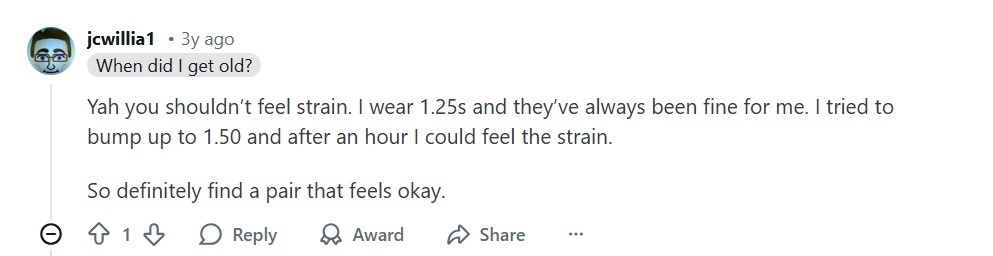
Another Redditor named jcwillia1 chimed in and said they shouldn’t feel that strong. They recommended getting a new pair:
“Yah you shouldn’t feel strain. I wear 1.25s and they’ve always been fine for me. I tried to bump up to 1.50 and after an hour I could feel the strain.
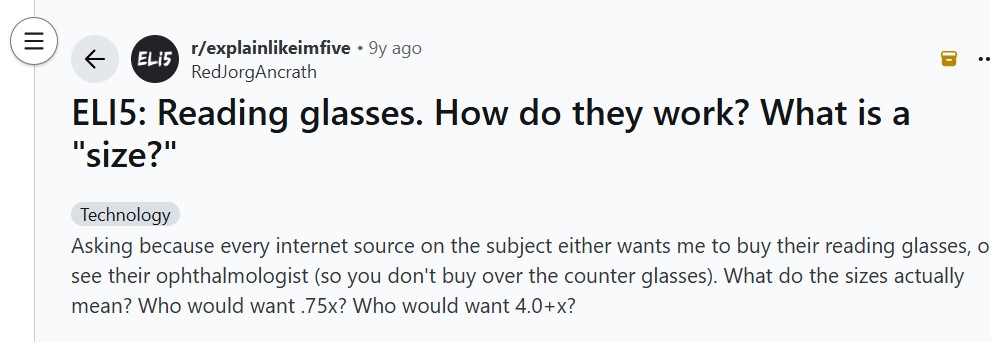
“Reading glasses. How do they work? What is a ‘size?‘
Asking because every internet source on the subject either wants me to buy their reading glasses, or see their ophthalmologist (so you don’t buy over the counter glasses). What do the sizes actually mean? Who would want .75x? Who would want 4.0+x?”
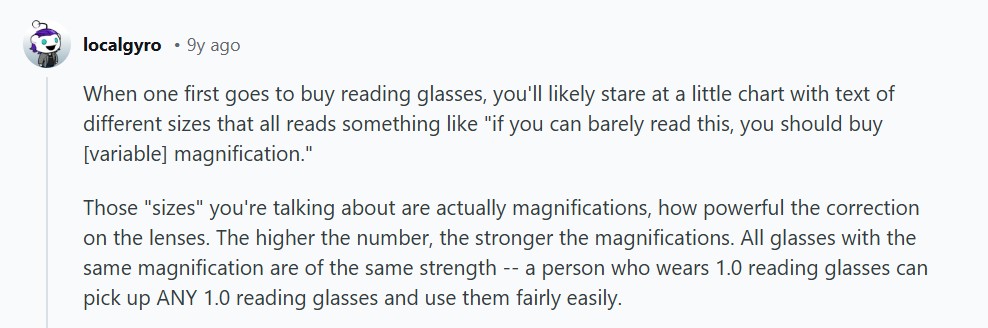
Another Redditor named localgyro helped answer RedJorgAncarth’s question:
“When one first goes to buy reading glasses, you’ll likely stare at a little chart with text of different sizes that all reads something like ‘if you can barely read this, you should buy [variable] magnification.‘
Those ‘sizes’ you’re talking about are actually magnifications, how powerful the correction on the lenses. The higher the number, the stronger the magnifications. All glasses with the same magnification are of the same strength — a person who wears 1.0 reading glasses can pick up ANY 1.0 reading glasses and use them fairly easily.”
From these threads, it’s clear that finding the right reading glasses strength can be tricky. So, how can you determine the strength you need?
How Is Reading Glasses Strength Measured?
Glasses Sitting on a Book With a Smartphone
Reading glasses’ strength is measured in diopters, just like regular prescription glasses. A diopter is a unit of measurement referring to the optical power of a lens. It refers to how close an object needs to be to your eyes for you to be able to see it clearly.
Over-the-counter reading glasses come in strengths starting at +0.25 on the low end, and they go up to +4.00. However, if you need a higher power, you can custom-order reading glasses from an optical shop. Then, you’ll be able to get up to +10.00 or even higher.
Reading glasses strength by age
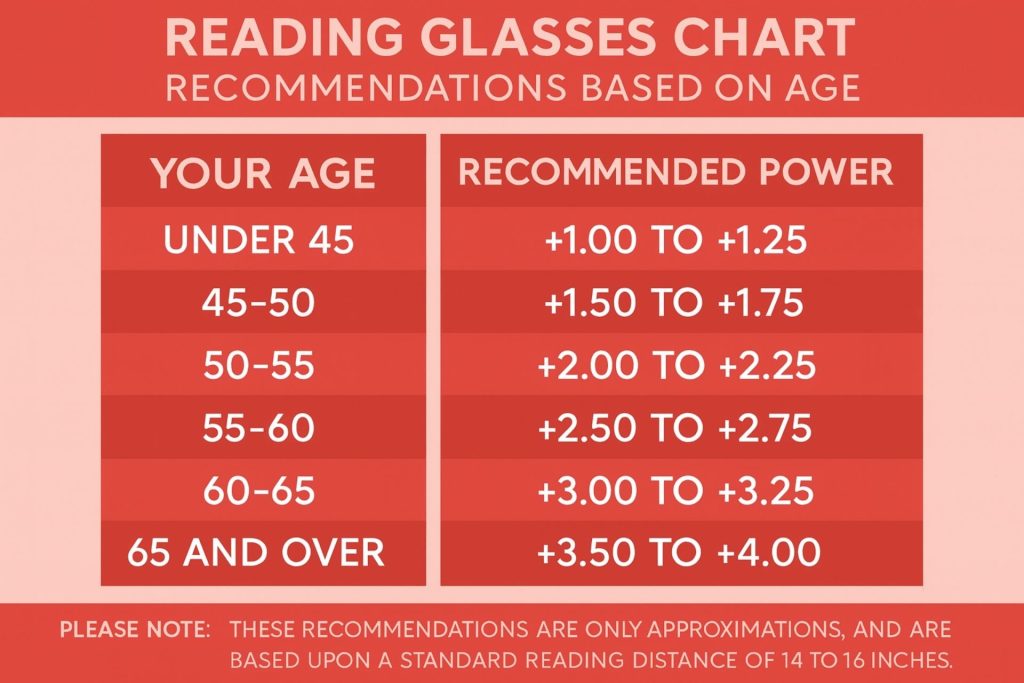
You’ll typically need lower-power reading glasses in your 40s and a higher power as you get older. This will, of course, vary from person to person, but the general rule of thumb is:
Reading Glasses Chart Based on Age
How to Find the Right Reading Glasses Strength
So, what reading glasses strength do you need? There are a couple of at-home methods you can try to determine this.
These methods can give you an approximate idea of which glasses you need. However, it’s always best to verify your reading glasses strength with your eye doctor.
Using a Reading Glasses Strength Chart
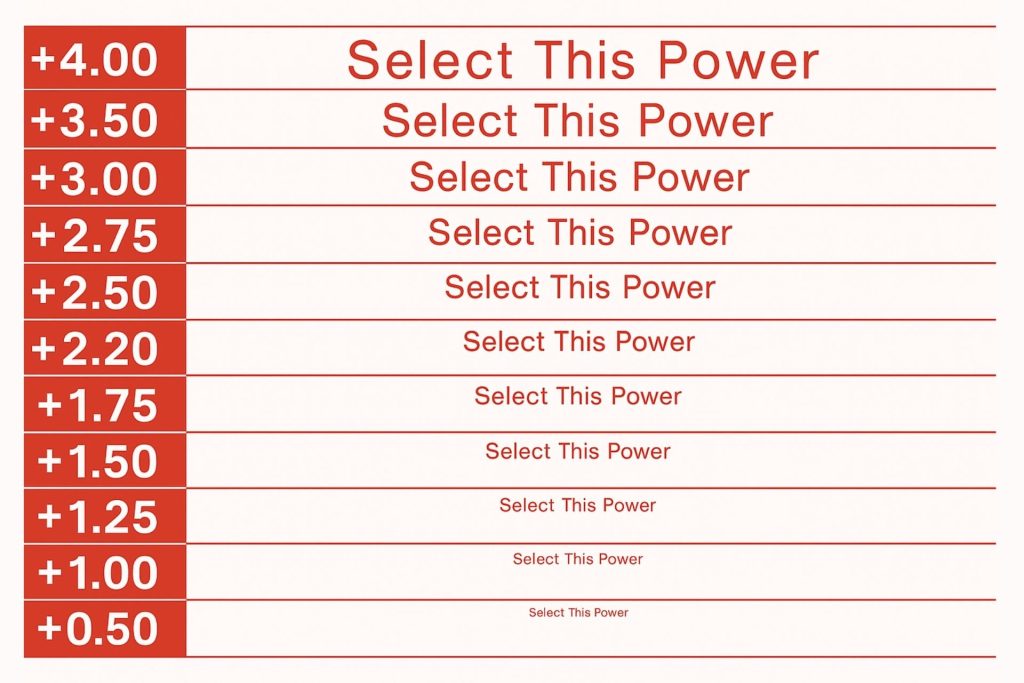
A reading glasses strength chart is one of the best ways to get an idea of the reading glasses power you need. Here’s how to use this chart:
Download and print out the chart. You won’t be able to get an accurate result by reading it off your digital device.
If you’re wearing prescription glasses or have contact lenses in, make sure to remove them.
Hold the chart about 14 inches away from your face. Or, hang it on the wall and step back 14 inches.
Start reading the chart from the top, and work your way down. Stop when you hit a line that you have difficulty reading.
Make note of the diopter number at the end of the line. This is the diopter strength you most likely need.
Reading Glasses Strength Chart
Trial and Error Method
While the reading glasses strength chart is helpful, it isn’t always completely precise. It might be off by an increment or two. And so, when you get your reading glasses, it’s a good idea to try out a few different pairs. If you believe you need reading glasses with +2.50 strength, you might also want to buy pairs in +2.25 and +2.75.
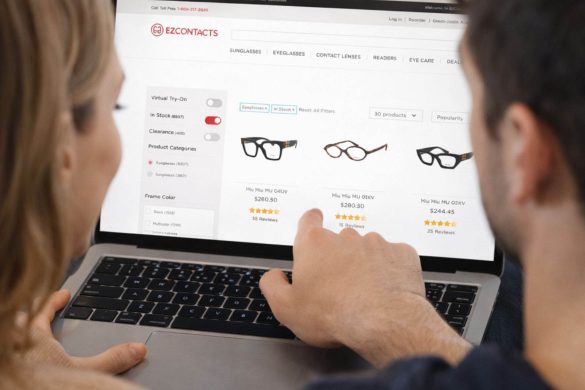
Just make sure that you can return the glasses you’re not going to keep. For instance, if you order your readers on EZContacts, you can return the pairs you don’t want for a full refund within 30 days of ordering.
Try reading with all three of these glasses, and see which ones feel the best. If, for example, you feel comfortable with both the +2.50 and the +2.25, you’ll probably want to go for the +2.25. It’s typically best to go slightly lower with your reading glasses strength. Wearing glasses that are too strong can cause dizziness, eye strain, and headaches.
What If Your Readers Aren’t Working As Well As They Used To?
As time goes by, you may notice text getting blurry again. You may have to start holding reading materials farther away to make them clearer. This is a sign that you may need to go up in reading glasses strength.
Head over to a nearby optical store and test out some new reading glasses. Make sure to bring some reading material with you to test the glasses. Start by going up +0.25 in diopters. If that still looks blurry, go up +0.50, and then continue on until you find the glasses that are right for you.
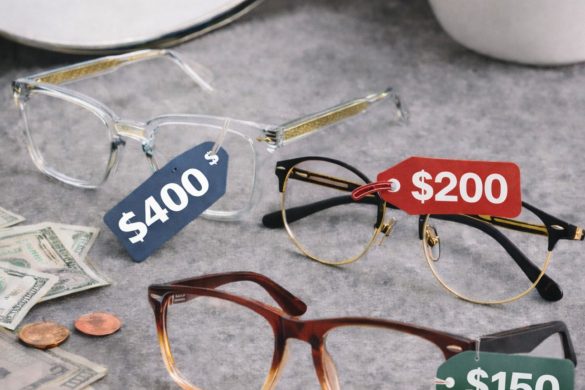
Choosing Your Reading Glasses
Woman Reading Book and Drinking Tea
While these at-home methods are useful, it’s always best to see an optometrist to confirm you have the right reading glass strength. This is particularly true if your eyes need different magnification powers.
For example, one eye may have astigmatism and the other may not, which would mean each lens would need to be different. An optometrist can give you a prescription you can use to order your glasses online.
Presbyopia is a normal part of getting older, and as you age, it’s natural to start needing reading glasses. The good news is there are tons of stylish readers! Pick a pair that fits your style, and get ready to enjoy reading your favorite novels again.
TL;DR
Presbyopia is the age-related condition where our eyes lose the ability to focus on close-up objects. It’s a common condition, and many people begin experiencing it between the ages of 40 and 65.
If you have presbyopia, you may have difficulty reading. Text may look fuzzy, and you may also experience headaches, tiredness, and eye strain. Reading glasses can help mitigate this condition.
Reading glasses’ strength is measured in diopters, which refers to the optical power of the lens. Over-the-counter reading glasses start at +0.25 and go up to +4.00. You can also custom-order reading glasses with strengths up to +10.00 or higher.
Generally, you’ll need lower-strength reading glasses in your 40s, and you’ll need a higher power as you get older. This varies from person to person, though.
To find your reading glasses strength at home, use a reading glasses strength chart. You can use a trial-and-error method.
It’s always a good idea to verify your reading glasses strength with your eye doctor.
I’m a Florida-based lifestyle and content creator who writes about the latest in eyewear, from smart lenses to sustainable frames. I have a Bachelor’s degree from Fairleigh Dickinson University and a Master’s Degree from the University of Edinburgh. I’ve previously worked for Gemini Literary Magazine, Featured, Brainfall, Shareably, and The Feed. When I’m not writing, you’ll find me exploring museums, hiking new trails, or soaking up the sun at the beach (always with great sunglasses, of course).