Have you decided on eyeglasses to correct your myopia (or nearsightedness)? Great! Now, it’s time to decide on your lenses!
Glass or plastic? Polycarbonate, Trivex, or high-index? So many things to consider!
If you go to Reddit for help about this, you’ll find conflicting suggestions. You might even get more confused. That’s what I did recently, and it made me want to get to the bottom of this!
Are high-index lenses really the best for myopia? Let’s find out.
If you hop onto Reddit for help with your lenses, prepare to get opposing opinions.
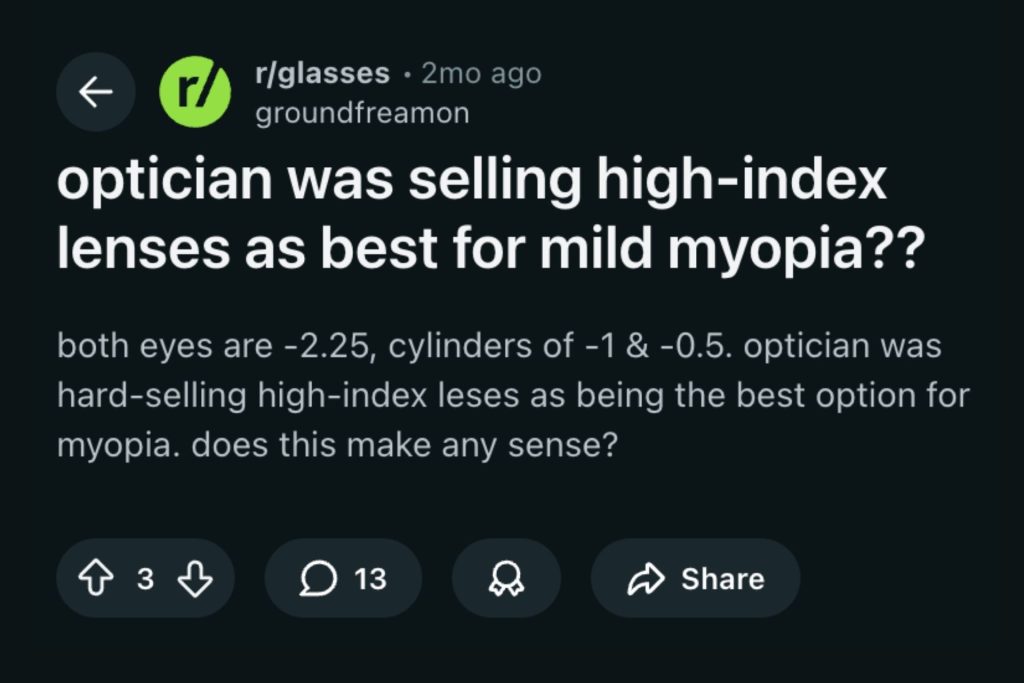
A Redditor named groundfreamon asked a straightforward question: Are high-index lenses best for mild myopia?
High-index lenses are lenses with a higher refractive index. This allows them to bend light more efficiently. Groundfreamon’s optician was upselling him these more expensive lenses, and he wasn’t sure if they were best for him. He wrote:
“Optician was selling high-index lenses as best for mild myopia??
Both eyes are -2.25, cylinders of -1 & -0.5. optician was hard-selling high-index leses as being the best option for myopia. does this make any sense?”
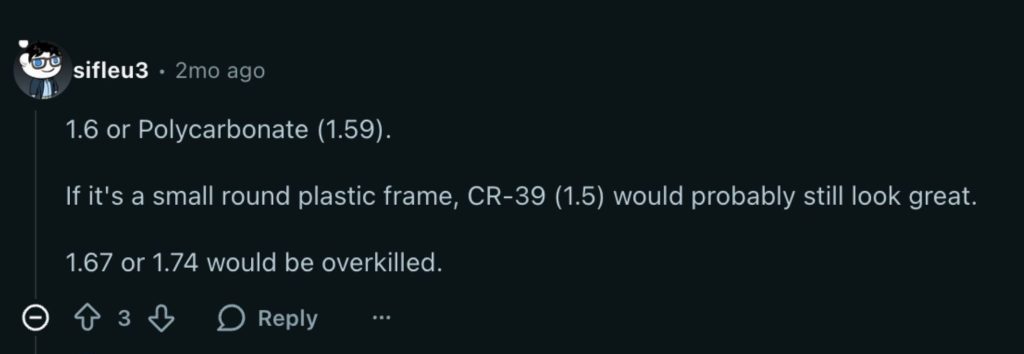
User Sifleu3 suggested polycarbonate and then CR-39, along with a bunch of numbers that laymen might not understand:
“1.6 or Polycarbonate (1.59).
If it’s a small round plastic frame, CR-39 (1.5) would probably still look great.
1.67 or 1.74 would be overkilled.”
This was contradicted by JuJu_Optics, who said that CR-39 is too fragile.
“I would never ever recommended cr39 to anyone because it’s so fragile to scratches.”
Another user named Mahatmatt disputed this and said that polycarbonate is easier to scratch than CR-39.
“Polycarbonate is way softer and easier to scratch than CR39 though.”
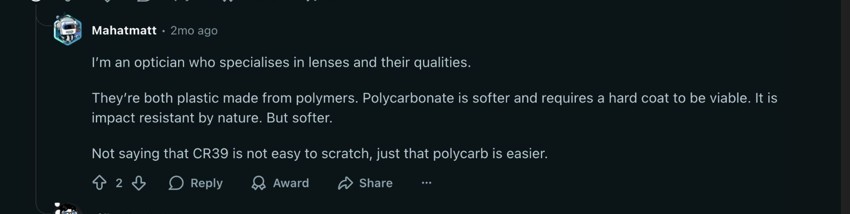
Mahatmatt continued, saying he’s an optician:
“I’m an optician who specialises in lenses and their qualities.
They’re both plastic made from polymers. Polycarbonate is softer and requires a hard coat to be viable. It is impact resistant by nature. But softer.
Not saying that CR39 is not easy to scratch, just that polycarb is easier.”
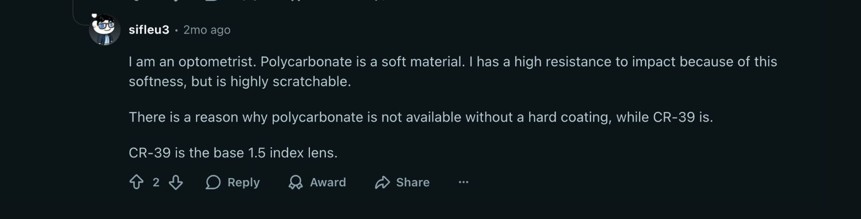
Sifleu3 said he was an optometrist. And by then, it looked like a battle of self-proclaimed expertise.
“I am an optometrist. Polycarbonate is a soft material. I has a high resistance to impact because of this softness, but is highly scratchable.
There is a reason why polycarbonate is not available without a hard coating, while CR-39 is.
CR-39 is the base 1.5 index lens.”
After all that, you’re left with the same question, still unanswered. Which of these lenses, if any, is truly better? To get into that, we need to know more about these lens materials.
The Different Types of Lens Materials
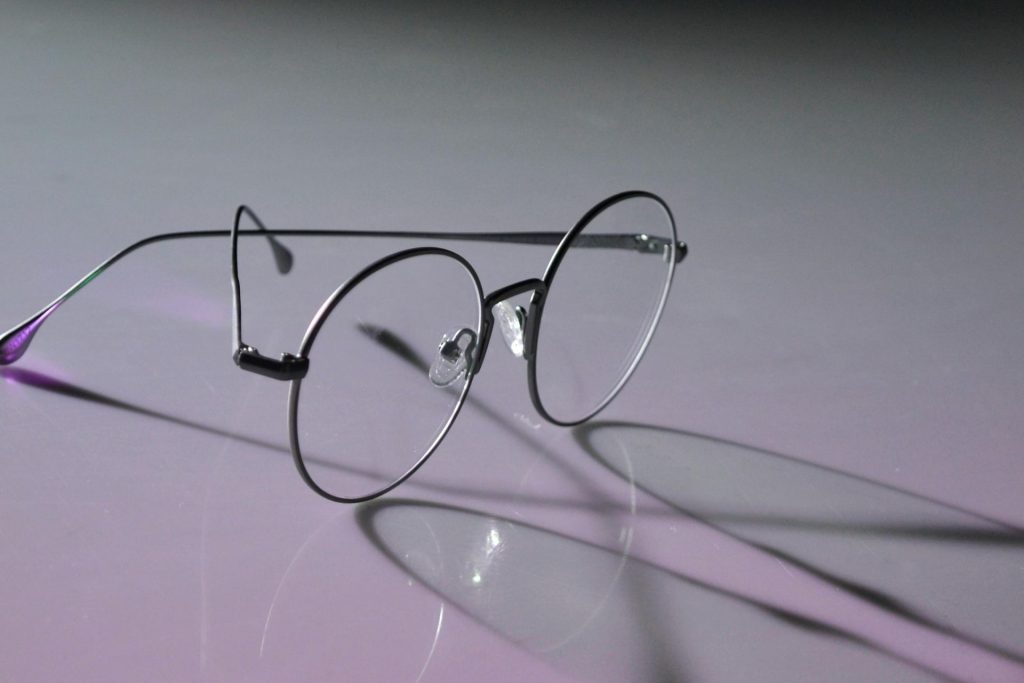
Wire Rimmed Glasses, Reflected on a Surface
Wherever you get your glasses, be it online or in an optical store, you will need to pick your lens materials. And no, glass (the material) is not the default. In fact, fewer people choose glass for their eyeglass lenses. Plastic lenses and their variants, such as high-index lenses, are the more popular choices.
Your lens material affects the clarity (hence, the effectiveness) of your eyeglasses, as well as their aesthetics and durability.
I’m eliminating glass from the discussion right away. It does offer good visual clarity, but the material fares poorly when judged on aesthetics and durability. Glass is heavier and thicker than other materials, and it’s more prone to shattering. At a higher price point than many plastic options, it just doesn’t cut it.
CR-39 Plastic
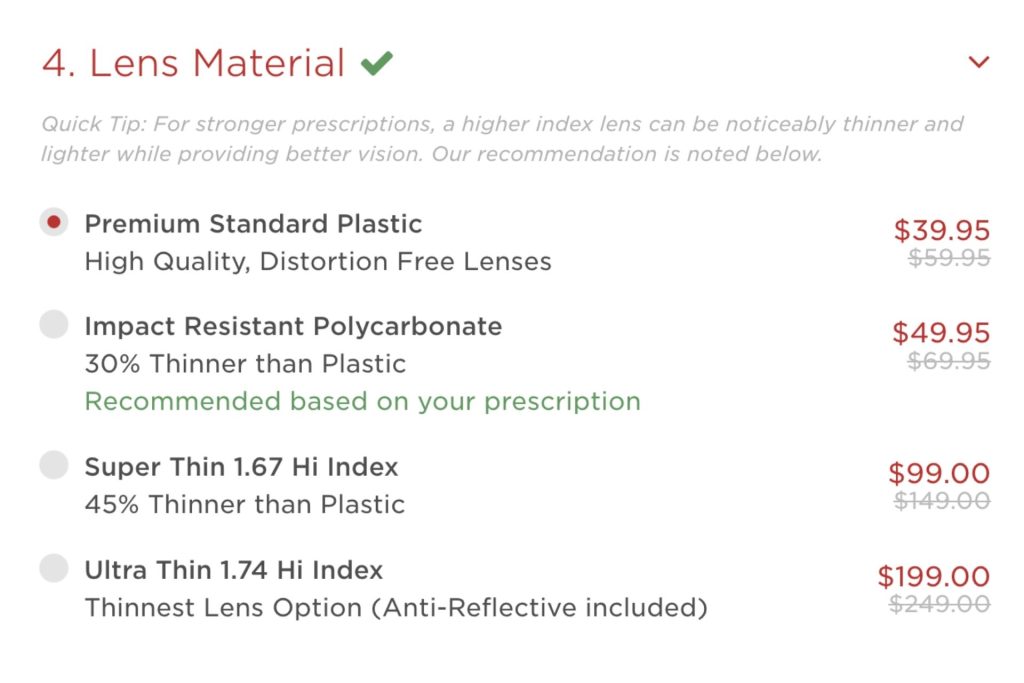
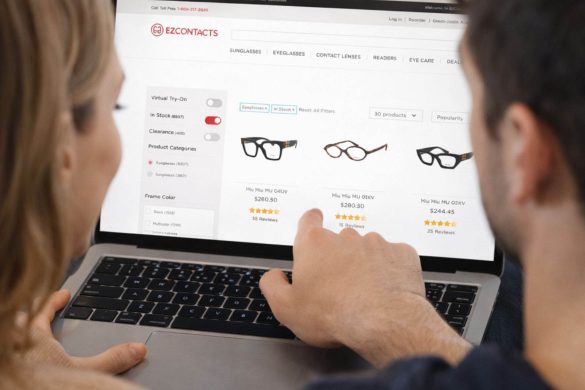
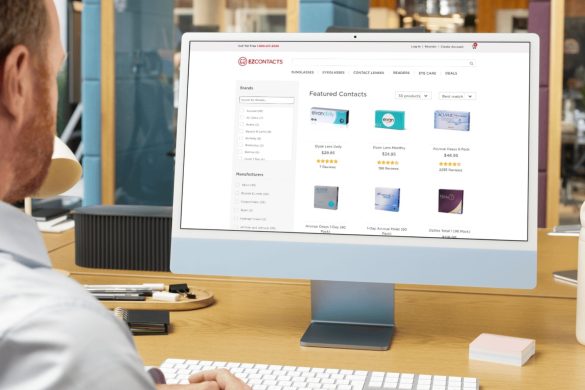
Lens Materials at EZContacts
CR-39 refers to Columbia Resin 39, which is a plastic polymer specially developed in the 1940s for clear optics. CR-39 plastic is your standard plastic lens option, and it’s offered at EZContacts at just $39.95.
It’s the most affordable lens material. You get good visual clarity, and it’s not as heavy as glass.
It is not advisable if you have a stronger prescription, though. CR-39 plastic lenses are suitable only for those with prescriptions up to 5.00 diopters. Anything beyond that and you’ll get thick and clunky lenses.
Likewise, consider that CR-39 plastics have lower scratch resistance compared to other plastic lens options. If you move around a lot, you might want to consider more scratch-resistant plastics.
Polycarbonate
If you’re active or buying eyeglasses for children, polycarbonate plastic is one of the best lens materials to consider. Polycarbonate lenses have superior impact resistance and built-in UV protection. They’re also thinner and lighter than CR-39.
The downside is that polycarbonate lenses offer slightly lower visual clarity. These lenses also get scratched more easily.
Still, many prefer polycarbonate for sports glasses, safety glasses, and toddler eyeglasses. It is only slightly more expensive than CR-39. Polycarbonate lenses are offered at $49.95 at EZContacts.
Trivex
Trivex plastic is very similar to polycarbonate. It is thinner and lighter than CR-39. Likewise, Trivex is also highly impact-resistant and offers 100% UV protection. Unlike polycarbonate, you can expect better visual clarity from Trivex.
High-Index Plastic
This is the most expensive plastic material for eyeglass lenses, ranging from $99 to $199 at EZContacts.
The main advantage of high-index plastic is that it is more efficient in bending light. When used in eyeglasses, you get thinner and lighter lenses even with higher prescriptions. You won’t get “Coke bottle” thick lenses that are typical with strong prescriptions. Visual clarity is superior, too.
The downside is the price. Likewise, it is less impact-resistant than polycarbonate.
Why Do Some Opticians Suggest High-Index Lenses for Myopia?
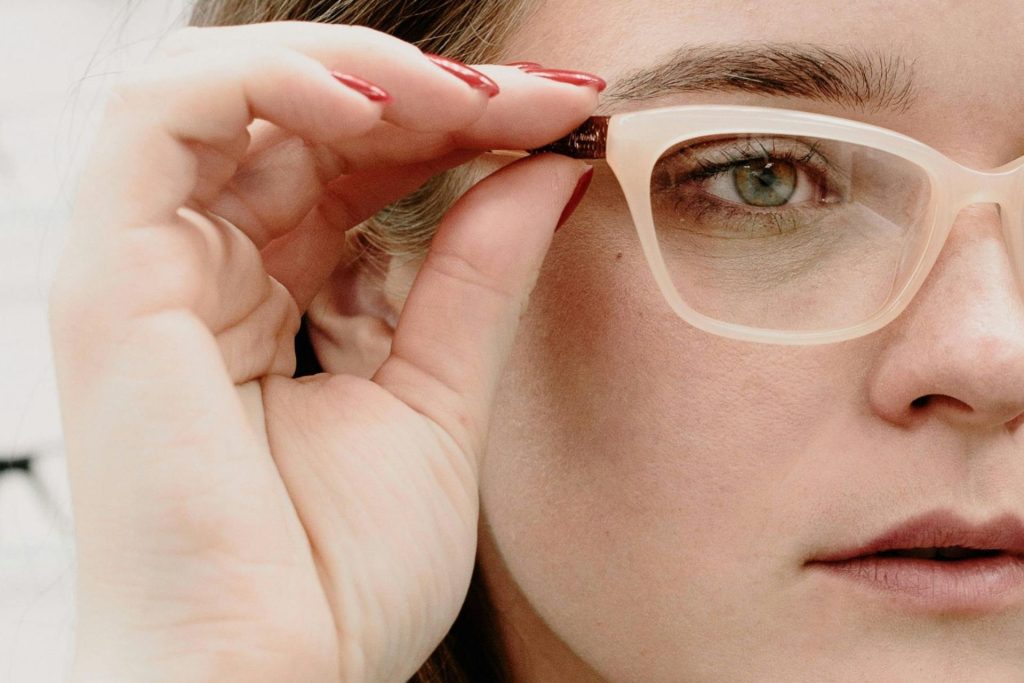
Woman Tries on Glasses in an Optical Center
There are good reasons why opticians would suggest high-index lenses, especially for those with moderate to high myopia.
Thinner and Lighter: The thinness and lighter weight of high-index lenses are their main selling points. Regardless of your prescription strength, you know you’re not going to get stuck with thick, unaesthetic lenses. Likewise, thin lenses lessen visual distortion.
Better Aesthetics: Thin, sleek lenses look better on eyeglasses. You have a wider selection of frames to choose from. You might even opt to go rimless.
Improved Comfort: Because they’re lighter, there’s less weight on your nose and ears. This is a plus in terms of comfort, especially for those who wear their eyeglasses for the whole day.
What You Need to Consider
There are some considerations to keep in mind if you’re thinking about getting high-index lenses:
Cost: High-index lenses are currently the most expensive plastic lens option. The cost is also typically higher for those with stronger prescriptions.
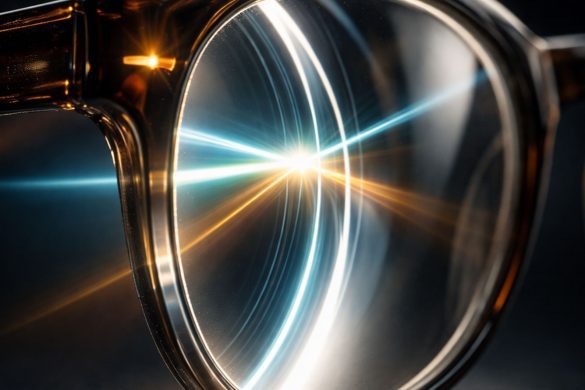
Color Fringing: Because this is a higher refractive index material, light that hits it bends differently. This varies by wavelength of light. Thus, you might see some color fringing or halos when you look at bright objects. This really depends on the quality of the high-index plastic, your prescription strength, and sensitivity.
Durability: Some high-index plastic materials are made slightly less scratch-resistant than CR-39 or polycarbonate. Again, you can fix this by applying a scratch-resistant coating.
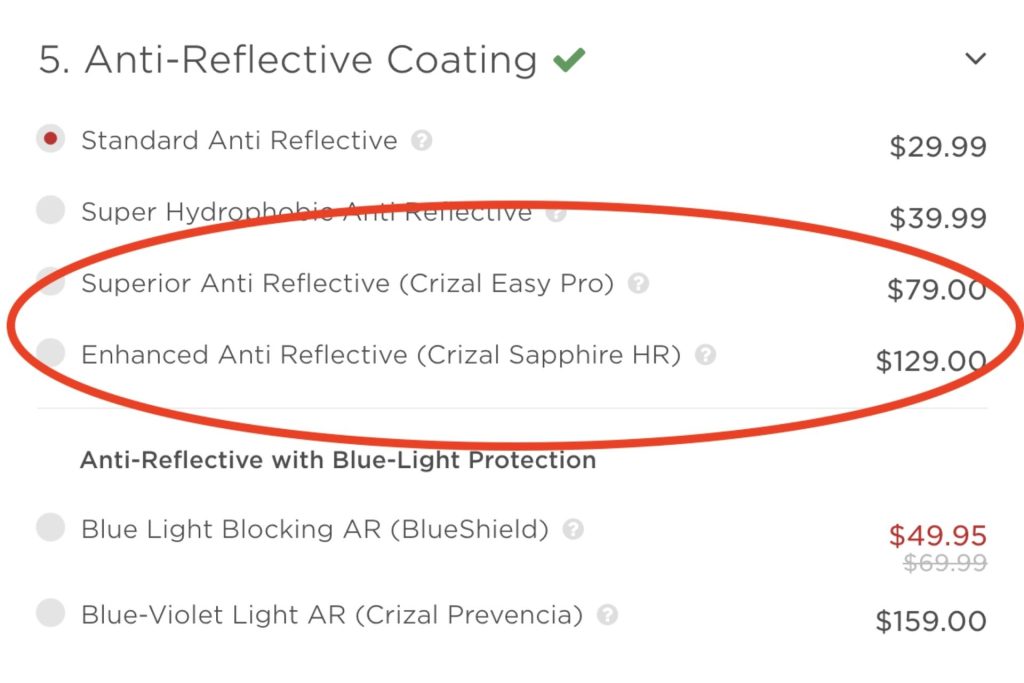
Reflections: High-index lenses can reflect more light compared to lower-index lenses. So, there’s some likelihood that you will see glare when you use these lenses. You can fix this by getting high-index lenses with anti-reflective coating. This is an add-on when you buy your eyeglasses at EZContacts.
Anti-Reflective Coating Options at EZContacts
Over at EZContacts, you can choose either of the Crizal Easy Pro and Crizal Sapphire HR Anti-Reflective coating add-ons, which come with improved scratch-resistance.
Choosing the Right Lens for Your Myopia
There is no one best lens for myopia. It really depends on your visual correction requirements and personal preferences. Here are a few things to consider:
Prescription Strength: If your myopia is mild, you won’t see that much of a difference in the thickness of high-index lenses and other cheaper plastic lens materials. Lens thickness only becomes more pronounced from 3.00 diopters and above.
Frame Style: Some frame styles require thinner lenses. If your preferred eyeglasses are rimless or have thin rims, then you’ll need thin lenses.
Lifestyle: If you lead an active lifestyle, then lenses with higher impact resistance, such as polycarbonate and Trivex, are better for you.
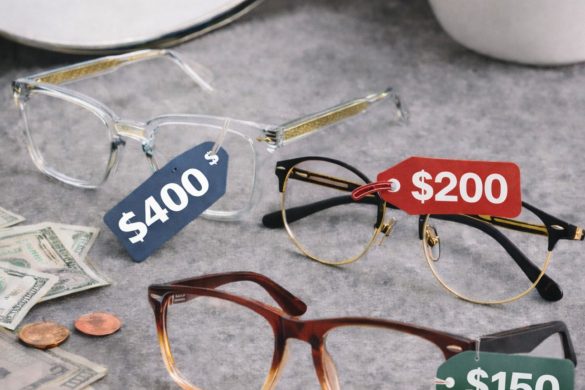
Budget: High-index lenses are significantly more expensive than other plastic lens options. So, carefully weigh the pros and cons of the different plastic lenses, and then ready your wallet.
Are High-Index Lenses Always the Best?
Let’s break it all down:
For those with strong prescriptions: High-index lenses are practical choices in terms of visual clarity, comfort, and aesthetics. Consider them as investments. If you can, get these lenses with anti-reflective and scratch-resistant coatings as add-ons.
For those with mild myopia: You will likely not notice the difference between high-index lenses and their cheaper plastic options. Consider CR-39, polycarbonate, and Trivex lenses instead.
For those with an active lifestyle: Impact resistance should be the top priority. Choose polycarbonate or Trivex lenses instead.
For those on a tight budget: CR-39 lenses are good quality options.
So, back to Redditor groundfreamon’s question: Are high-index lenses the best for his myopia? Based on his prescription, no, they’re not. The OP can get comparable visual clarity and aesthetic quality from cheaper plastic lens materials. His optician might just be upselling more expensive, albeit unnecessary, lenses.
TL;DR
If you have myopia, you have many different choices for lens materials. This includes high-index lenses.
Redditor Groundfreamon had questions about the best lens material for him. To try to resolve Groundfreamon’s high-index lens material predicament, I examined the different plastic lens material options: CR-39 plastic, polycarbonate, Trivex, and high-index plastic.
CR-39 plastic is the cheapest option that offers good visual clarity. However, these lenses can be too thick and heavy for those with strong prescriptions.
Polycarbonate and Trivex are great options if you want light and impact-resistant lenses. These lenses are only slightly more expensive than CR-39.
High-index plastic provides light and thin lenses, regardless of prescription strength. They are significantly more expensive. They may also need additional anti-reflective and anti-scratch coating add-ons.
The best lens material for you depends on your prescription strength, aesthetic preferences, and budget.
I cover eyewear news, emerging trends, and industry developments. I have a Bachelor’s degree in Economics, and I’ve worked for Yapak Travel Online, Great Lakes Family Magazine, Echoes Magazine, and R & G Publication. I’m a PADI Master Scuba Diver, and when I’m not writing, you’ll typically find me below the sea.