Glare is not the same as reflection. Reflection is light bouncing off a surface. Glare is your visual experience when you see light being reflected, which can typically include discomfort and loss of clarity. In this way, glare is often caused by reflection.
Anti-glare coating and anti-reflective coating are related, but they’re technically not the same. Anti-reflective coating uses optical interference to reduce reflection. On the other hand, a traditional anti-glare treatment scatters light to reduce glare.
Because modern anti-reflective (AR) coating (the one used for eyeglasses) combines these two approaches, the two terms have become interchangeable. In fact, when you ask for anti-glare coating for your eyeglasses, you are given AR coating options.
Keep this in mind as you read on and when you order your eyeglasses.
Benefits of Anti-Glare Coating
Anti-glare coatings can help reduce eye strain and fatigue. The coating also removes distracting reflections that can interfere with photos and videos.
In addition, your visual clarity improves dramatically when you use an anti-glare coating, especially in low-light conditions. The increased light transmission means you see more contrast and detail.
Woman Wearing Eyeglasses While Working on Her Desk
The aesthetic benefits shouldn’t be overlooked either. Anti-glare lenses make your lenses look nearly invisible in most lighting conditions. When people look at you, they see your eyes, not your lenses.
Computer and Digital Screen Use
For computer users, an anti-glare coating is one of the best solutions to reduce digital eye strain. The coating reduces computer vision syndrome symptoms, such as headaches, dry eyes, and blurred vision. Likewise, in recent studies, people claim significantly less fatigue at the end of their workday when using anti-glare coated lenses.
The benefits from anti-glare coating are so apparent that the American Optometric Association specifically recommends anti-glare coatings for anyone spending more than two hours daily on digital devices.
Anti-glare coating can work alongside blue light filtering, so you get the best digital screen viewing experience.
Night Driving Safety
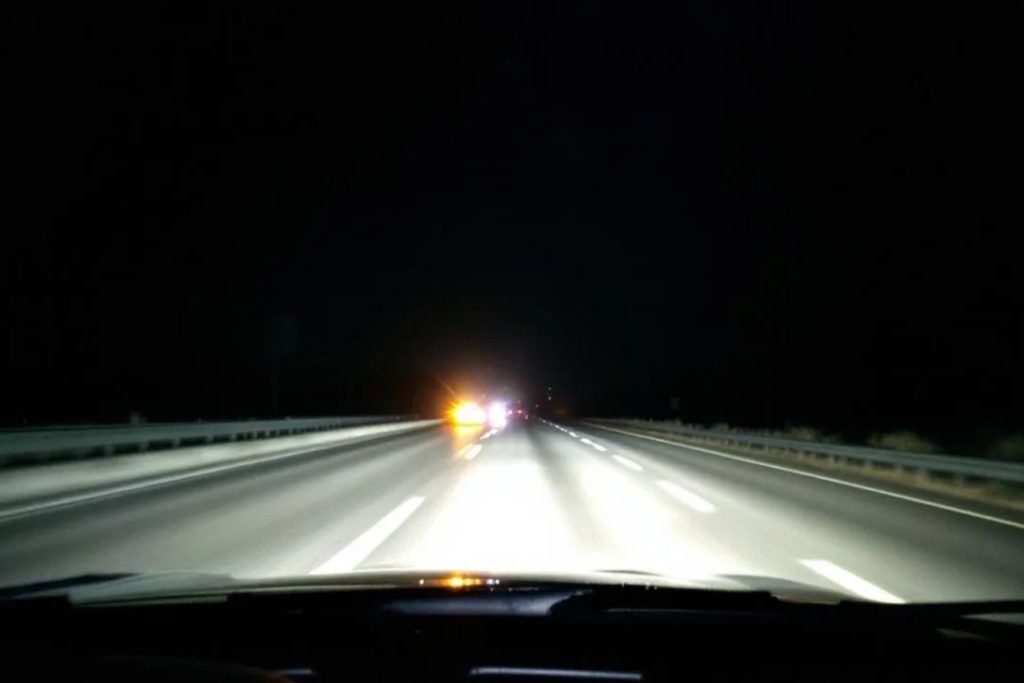
Night driving has unique challenges that make anti-glare coating particularly advantageous. The coating reduces dangerous glare from oncoming headlights, streetlights, and LED lights. This can improve your nighttime driving comfort and safety.
For drivers with astigmatism, the benefits are especially dramatic. Uncorrected astigmatism causes halos and starbursts around bright lights. Anti-reflective lenses help minimize these visual distortions, giving you a clearer perception of the road ahead.
Also, consider that better visual contrast through anti-glare coating can improve your reaction time in low-light conditions. When more light reaches your eyes instead of reflecting off your lens surface, you can better distinguish between objects, pedestrians, and road hazards in challenging lighting situations.
Nighttime Driving With Oncoming Traffic
Note that some night vision driving glasses come with yellow-tinted lenses that are supposed to reduce glare by filtering out light wavelengths. These may not be as effective as clear lenses with anti-glare coating. The yellow-tinting can decrease overall light transmission, which could potentially make it harder to see in low-light conditions.
Potential Drawbacks to Consider
Even with the proven benefits of anti-glare coating, there are a few considerations to think about.
Foremost here is the price tag. The cost of anti-glare coating can stop some people from ordering it as an add-on. Anti-reflective/anti-glare coating adds $40 to $150 to your lens price, depending on the quality and brand of the coating you choose.
Lower-quality anti-glare coatings may help. However, note that they may also increase your maintenance requirements in the long run. Cheaper coatings can be more susceptible to smudges and fingerprints. This means more lens cleaning work for you. Some people say this is a major reason why they think anti-glare coating isn’t worth it.
The durability of anti-glare coating varies significantly depending on the manufacturer and the price point. Poor-quality options may wear off after just two to three years. This premature deterioration often appears as cloudy or scratched areas that can’t be cleaned away. You will need to get the coating reapplied.
Likewise, some people notice a slight color tint under certain lighting conditions, particularly with fluorescent or LED lights. While modern higher-quality coatings minimize this effect, the subtle green or blue reflection can be noticeable to sensitive individuals, especially when looking at their glasses from the side.
So, Do You Need Anti-Glare Coating?
Yes, definitely! Modern lifestyles involve using digital screens for several hours a day. You use them at work, play, and even for basic communication and navigation. It’s nearly impossible to escape them! Thus, protecting your eyes is your best course of action. In the same way, anti-glare coating is an extra level of protection if you find yourself on the road at night often.
How Much Should You Pay for Anti-Glare Coating?
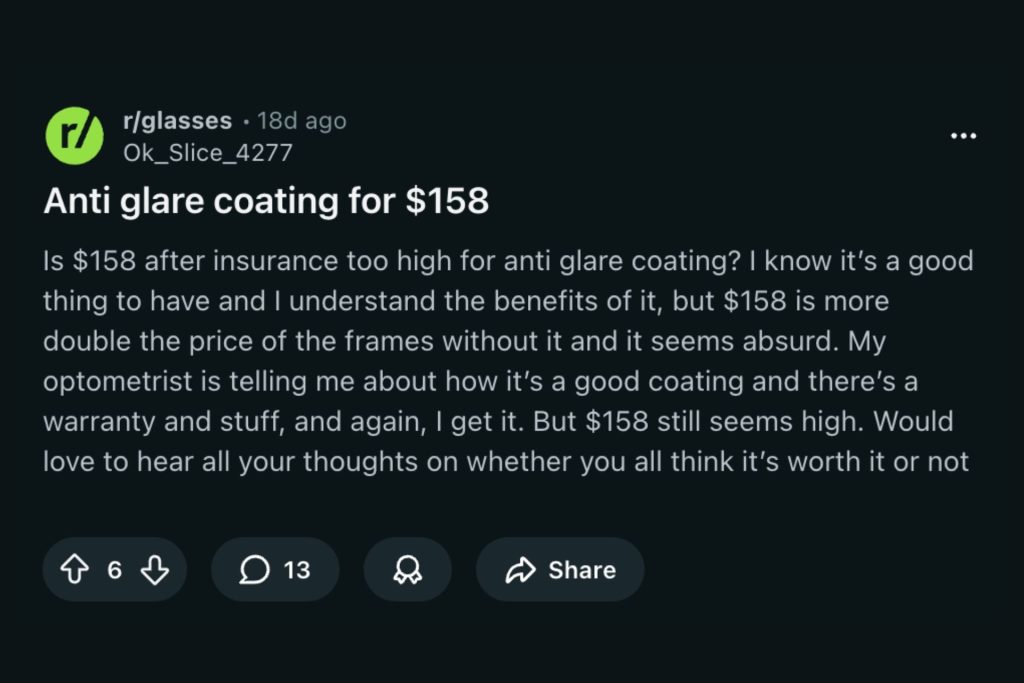
Over on Reddit, there’s a debate going on about how much you should pay for anti-glare coating for glasses. It began with a question from Reddit user Ok_Slice_4277. She claimed to already be sold on the benefits of anti-glare coating. Price seemed to be the only remaining barrier.
She asked:
“Is $158 after insurance too high for anti glare coating? ….$158 is more than double the price of the frames without it and it seems absurd.”
Many of the Reddit users who chimed in agreed that $158 is steep, especially considering that this is after insurance.
User jearam said:
“My company’s most expensive AR is $139 before insurance.”
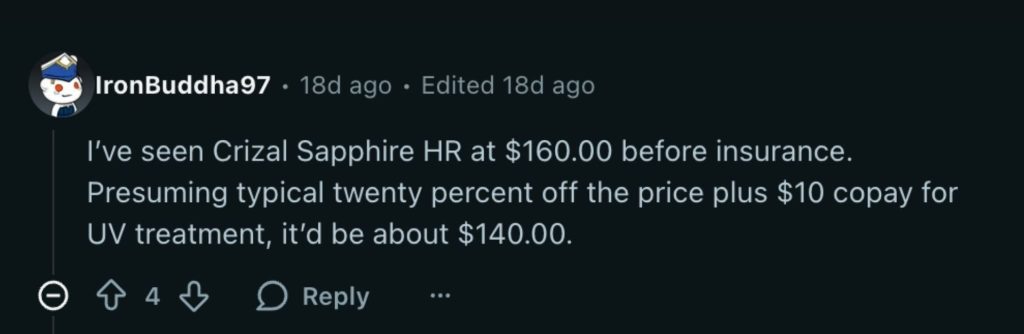
IronBuddha97, on the other hand, shared his experience. He said:
“I’ve seen Crizal Sapphire HR at $160.00 before insurance. Presuming typical twenty percent off the price plus $10 copay for UV treatment, it’d be about $140.”
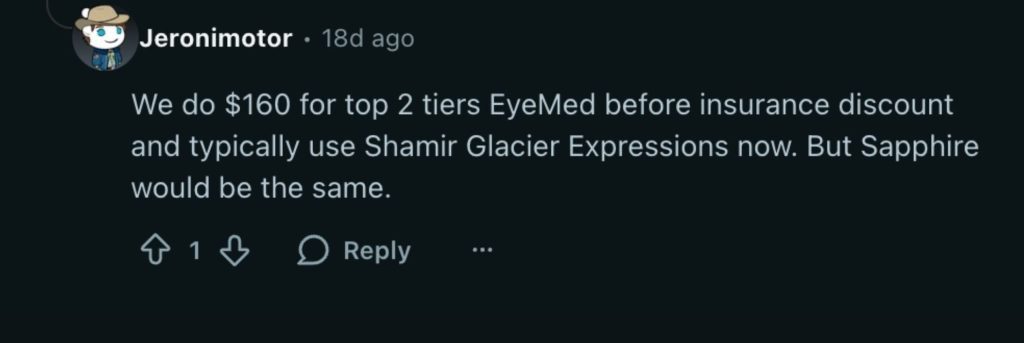
User Jeronimotor responded to this with his own pricing claims:
“We do $160 for top 2 EyeMed before insurance discount and typically use Shamir Glacier Expressions now. But Sapphire would be the same.”
Compared to our pricing at EZContacts, the price mentioned by Reddit user Ok_Slice_4277 after insurance does seem a bit steep.
Anti-Reflective Coating Options
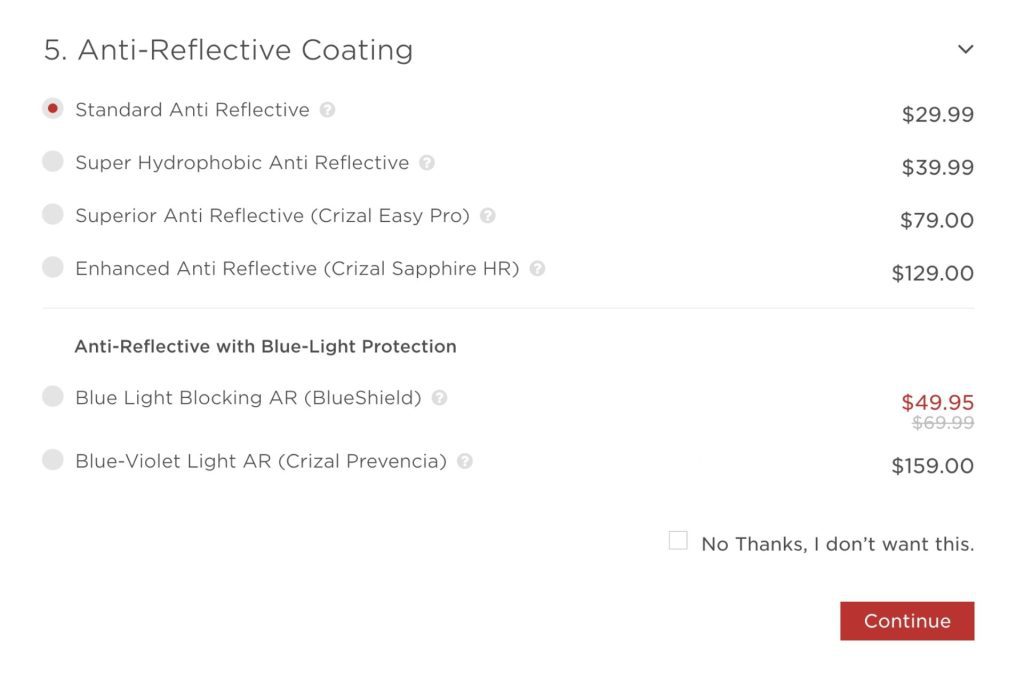
When you add anti-reflective coating to your eyewear purchase at EZContacts, your more expensive option is Crizal Sapphire HR for $129. If you want blue light filtering with that, you can get a top-tier coating for $159.
All this is without insurance, so yes, the price offered to Ok_Slice_4277 is too high. The user should still get an anti-glare coating. However, she might be better off buying her eyewear elsewhere.
Make the Most of Your Anti-Glare Coating
Good quality anti-glare coating can last anywhere from three to five years, and it is a worthy investment. That is, as long as you take care of it. Here are some tips to try:
Always clean your lenses with water, mild soap, and a microfiber cloth. Rinse first to make sure there’s no leftover grit or dirt that can scratch your lenses. Stay away from abrasive products, such as alcohol and paper towels.
Use gentle motions when cleaning your lens. Don’t rub your lenses too hard.
Keep your eyeglasses away from extreme temperatures, especially heat.
Stay away from chemicals that can degrade the coating, including perfume, hairspray, household cleaners, and alcohol.
Always store your glasses in their protective case.
TL;DR
Anti-glare and anti-reflective are used interchangeably when it comes to eyeglasses.
There are research-supported benefits of anti-glare coating, including reduced eye strain from digital screen use and better vision clarity during night drives.
Price is a major drawback when it comes to anti-glare coating.
Likewise, cheaper anti-glare coating may be more susceptible to smudges and require more cleaning in the long run.
On Reddit, there was a debate about how much to pay for anti-glare coating for glasses. One Reddit user asked if $158 was too high a price to pay. It was concluded that this price is higher than average. You can find fairer prices at reputable eyewear providers, such as EZContacts.
Anti-glare coating is a beneficial add-on for your glasses. Make your anti-glare coating last longer through proper lens cleaning and storing.
I cover eyewear news, emerging trends, and industry developments. I have a Bachelor’s degree in Economics, and I’ve worked for Yapak Travel Online, Great Lakes Family Magazine, Echoes Magazine, and R & G Publication. I’m a PADI Master Scuba Diver, and when I’m not writing, you’ll typically find me below the sea.