
What do toric contact lenses and donuts have to do with each other? More than you may think!
But let’s back up. Before we get into that, you may be asking, ‘Wait, what does toric mean exactly? And what are toric contact lenses?’
That’s what we’re here to discuss. I’ll answer those questions and more in this guide!
What Are Toric Contacts?

Toric comes from the word ‘torus,’ which refers to a donut-shaped geometric object. If you cut off a slice of the side of the donut, that’s what a toric lens is shaped like.
Toric lenses are designed specially to correct astigmatism. Astigmatism is a very common condition; about one in three people has it to some degree.
People with astigmatism have corneas that are football-shaped. This shape refracts light unequally in different directions, which leads to vision distortion. Toric lenses correct for this by having different focusing powers in different parts of the contact. This helps match the unique curvature of astigmatic eyes.
Because light is refracted unequally, regular spherical contacts don’t work for people with astigmatism. Spherical lenses focus light equally from all directions, which can cause blurry or distorted vision in astigmatic eyes.
Toric lenses are available in both soft lenses and hard, rigid gas-permeable lenses (RGP). Soft contacts are generally more common and comfortable. Hard contacts can take some getting used to, but they can provide sharper vision.
Toric Lens Design
Spherical contacts have uniform curvature in all directions, and they can be rotated in any direction without affecting vision. However, this isn’t the case for toric lenses. Many toric contacts have a ‘prism ballast’ design. This features a thicker bottom, which prevents the contacts from rotating and misaligning in your eyes.
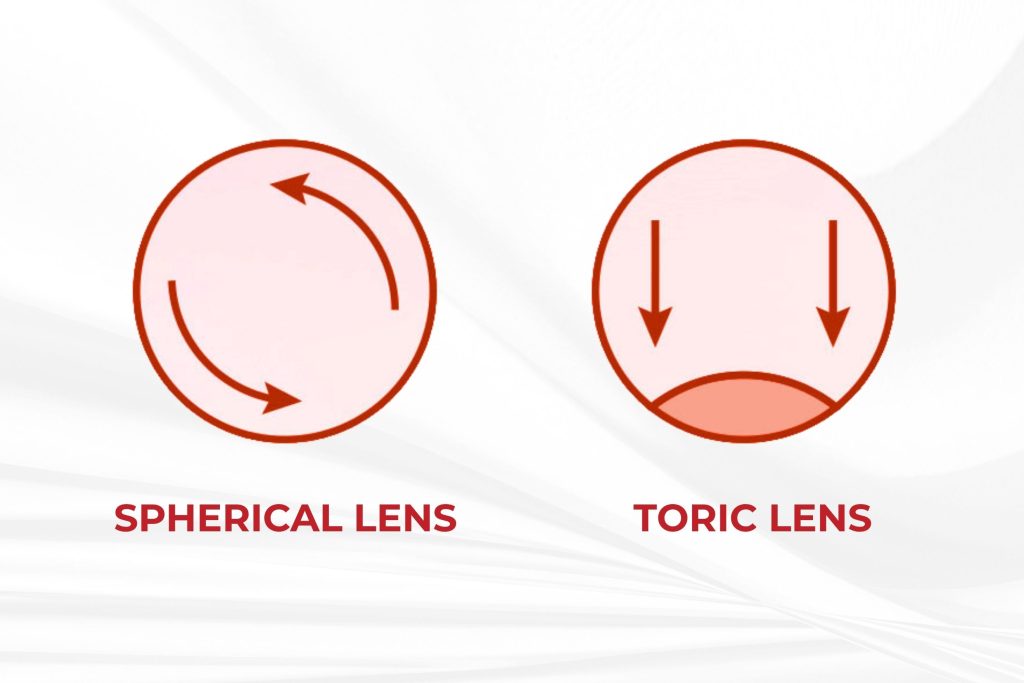
Depending on the brand, there may also be other stabilization techniques used in the contacts. Some brands use a ‘thin zone design.’ This involves making the lens thinner at the top and bottom. On these contacts, the thicker zone is near the nasal and temporal areas of the contact.
Some brands also use blink stabilization to keep your contacts correctly aligned. These contacts feature a thin lens at the bottom, which interacts with your lower eyelid. There are also four ‘active zones’ that realign the contact as you blink.
Understanding Your Toric Contact Lens Prescription
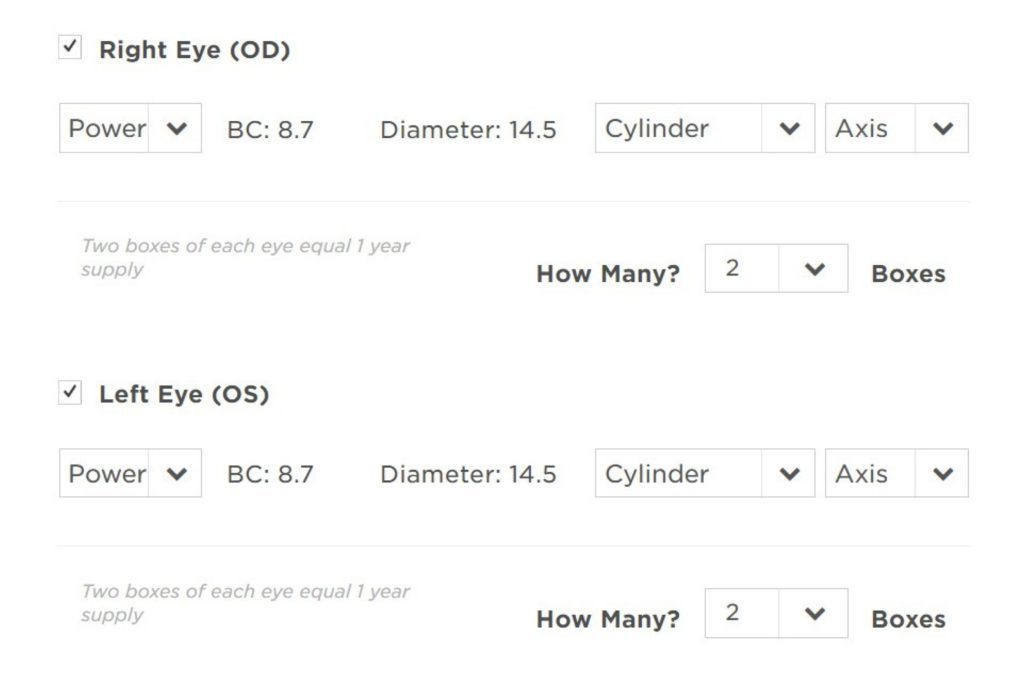
A toric contact lens prescription is more complex than a regular prescription because it includes extra measurements to correct astigmatism. On your prescription for toric lenses, you’ll see numbers in the “SPH/PWR,” “CYL,” and “Axis” columns. Here’s what these terms mean:
- Sphere/Power (SPH/PWR): This refers to the strength needed to correct your nearsightedness or farsightedness. Nearsighted prescriptions have a plus sign in front of the number. Farsighted prescriptions have a minus sign in front of the number.
- Cylinder (CYL): This is a number that’s measured in diopters. It indicates the amount of astigmatism you have and what power is needed to correct the curvature of your cornea.
- Axis: This number shows the orientation and location of the astigmatism in your eyes. It is measured in degrees from 0 to 180.
You’ll need all three of these numbers when you’re ordering contacts for astigmatism online.
How To Put in Toric Contact Lenses
With spherical contact lenses, putting them in is simple since every side is the same. However, it can be trickier with toric lenses.
One of the unique things about toric contacts is that they have markings showing orientation. Depending on your prescription and the brand you use, these marks may be at the 3 o’clock, 6 o’clock, or 9 o’clock position. They could also be dots, lines, or letters.
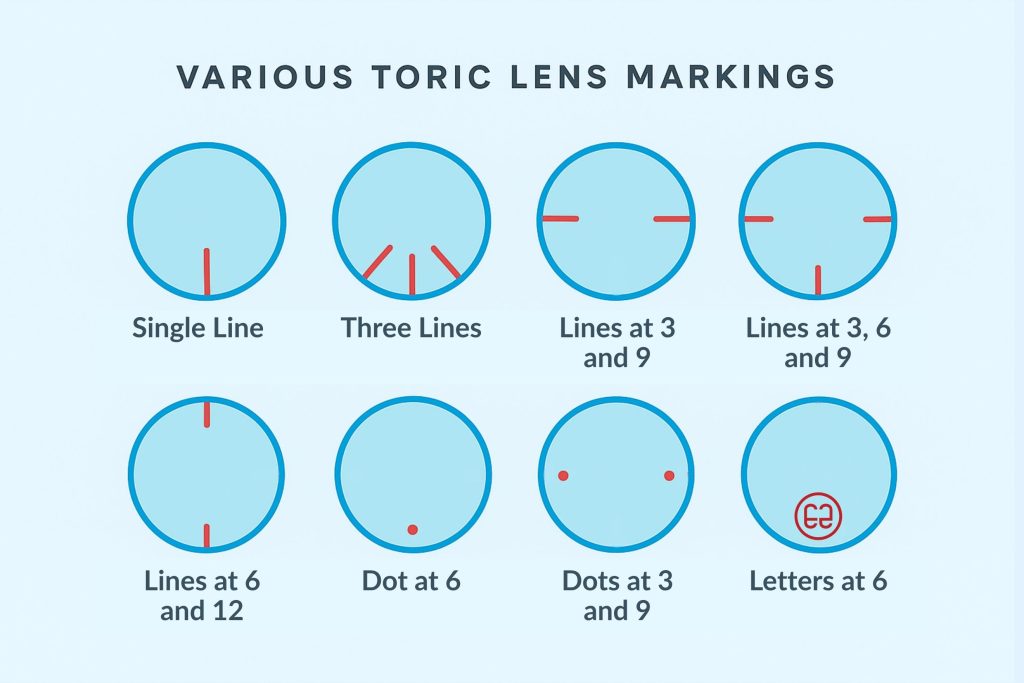
The markings are difficult to see, and they’re there to help your optometrist as they fit your contacts. You can also use them when putting in your contacts, though.
Hold your contact lens up to a light, and you should be able to see the markings. If you’re having trouble seeing them, you can also orient the lens by making sure the weighted or thicker side is at the bottom of the contact.
To insert the contact lens, gently lift your eyelid and look directly into the mirror. Because of the bottom-heavy nature of the lens, it could be helpful to move the lens in an upward direction as you’re inserting it into your eye.
Once the contact is in your eye, release your eyelid, and blink a few times to let the lens settle. It may take a moment for the toric lens to rotate into its final position. If it feels off or your vision is blurry, the lens may have shifted out of the correct position. Remove the contact and try inserting it again.
As you’re putting the contact in, it’s important not to fold in half, like you would with a cylindrical contact. Folding a toric contact in half may cause it to rip along the ballast.
Top Toric Contact Lens Brands
Want to give toric contact lenses a try? Here are some of the top options available! There are options here for daily, monthly, and biweekly contacts. These contacts all have positive reviews from verified buyers.
Acuvue Oasys for Astigmatism: 4.6/5 Stars from 430+ Users
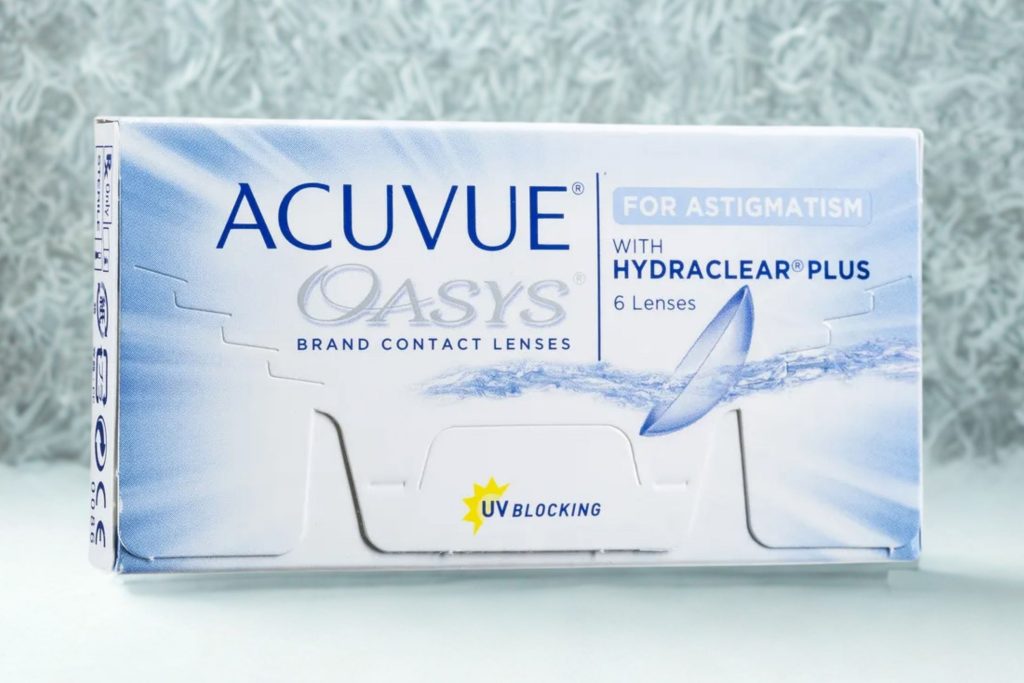
ACUVUE OASYS for Astigmatism biweekly contacts are lightweight, and they offer exceptional comfort and breathability. They also offer improved visual clarity and UV blocking. Some of the downsides, though, include a potential for dryness and tearing.
Many reviewers like ACUVUE OASYS. Maribel E. says the contacts were great for her daughter:
“I was a bit nervous to order online but I’m so happy I order from ezcontacts everything was perfect and wow arrived super fast! My daughter was happy to be able to see clear again. Thanks you.”
However, there were a few critiques. Leslie S. gave the contacts 3 stars and says:
“The Acuvue Oasys contacts are working so well for my astigmatism. Very comfortable! Easy to insert and remove but there is an issue while you’re cleaning it etc, that because of their shape, they tend to fold in half.”
Precision1 for Astigmatism: 4.7/5 Stars from 40+ Users
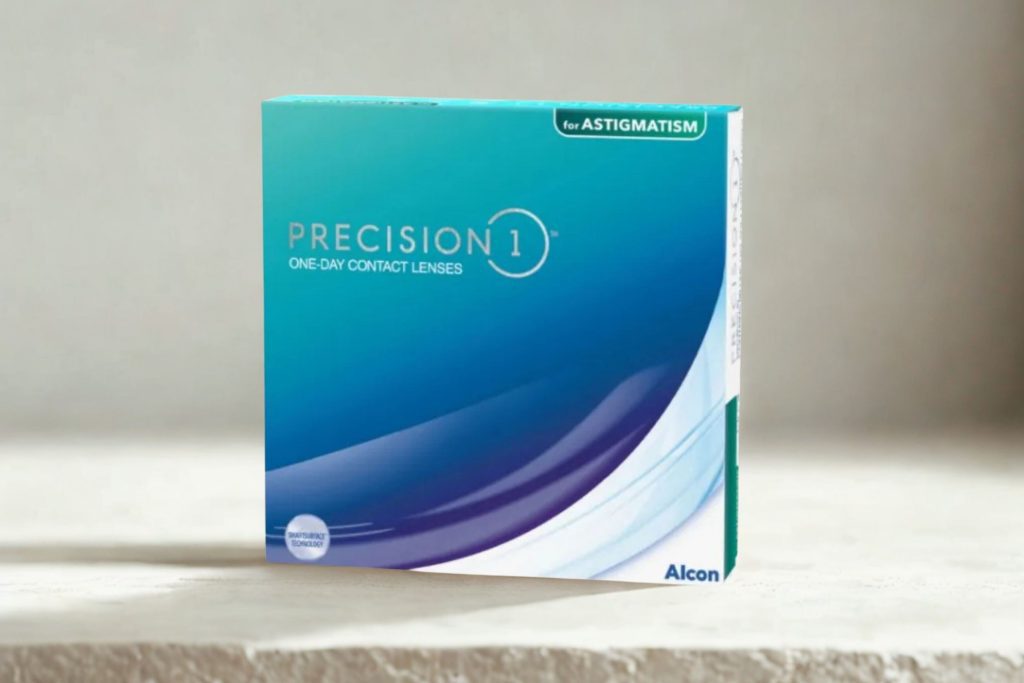
If you’re looking for daily disposable contacts for astigmatism, Precision1 is a good choice. They feature Alcon’s proprietary SMARTSURFACE® Technology. This creates a micro-thin moisture layer on the surface of the lens.
Because of that, the surface layer contains more than 80% water, and the core has about 51% water. This technology keeps the contacts moist and comfortable all day long.
Verified users praise Precision1’s comfort. Carissa B. almost forgot she had the contacts in:
“All day comfort . These contact are so comfortable I forget that I am wearing them.”
Some reviewers said the contacts can be hard to remove, but Ann A. gave a good tip to help:
“I like these lenses (regular and toric) very much. I am returning to contacts after about 4 years not wearing them, so Precision1 is new to me. I’ve read some people’s reviews saying they can be hard to remove, and I just want to say that if your fingers are completely dry, they’re not harder to remove than other lenses.”
Air Optix Hydraglyde for Astigmatism: 4.8/5 Stars from 160+ Users
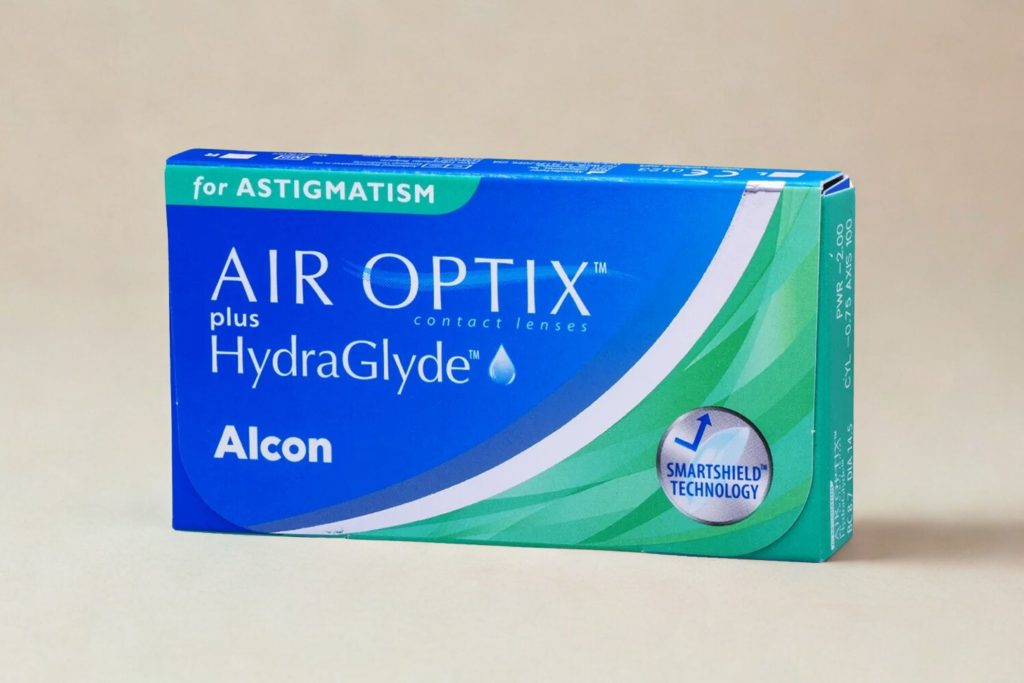
Air Optix Plus Hydraglade monthly contacts are a good choice for dry eyes. The HydraGlyde Moisture Matrix technology keeps lenses comfortable for extended wear. They also have SmartShield Technology that helps resist deposits and allergens.
Some users say there can be a bit of an adjustment period, though. The contacts also don’t have UV blocking.
Kathleen S. thought these contacts were great:
“I love these lenses! They provide comfort for my dry eyes and have a nice stable feel on my eyes. Great price also!”
Shelbey E. didn’t like them as much, though:
“I have dry eyes especially with contacts. I thought this brand was supposed to help. Got dry eyes immediately after putting them in.”
Biofinity Toric: 4.7/5 Stars from 275+ Users
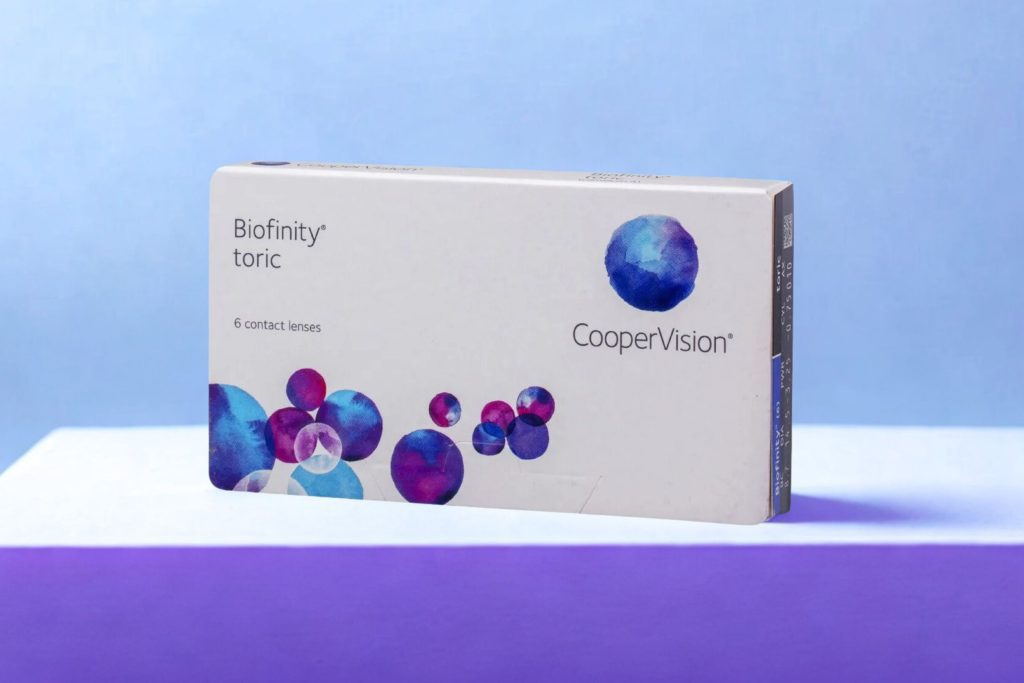
Biofinity Toric lenses are monthly contacts that are praised for their high oxygen permeability. This keeps eyes healthy and comfortable. They also feature CooperVision’s AquaForm Technology, which keeps the contacts moist.
However, one of the downsides of these contacts is that they’re prone to tearing. They also don’t offer UV blocking.
DeAnn St L. likes these contacts:
“The Biofinity Toric was recommended by my eye doctor and I like them. They do not irritate or dry out my eyes and they feel very comfortable all day. I can even sleep in them overnight. They work well for me.”
However, Gerry L. encountered problems with tearing:
“I have had sporadic problems with tearing with this brand, and it has grown worse. I ordered two boxes in March, and now I have only one lens left. The one I am wearing now is slightly torn around the edge but still wearable. I have changed the cleaning products and storage, which has not helped. I will be checking on alternative brands.”
Bausch & Lomb ULTRA for Astigmatism: 4.6/5 Stars from 100+ Users
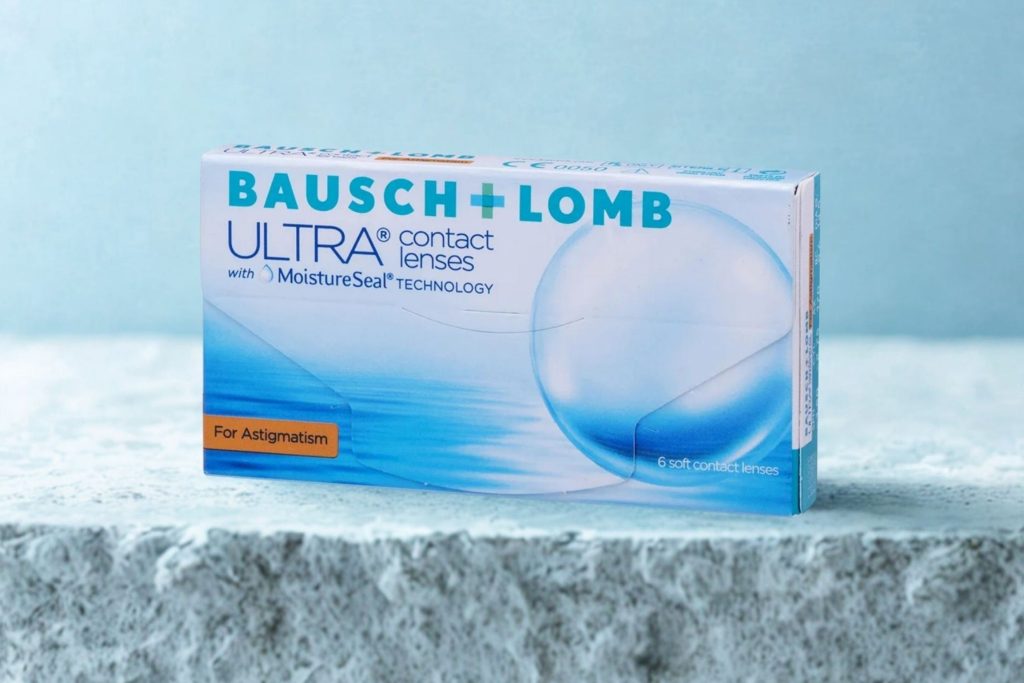
Bausch & Lomb’s ULTRA for Astigmatism features their OPTICALIGN® Design. This helps provide a better fit for irregularly shaped corneas. With this design, you just have to blink to stabilize the lenses.
ULTRA contacts for astigmatism are getting praise from some EZContacts users. Stella C. says:
“I had been wearing accuvue for astigmatism for years and haven’t had clear vision for years! I’ve had such an improvement with these it’s absolutely amazing. Crisp vision and very comfortable…I don’t feel like ripping them out at the end of the day. I’m thrilled beyond belief that I can see again.”
However, Tiffany C. gave a more mixed review:
“Great wear at the beginning of the day, but as day progresses, contacts feel heavy and vision blurs.”
TL;DR
- Toric contact lenses are contacts for astigmatism. Astigmatism is a condition where the cornea has irregular curvature, which causes distorted vision.
- Toric contacts are shaped like the side of a donut, rather than the beach ball-like shape of a spherical contact.
- The contacts often have thicker bottoms, along with other stabilization techniques.
- A toric contact lens prescription will include numbers in the Sphere/Power, Cylinder, and Axis columns.
- When putting in toric contacts, look for the markings that show orientation. You can also orient by making sure the weighted side is at the bottom of the contact.
- Some of the top toric contact lens options include ACUVUE OASYS, Precision1 for Astigmatism, Air Optix Hydraglyde for Astigmatism, Biofinity Toric, and Bausch & Lomb ULTRA for Astigmatism.