
Do your eyeglasses feel or look off? Don’t panic; they might just need some adjustments!
Sometimes, you just need to do a few simple fixes to make your glasses fit better. Here are a few DIY tips on how to tighten eyeglasses to get the perfect fit.
Identify Loose Screws and Components
There are a few signs that your glasses may need tightening or adjusting. Your glasses may feel loose when you handle them. Or, they might not sit right on your face. They could also lean to the side and look crooked.
Take a closer look at your glasses to find out what needs tightening. This is actually something you should do regularly as part of your eyewear maintenance, with or without that loose feeling.
First, check for loose screws. Make sure you have good lighting when you do so. If you’ve got a magnifying glass, use it. This way, you don’t strain your eyes as much.

Another strategy is to lay your glasses down on an even surface, such as a desk or table. The temple tips and the bottom rim should be touching the surface. Tip the glasses lightly to see if they rock. If they do, a component or two might be uneven and need tightening.
Use a Screwdriver to Tighten Glasses
A simple screwdriver can save you from a trip to your optician. If you have a glasses repair kit, you’ll find precision screwdrivers as part of your set. Otherwise, you can purchase these online or from a nearby hardware store.

Check your loose screws and tighten them with your screwdriver:
- Check the screws along the hinges of both sides of your glasses. They can loosen over time.
- Turn the screws clockwise to tighten them. Remember: righty-tighty. Avoid using too much force to prevent damage.
- When adjusting temple arms, use gentle movements to avoid bends or breaks.
If you’re new to this, go slowly. Use your thumb and index finger to gently push the screws in place. Be aware that one slight misplacement can lead to accidentally scratching your lenses. So be careful!
Fix Crooked Frames
If you accidentally sat or lay down on your glasses, you may need to do more than tighten screws. You might need to adjust the entire frame to fix your glasses. This is something that requires delicate handling. Any misstep can do more damage than good.
First, check if your eyeglasses are actually crooked:
- Wear them and then examine yourself in a mirror to see if one side is uneven.
- Place the glasses on an even surface. The temple tips and the bottom rim should be touching the surface.
If you’ve got crooked plastic or acetate frames, try this quick fix:
- Gently heat the temple tips in warm water to make bending easier. Then, carefully bend the tips with your fingers, ensuring both sides are adjusted equally.
- Test by wearing the glasses. Redo the process if they remain uneven.
- If this doesn’t work after repeated tries, see your optician for help.
If you’ve got metal frames, try this:
- Gently bend the temple tips downward. Use your thumb and index finger for precision.
- Careful and controlled adjustments are key. Try not to use too much force, as doing so can cause frame damage.
Remember that with these kinds of fixes, multiple small adjustments are better than one big move. Manually adjusting your frames comes with risks. You minimize the risk by moving deliberately and with care.
Adjust Nose Pads for Comfort

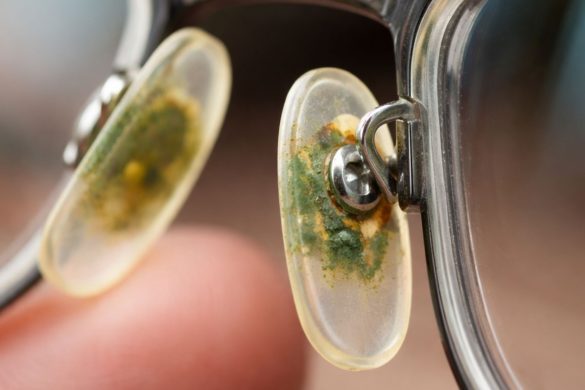
Sometimes, the frames and temple arms are even, and the misalignment is caused by your nose pads. The pads might be screwed on too closely and feel tight on your nose. Conversely, they might be loose and cause the glasses to slip.
Here’s what you can do:
- Unscrew the nose pads.
- Clean them using lukewarm water and mild soap.
- Replace the nose pads at an angle that feels comfortable on your nose. Use a precision screwdriver to tighten the screws.
Clean, well-adjusted nose pads keep your glasses in place and ensure all-day comfort.
Check Lens Alignment
Sometimes, too, everything’s even except for the actual lenses. Lenses should be aligned with each other, and when you wear your glasses, they should be equidistant from your eyes. If the alignment’s off, you’ll see and feel it. You won’t see very clearly, and you might experience some eye discomfort or headaches.
Here are a few things to try:
- If one lens is closer to your face, adjust the corresponding temple arm inward at the hinge. Or, try adjusting the opposite arm outward using slow, controlled pressure.
- Check the hinges where the temple arms attach to the frame for loose screws. Sometimes, simply tightening these screws will do the trick.
If your lenses can’t be aligned with these steps, have your optical clinic’s lab make the adjustments for you.
When to Seek Professional Help
DIY adjustments are useful, but sometimes professional help is necessary. You should consult an optician rather than attempting a repair if:
- Screws fall out
- Either of the temple arms detaches
- Frames fit poorly
- You experience discomfort with your glasses
Too much force while tightening or adjusting can damage frames or strip screws. Once you encounter resistance, stop and seek professional help.
TL;DR
- Tightening and adjusting your eyeglasses at home is a practical skill that can save you time and money.
- Check regularly for loose screws and misalignments, or unevenness.
- Use a precision screwdriver to tighten loose screws.
- For crooked frames, make small adjustments using gentle movement.
- Making multiple adjustments is better than one big adjustment. Go slow. Do not force anything.
- Lenses should be equidistant from your eyes. Otherwise, you might not see clearly and experience minor discomfort.
- For misaligned lenses, tightening the hinges’ screws can be the quick fix. Otherwise, see your optician ASAP.
- If you run into resistance, stop.
- For drastic scenarios, such as screws that fall out or ill-fitting frames, seek professional help.