Are you curious what the ‘PD’ means on your eyeglasses prescription? This little acronym, which stands for pupillary distance, plays a big role in how your glasses fit.
But what is pupillary distance, and how exactly is it measured? And can you measure it at home? We’ll answer all those questions and more in this guide.
What Is Pupillary Distance?
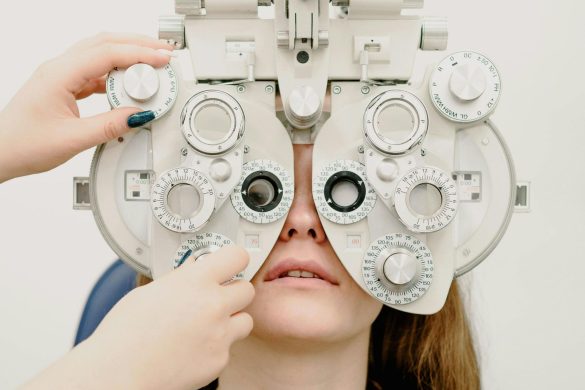
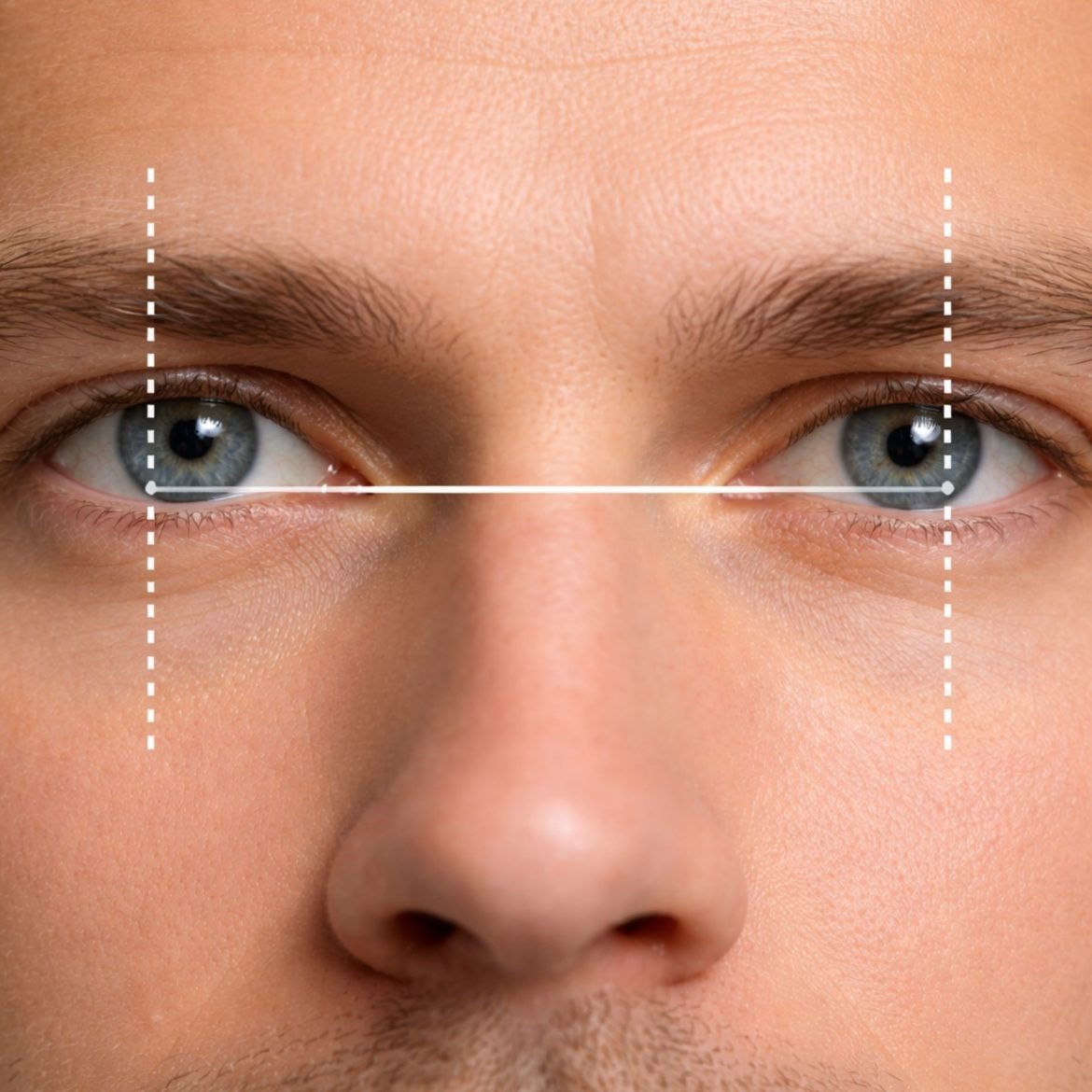
Pupillary distance is the measurement between the centers of your pupils. It’s measured in millimeters. Your optician will take this measurement during an eye exam, and they’ll do so using an instrument called a pupillometer.
When you get your prescription, it will typically include your PD. You’ll need this measurement when you’re buying eyeglasses.
A measurement from a pupillometer will always be the most accurate. However, you can also measure your pupillary distance yourself at home. We’ll get into some different ways to do so shortly.
Why Is Pupillary Distance So Important?
Your glasses have what’s called an ‘optical center.’ This is the spot you want to look through for optimal vision. Pupillary distance is crucial for ensuring that the optical center of your prescription aligns perfectly with your eyes.
If your glasses aren’t aligned properly, it could lead to distorted vision. You could also experience dizziness, headaches, and eye strain. People with high prescriptions are particularly at risk for these symptoms.
What’s the Average Pupillary Distance Measurement?
The average pupillary distance for an adult is typically between 60 mm and 65 mm. However, the number can vary greatly. A range of 54 mm to 74 mm is considered normal for adults.
Single PD vs. Dual PD
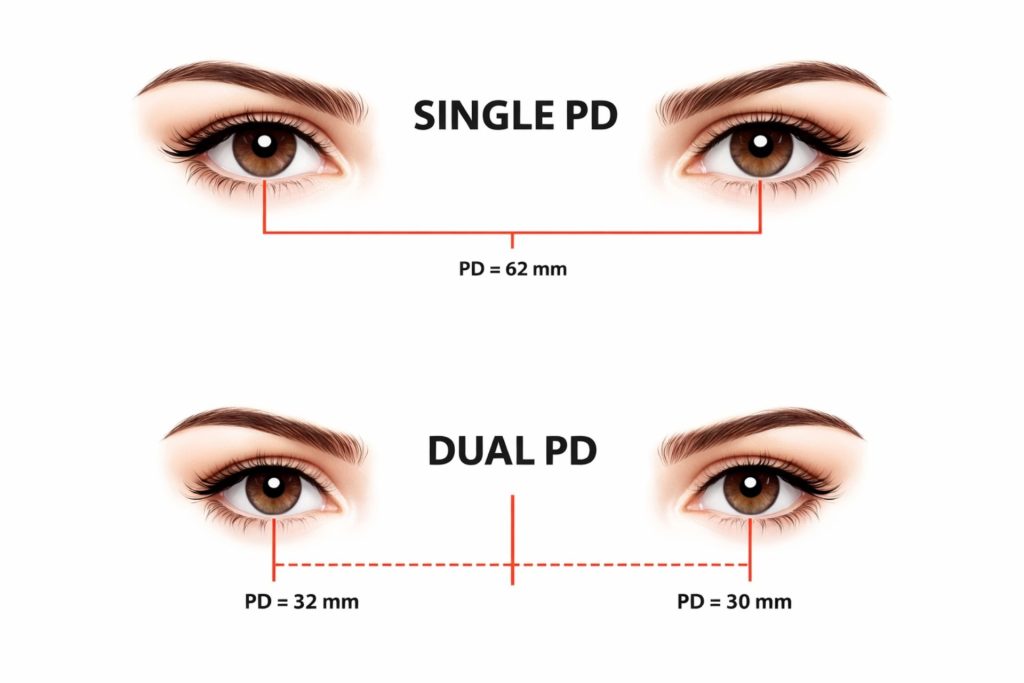
Some eye prescriptions may have two numbers: single PD and dual PD.
Single PD, which is also called binocular PD, is the total measurement in millimeters between the centers of both pupils.
Dual PD, also called monocular PD, is the distance between the center of each pupil and the bridge of the nose.
A dual PD measurement has two numbers. The first number is for the right eye, and the second is for the left eye. It’s written like this: 33/31. This number is helpful to have if you’re buying progressive glasses.
Reading Glasses PD
The pupillary distance for reading glasses is measured slightly differently. To get this number, you’ll just need to subtract 3.0 mm from your single PD, or 1.5 mm from each number in your dual PD.
How to Measure Pupillary Distance at Home
Want to measure your PD at home? There are a few different ways you can do so. Let’s go through some of your options.
Option 1: Ruler and Mirror
One of the simplest ways to measure your PD at home is by using a ruler and a mirror. You can either do this by yourself or with a friend or family member.
Measuring By Yourself
- Stand about eight inches away from the mirror. Hold the ruler flat against your browline.
- Close your right eye, and and align the ruler’s 0 mm mark with your left pupil.
- Now, open your right eye and close your left eye.
- Find the millimeter line that aligns with the center of your right pupil. This is your pupillary distance.
Measuring With a Friend/Family Member
- Look straight ahead and focus on an object that’s about 10 to 20 feet away. Keep your eyes still.
- Have your friend hold the ruler up to your browline. Line up the ruler’s 0 mm mark with one of your pupils.
- Finally, ask your friend to find the millimeter line that aligns with the center of your other pupil. This is your pupillary distance.
Option 2: Glasses, Ruler, and a Felt-Tip Marker
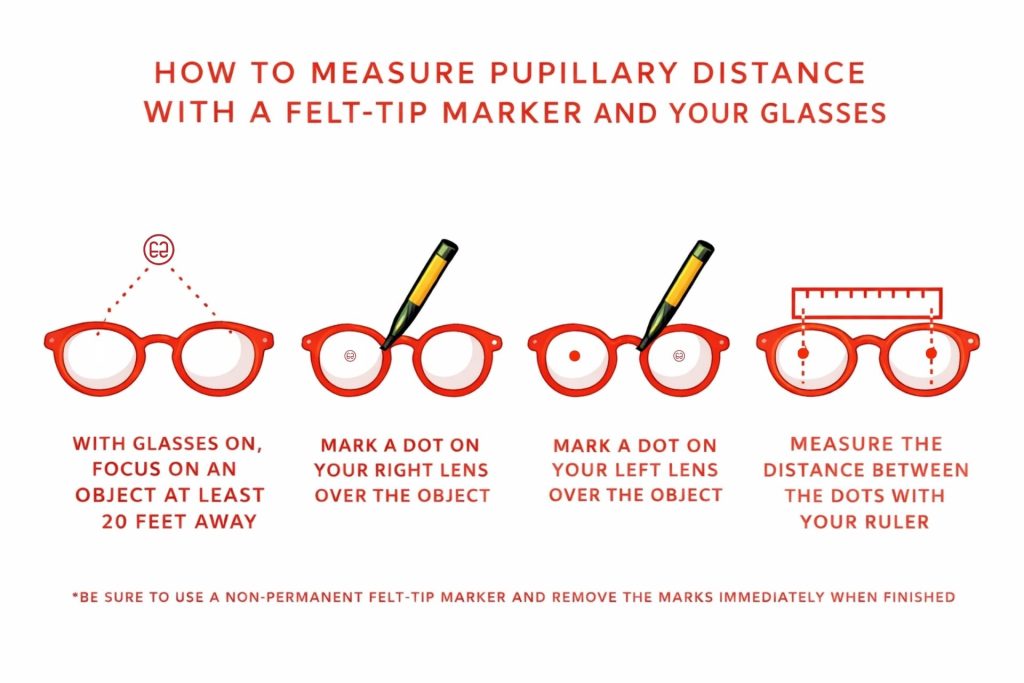
You can also use a felt-tip marker and your glasses to measure your pupillary distance. Make sure to use a non-permanent marker for this, and be sure to remove the mark right when you finish. Here’s how to do this:
- Put your glasses on. Focus on an object about 20 feet away.
- Mark a dot on your right lens over the object.
- Then, also mark a dot on your left lens over the object.
- With both eyes still focused on the object, make sure the two dots overlap into one dot in your field of vision.
- Take off your glasses, and measure the distance between dots. This is your pupillary distance.
Option 3: Use a PD Measuring App
Don’t have a ruler, or don’t want to mark up your glasses? No problem! There are apps that will measure your PD straight from your smartphone or computer.
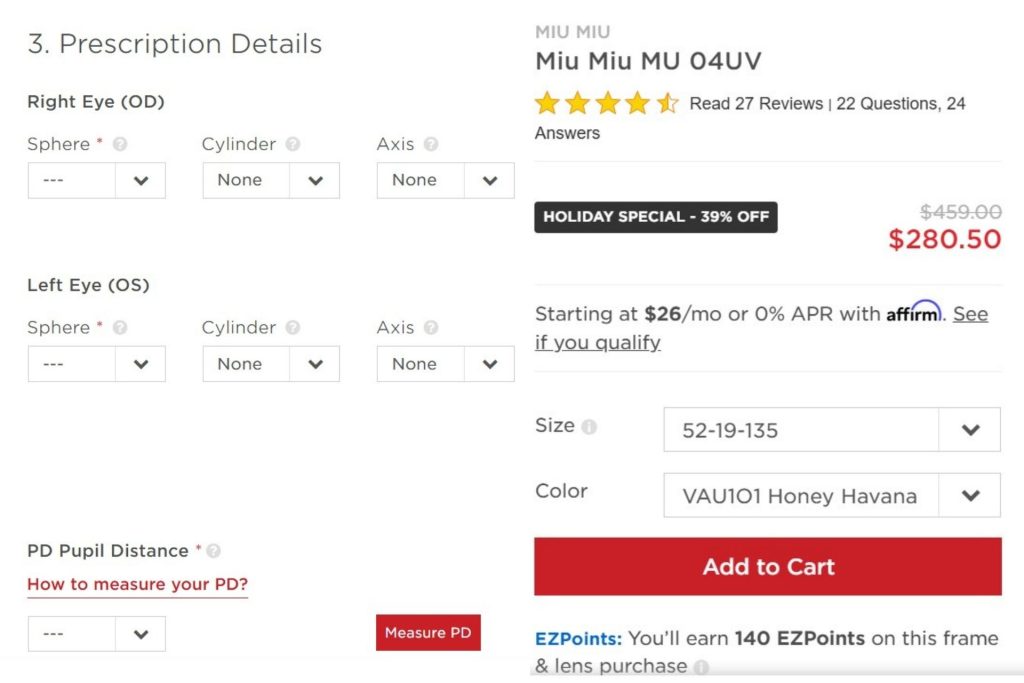
EZContacts has an app you can use to measure your PD. To find this app, click on a pair of eyeglasses. Then, scroll down to the ‘Prescription Details’ section. Once there, click on the red ‘Measure PD’ button.
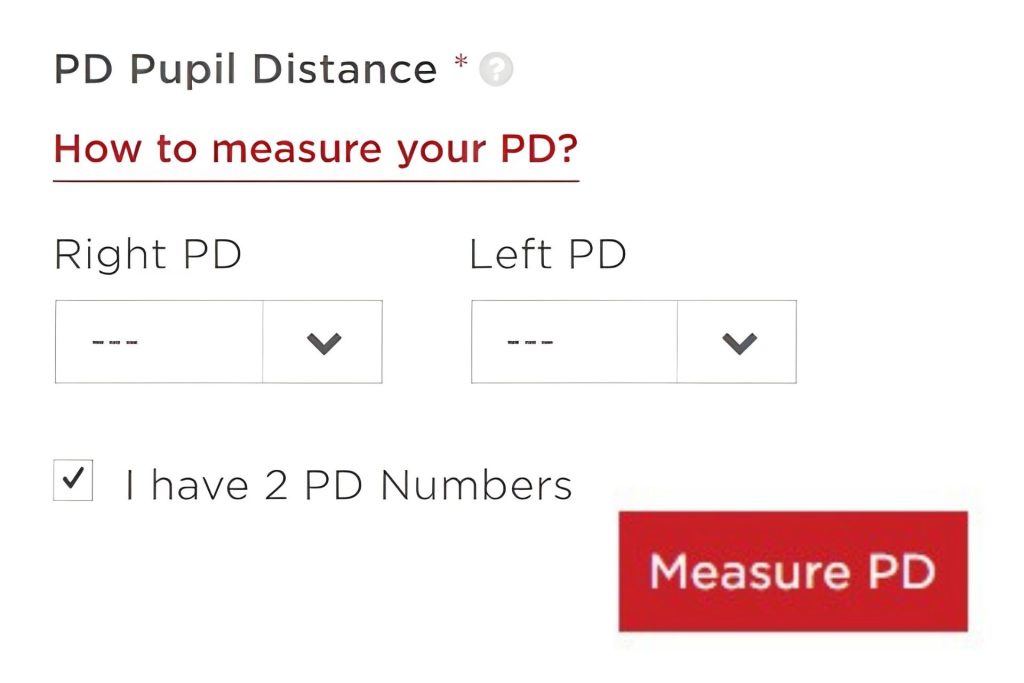
When you click on ‘Measure PD,’ you’ll see this pop-up. You can choose to measure from your iPhone or from your computer.
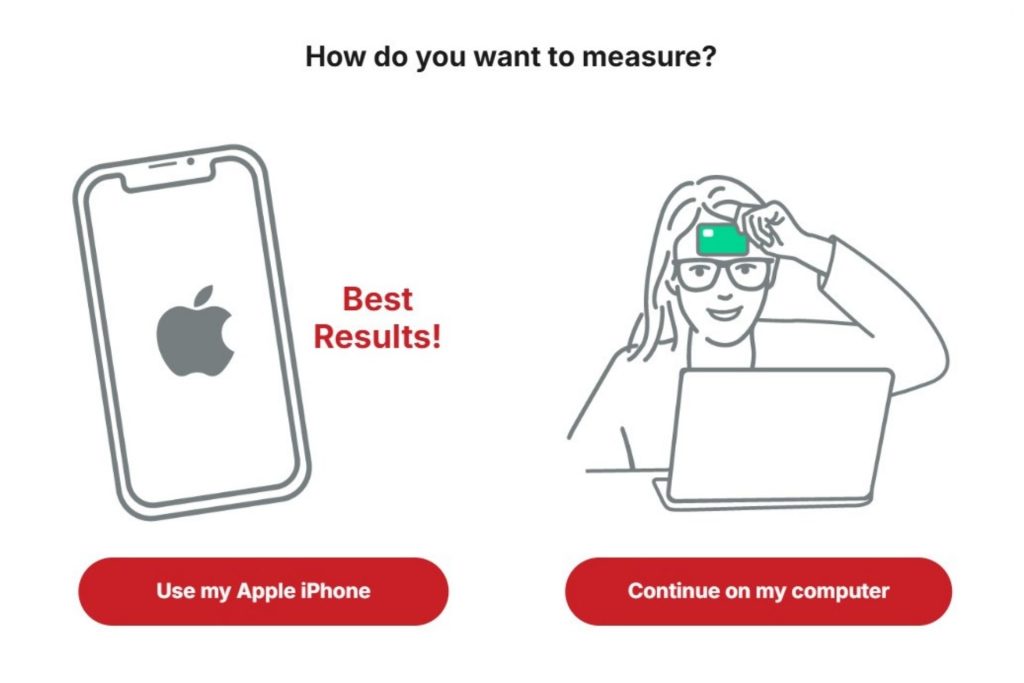
If you choose your iPhone, you’ll be prompted to scan a QR code. After you scan the code, follow the prompts on your phone screen to get your PD.
If you choose your computer, allow access to your camera, and turn up the volume for instructions.
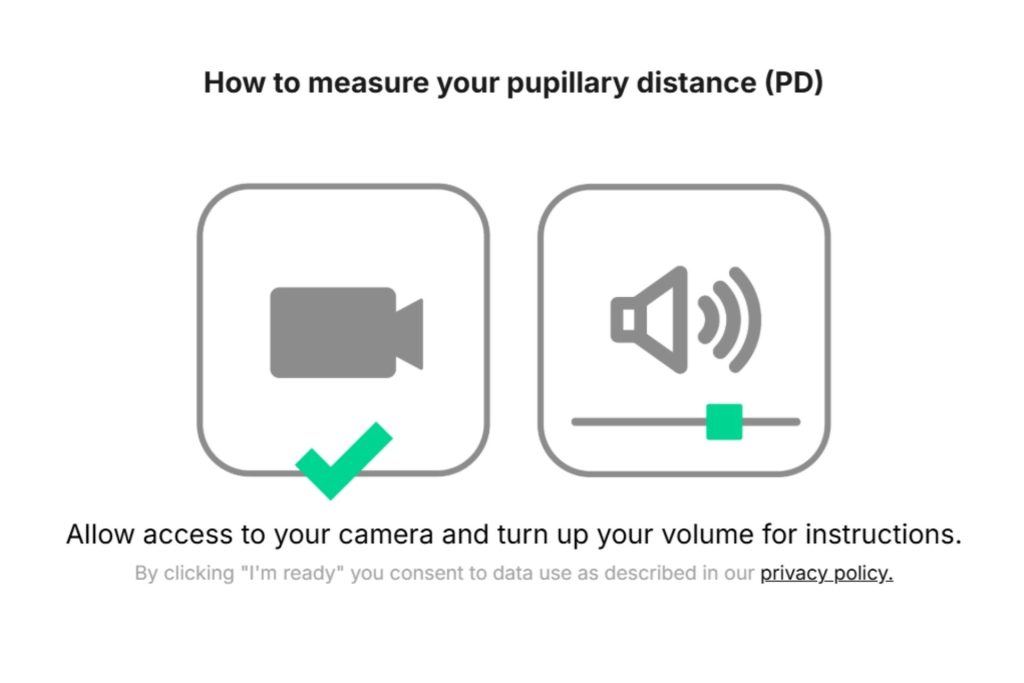
Follow the instructions, and your PD will pop up on your computer screen.
When to See an Optician
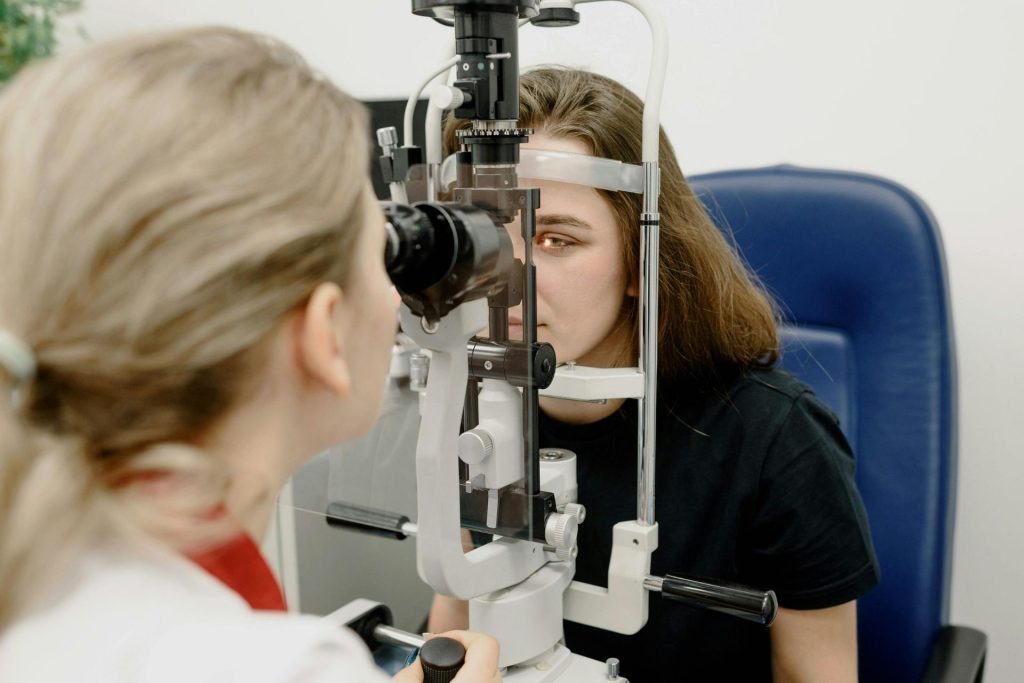
If you’re having trouble doing these measurements, or if you’re worried they’re off, it’s a good idea to see an optician to get your pupillary distance officially measured. Pupillary distance is a very important measurement, and you want it to be as accurate as possible.
Also, if your prescription includes prism correction, it’s a good idea to get your pupillary distance measured by an optician. This is because prism lenses have a specific ‘base’ that needs to be precisely positioned to work well.
In addition, the stronger your prescription or prism, the more sensitive your eyes are to even the tiniest inaccuracy in your PD. The wrong PD could cause double vision, eye strain, and headaches.
After You Get Your Pupillary Distance
Once you’ve got your pupillary distance, it’s time for the fun part: shopping for cool new eyeglasses! Head to the eyewear page on EZContacts, and take a look through all the different brands and styles available.
Have your prescription details ready, including your PD. You’ll input those numbers during the checkout process.
TL;DR
- Pupillary distance is the measurement of the distance between the centers of your pupils. It’s measured in millimeters. An optician will find this measurement using a pupillometer during an eye exam. You can also measure for PD at home.
- PD is so important because it ensures the optical center of your prescription aligns perfectly with your eyes. If your glasses aren’t properly aligned, it could lead to dizziness and eye strain.
- The average pupillary distance for an adult is between 60 mm and 65 mm, but this number can vary.
- Some eye prescriptions may have a single PD and a dual PD. Single PD is the distance between the centers of both pupils. Dual PD is the distance between the center of each pupil and the bridge of the nose. Dual PD is helpful to have if you’re buying progressive glasses.
- There are a few different ways to measure PD at home. You can measure with a ruler either by yourself or with a friend.
- You can also use a felt-tip marker to measure your pupillary distance.
- There are also apps available that will measure your pupillary distance from your phone or computer.
- If you’re having trouble measuring your pupillary distance, see an optician. It’s also best to see an optician if you’re looking to buy prism lenses.