Glasses that don’t fit right can be a nuisance. They might dig into your temples, slide down your nose, or simply look off on your face.
It can also be harder to see with ill-fitting glasses; they could limit your peripheral vision and ability to see clearly.
But how do you find glasses that fit right? That’s what we’re here to discuss.
I’ll run through what you should look for in eyewear, the measurements to have with you, and what you need to ask your optometrist so you can buy your glasses confidently.
Anatomy of Eyeglasses
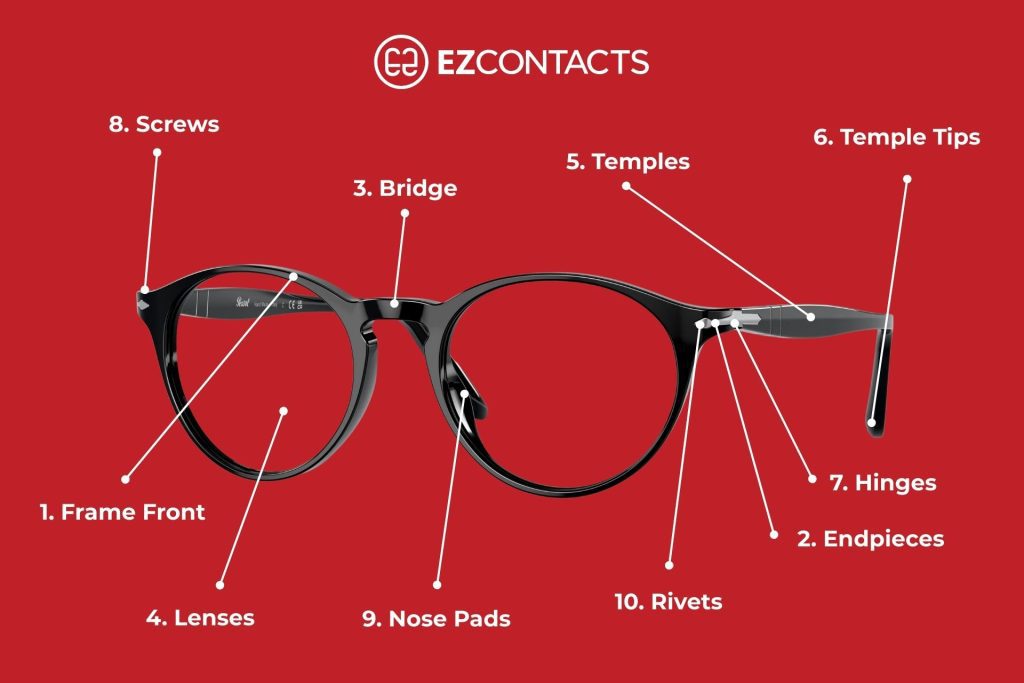
Let’s start with the parts of the eyeglasses first. No, this doesn’t get technical, and there’s no pop quiz right after. It’s just important to know what we’re talking about, as well as typical measurements for each part.
Frame Front
The frame front includes the rims that hold the lenses, the bridge that sits on your nose, and the end pieces that connect to the temples.
End Pieces
The end pieces are the parts of the frame front where the hinges connect to the temple arms.
Bridge
The bridge is the part of the frame that rests on your nose. Its width is the distance between the lenses, measured in millimeters.
Lenses
The glasses’ lenses correct your vision, and you can get them made from high-end plastic or glass. Their shape and size depend on your frames. Their thickness depends on the lens material and your prescription. In addition, their width depends on your frames and prescription.
Temples
The temples are the arms that extend from the frame front and curve over your ears to keep the glasses in place. The arms are measured in millimeters.
Temple Tips
These are the tips of the temple arms, which curve over your ears.
Hinges
The hinges connect the temples to the frame front, allowing them to fold.
Nose Pads
The nose pads are right under the bridge and sit directly on your nose. They secure the glasses on your face.
Rivets
The rivets are the small, metal pins used to secure the hinges to the frame front or temple arms.
Measuring for Eyeglasses
Eyeglass frames are typically marked with a series of numbers that represent their sizing information. These numbers are usually found on the inside of the temple arm.
The number will look something like this: 52-18-140. This just means:
- Lens width: 52 mm
- Bridge width: 18 mm
- Temple length: 140 mm
But how do you know your measurements? Simple: measure your face! Here’s how to easily measure your face at home.
Frame Width
The frame width is the total horizontal length of the glasses. To find this measurement, stand in front of a mirror. Use a ruler to measure the distance between your temples in millimeters.
Bridge Width
Stand in front of the mirror, and place a ruler across the bridge of your nose, aligning the zero mark with where your glasses would typically sit. This is usually level with your pupils. Then, note the distance in millimeters.
Also, take note of where your nose bridge sits relative to your pupils. If your nose bridge is aligned or below your pupils, your likely ideal bridge width is 16 to 18 mm. If your bridge is above your pupils, your eyeglass bridge width should be 19 to 21 mm.
Lens Width
To calculate your lens width, subtract your bridge width from your total frame width. Then, subtract an additional 6 mm to account for the endpieces. Finally, divide this number by two. This will give you your lens width.
Temple Arm Length
To find this measurement, it’s best to use a flexible tape measure. Measure from the edge of your eyebrow to behind the ear, stopping where the tips of the glasses will rest. Temple lengths typically range from 120 mm to 150 mm.
Pupillary Distance (PD)
This is one of the most important measurements to have ready when ordering glasses. Your pupillary distance, or PD, measures the distance between the centers of your pupils. The right measurement ensures that your lenses are aligned with your eyes.
Your optician should provide you with your PD. Otherwise, you can try to measure on your own or with a friend.
Stand about eight inches away from a mirror. Look straight ahead, and hold your ruler up to your browline. Close your right eye, and then position the ruler’s 0 mm mark at the center of your left eye.
Then, open your right eye and close your left eye. Find the millimeter line that aligns with the center of your right pupil. This is your pupillary distance.
When to See an Optician
If you’re having trouble doing these measurements or are worried they’re off, it’s best to see an optician to get official measurements. You want your glasses to fit well, and an optician can help ensure that.
Finding Your Perfect Pair
Now that you have the measurements of your face, you should be able to buy your glasses confidently anywhere. Online or at an actual shop, you know what to look for.
Buying Online
When you buy eyeglasses online, make sure to have your face measurements and PD ready. Likewise, check the specifications of the eyeglasses. Let’s go to EZContacts as an example.
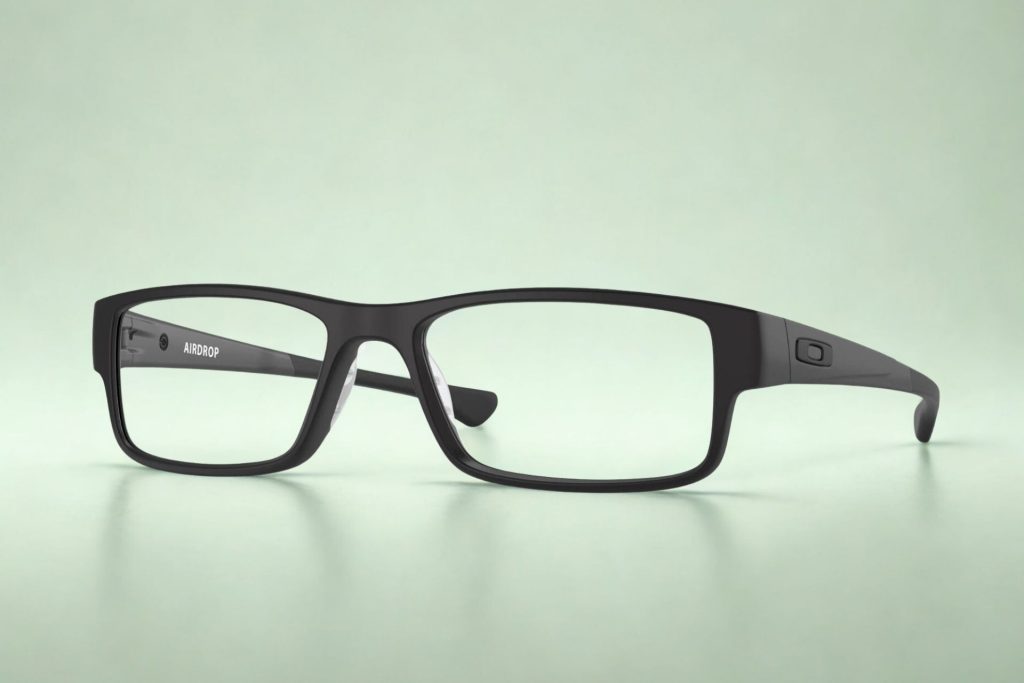
This is a pair of Oakley AIRDROP OX8046. They’re great eyeglasses that are currently available for less than $150 at EZContacts.
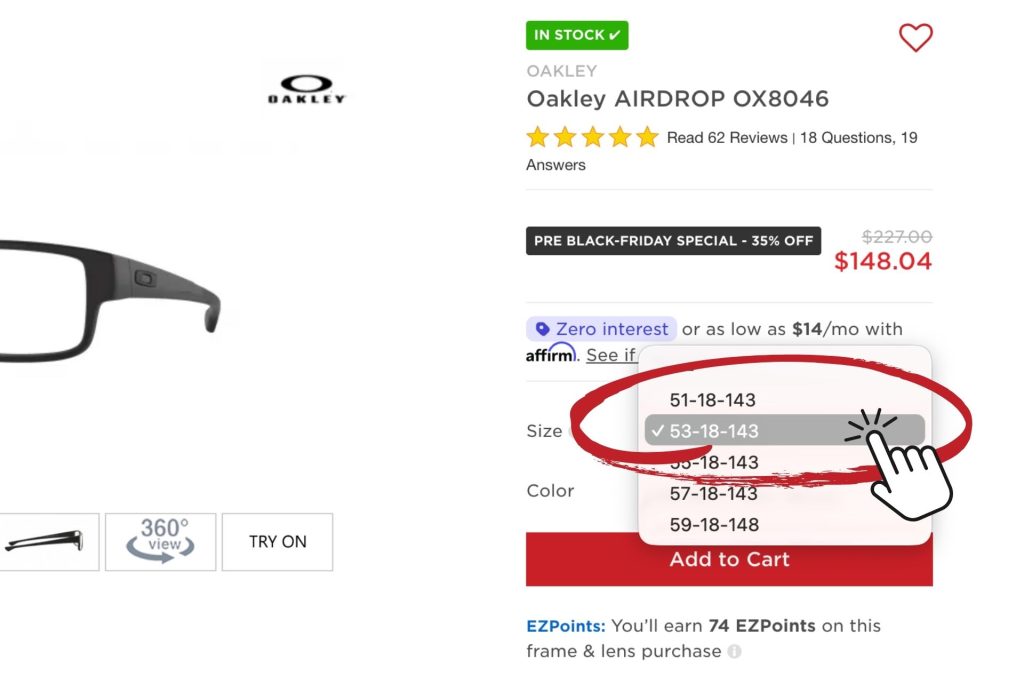
One of the first things that you see on the product page is your size choices.
You will also see the same information under the Specifications section (right column).
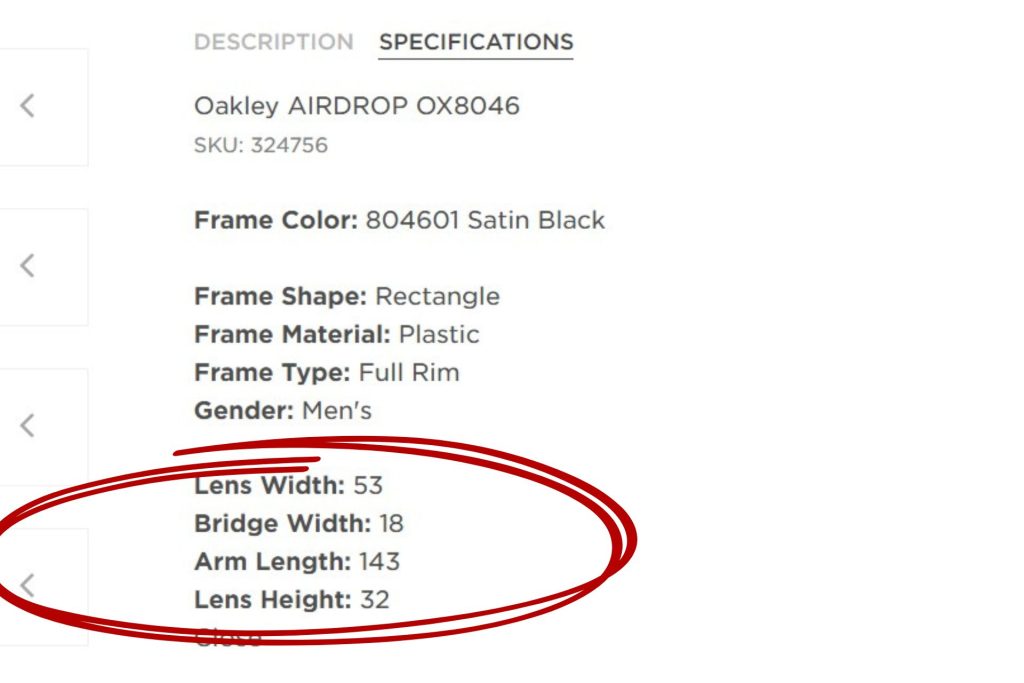
Use your face measurements to choose the best size pair for you.
Your PD comes in later, once you begin filling out your prescription details.
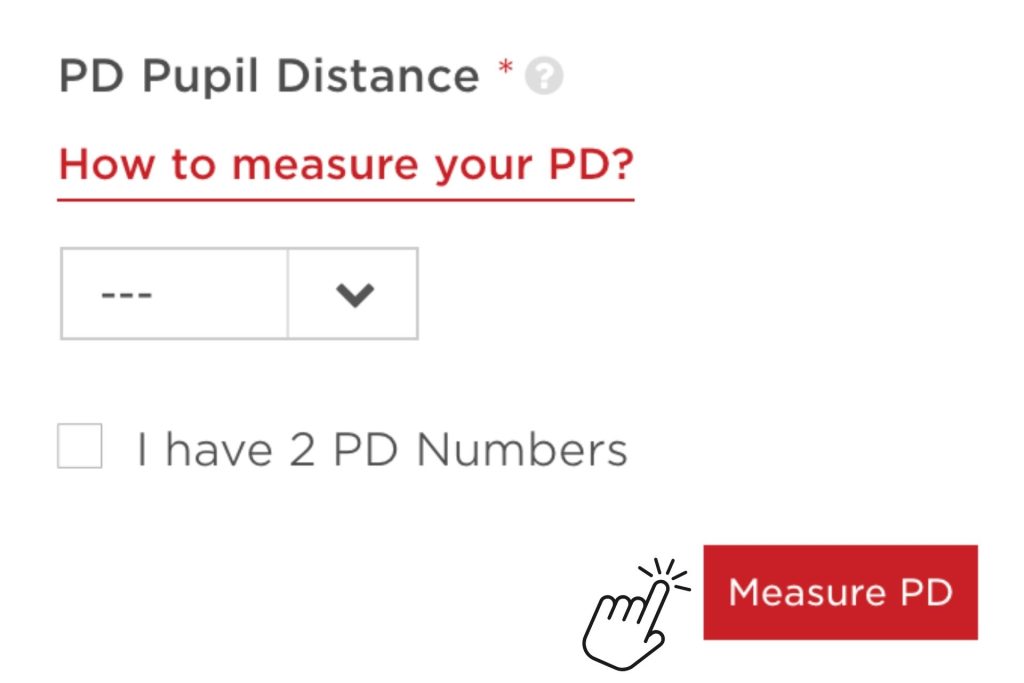
The great thing about shopping for your eyeglasses at EZContacts is that they offer a way to measure your PD online. If you did your own measurement, it’s a good idea to double-check.
Just click on the Measure PD button. Have your mobile phone ready. Scan the QR code and then follow the instructions.
Buying From a Brick-and-Mortar Eyewear Shop
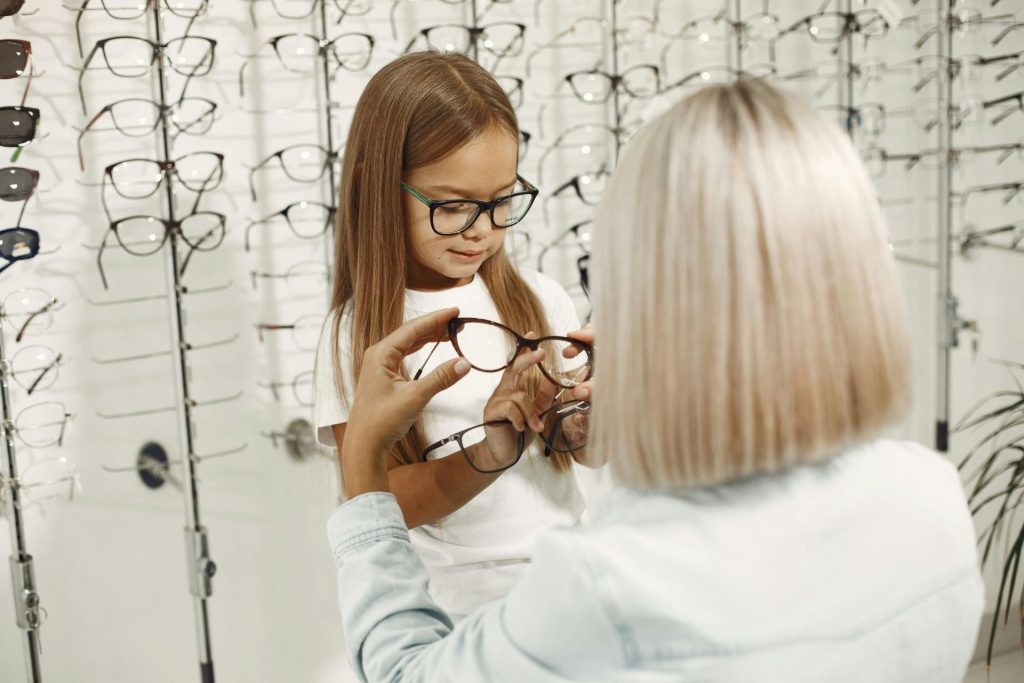
If you’re buying from a brick-and-mortar eyewear store, bring your measurements and have the shop double-check to confirm.
This also gives you a chance to do an actual eyeglass fitting. If it’s your first pair of glasses, a fitting allows you to assess how certain styles and materials feel to you.
Notice how metal and plastic/acetate eyeglasses feel. Do you like how they sit on your nose? Do you feel comfortable with oversized frames, or are they too heavy?
Take note of the following, too:
Bridge Fit
The bridge should sit comfortably on your nose without pressing too tightly or slipping down. If the bridge is too wide, the glasses will slide down. If it’s too narrow, the glasses will pinch your nose.
Temple Arm Length
The arms should reach comfortably over your ears without pressing against your temples or causing the glasses to sit too far away from your face.
Lens Position
The lenses should sit close to your eyes, with the optical center of the lenses aligned with your pupils.
Overall Balance
Your eyeglasses should sit level on your face without tilting or leaning to one side.
Materials and Their Impact on Fit
The material of your frames can also affect their fit and comfort:
Metal Frames
Metal frames, like those made from titanium, are often lightweight and durable. They can be easily adjusted by your optician to best fit your face.
Plastic Frames
Plastic frames, like those made from acetate or nylon, come in many different styles and colors. So, if you’re a fashionista, you’ll love the seemingly unlimited style choices when it comes to plastic frames. The downside is that plastic frames are less adjustable than metal frames.
Combination Frames
These frames combine metal and plastic elements. You get a unique-looking pair that may combine the easy adjustability of metal frames and the variety of style choices of plastic frames.
What Your Optician Does for You
Of course, consult your optician about all this. These tips are great if you’ve already gone to them for your prescription and are just looking to buy a new pair online or from another shop.
But, if you’re seeing an optician anyway, take the opportunity to get your precise measurements. An optician has the specialized tools to get these measurements.
If you’re ordering your eyeglasses from them, get their advice on the best-fitting eyewear for your face. Try on a few pairs and see how you feel about them. Nothing beats an actual fitting and discussing your options with an expert.
TL;DR
- The perfect pair of eyeglasses doesn’t just need to look right; they need to fit perfectly, too.
- Eyeglasses have several parts. To find the best-fitting pair, you need to know these parts, how they are typically measured, and how they should sit and feel on your face.
- You can see eyeglass size specifications marked on the inside of temple arms.
- Pupillary Distance (PD) is a crucial measurement to have. This measures the distance between the centers of your pupils. The centers of your lenses should align with your pupil centers. If you buy your glasses from EZContacts, there’s an online tool for measuring your PD accurately.
- You can measure for glasses at home, including your PD.
- If you’re buying your pair from an optical shop, have them confirm your measurements. Use this as an opportunity to do an actual fitting.
- Have your measurements, as well as your prescription, ready when buying online. You will need them when filling out an order.
- The material of your eyeglasses impacts their fit. Metal eyeglasses are easier to adjust than plastic frames.
- Consult your optician about your measurements.