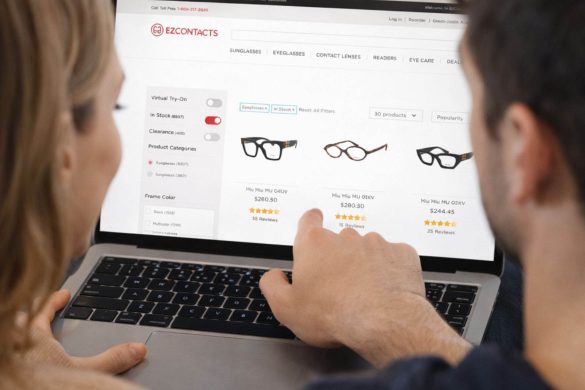

Online shopping can feel like a minefield! Figuring out how to find your ideal product is the first step, but then comes the checkout process, which can take forever.
Sometimes, as a business, it’s easy to forget that the customer shopping journey should be as smooth as possible. But at EZContacts, when our customers ask, we listen.
So here’s some insight into how a simple complaint led us to redesign our product pages for contact lenses for astigmatism.
How a Text Led Us to Overhaul Product Pages
It started with a text message from a friend, who happens to be an EZContacts customer. He’s a regular buyer of contact lenses, so it was a bit of a shock to see a text that started, “I have a problem with my order.”
The customer had astigmatism, and he was buying new contact lenses. However, the contacts he bought weren’t suitable for astigmatism. Our contact lens page didn’t make it clear to him that he was buying the wrong contacts.
It was a head-scratching, ‘wait what?’ moment.
Our Initial Reaction To Getting It Wrong
Our first thought was, wait a second, the category the lenses were in was called ‘spherical lenses.’ You couldn’t miss it!
We assumed that people with astigmatism know they need toric lenses. The product our customer was looking at was categorized under spherical lenses, and it didn’t say ‘Toric’ in the title. Plus, the lenses our customer was talking about didn’t have Cyl/Axis input fields.
Case closed, right? It was obvious to us they weren’t meant for astigmatism.
But Then We Asked Him a Simple Question
“How do you know which lenses to buy for astigmatism?”
His answer changed the whole story.
It turns out he doesn’t really know what the Cyl/Axis values on his prescription mean. Plus, he doesn’t understand the differences between spherical and toric.
He just knew from previous purchases that some lenses said “for astigmatism” and some didn’t.
And that’s when it hit me…
We failed the grandma test.
How the Grandma Test Applies to Online Shopping
The grandma test is a pretty straightforward concept and not as gimmicky as it sounds.
If you’re designing a product page or website, and your grandmother, or rather anyone who isn’t very familiar with your products, can’t understand your site, then guess what?
It’s a fail.
So the short story is that we realized we were using too much contact lens jargon. Most people don’t know these terms or the differences between spherical and toric lenses.
All they know is that they’re having a problem with their vision. And so, they go to the doctor to get a prescription, and now it’s time to buy contact lenses.
We forgot that it should be as easy as possible for any and every customer to find the right lenses.
It shouldn’t be rocket science, and we shouldn’t use language that only optometry experts understand. After all, the average person hasn’t memorized what Cyl/Axis means, and we’re here to make our customers’ lives easier, not harder.
Shopping for Contact Lenses for the First Time
As retailers of contact lenses, it’s easy to forget that countless everyday customers are first-time contact lens buyers. And they’re confused.
After all, even longtime wearers don’t always understand their prescriptions. It’s no surprise that medical terminology isn’t exactly easy to figure out.
So, we’ve decided to make our product pages more straightforward.
What We’re Changing
We are working on adding clear callouts to our contact lens pages. This includes:
- “These are spherical lenses” (for nearsightedness/farsightedness only)
- “Have astigmatism?” (You’ll need toric lenses – shop here)
- We’re also adding information on how to understand your prescription
So, less jargon and instead just clear guidance.
FAQs
Still confused about if you need contact lenses for astigmatism? Here are the answers to a few commonly asked questions.
What are contact lenses for astigmatism?
Contacts for astigmatism are also known as toric lenses. They’re different from other lenses because they have different focusing powers horizontally and vertically (regular spherical lenses have one power across the lens). This helps match the unique curvature of astigmatic eyes.
Toric lenses also feature specialized stabilization mechanisms that minimize movement. This helps ensure more accurate vision.
How do I know if I have a prescription for astigmatism?
If you have astigmatism, your prescription will likely include a Cyl and Axis. If you’re confused about reading your prescription, it’s wise to talk to your doctor about any concerns.
Can my astigmatism prescription be combined with other prescriptions?
Your astigmatism prescription can be combined with corrections for other eye conditions, including myopia (nearsightedness) and hyperopia (farsightedness).
Product Pages Should Use Universal Language

Through one customer complaint, we realized that your definition of ‘obvious’ could be confusing to others.
Doctors wouldn’t get very far explaining how to soothe varicella to a patient; instead, they just call it chickenpox. Or, tech companies wouldn’t have much success explaining how Bluetooth functions; instead, they just tell customers what it does and how to use it.
We’re not all fluent in industry language, which is why we decided to make our product pages simpler. We know our contact lens customers are on a mission to find the best solution as quickly as possible.
We Take Our Customers Seriously
Our friend and customer helped us greatly by coming forward and sharing his thoughts. As consumers, it can feel like your opinions aren’t heard by companies, but we’re trying to change that.
It’s why our product pages feature real customer reviews and a Q&A section, and we don’t remove any criticism of us or our products. It’s all about transparency.
TL;DR
We aren’t the type of business that thinks they’re always right. In fact, a simple customer complaint prompted us to improve our contact lens pages.
- A friend and customer texted and said he couldn’t figure out which contact lenses were right for astigmatism. Our product pages weren’t helping him to decide.
- At first, we were confused, maybe even slightly defensive. But we quickly realized that contact lens pages that use too much jargon and medical language aren’t helpful.
- It was an eye-opening moment of truth. As a business, sometimes it’s easy to overlook the basics, but that can make all the difference to customers.
- So we’re adding clear descriptions so people with astigmatism can easily find the right lenses and other wearers can better understand their prescriptions.
It was a great reminder that, as a company, there’s always room for improvement.