Are you struggling with your new glasses? Do your eyes feel strained, and are you experiencing headaches or dizziness?
Don’t panic; this is a normal part of getting new glasses. It can be uncomfortable, though. And it may leave you asking, how long does it take to adjust to new glasses?
Let’s get into how long the adjustment period may last and what you can do to make it easier.
If you’re having trouble adjusting to your new glasses, you’re not alone. Over on Reddit, many people have shared their struggles with new eyewear.
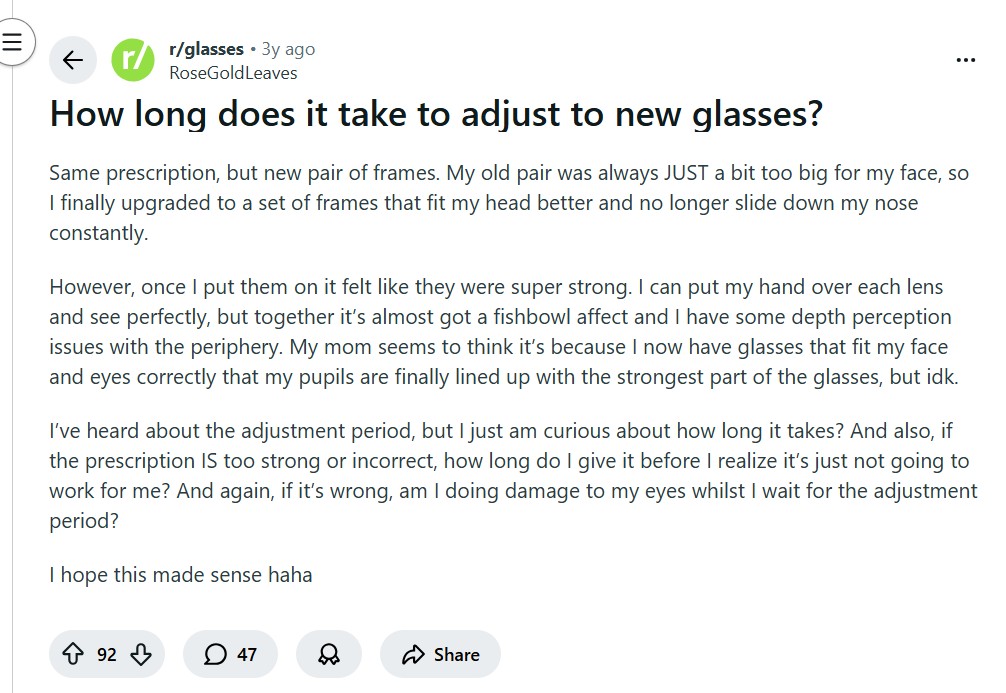
In a thread titled, “How long does it take to adjust to new glasses,” Redditor RoseGoldLeaves asked for advice. They wrote:
“Same prescription, but new pair of frames. My old pair was always JUST a bit too big for my face, so I finally upgraded to a set of frames that fit my head better and no longer slide down my nose constantly.
However, once I put them on it felt like they were super strong. I can put my hand over each lens and see perfectly, but together it’s almost got a fishbowl affect and I have some depth perception issues with the periphery. My mom seems to think it’s because I now have glasses that fit my face and eyes correctly that my pupils are finally lined up with the strongest part of the glasses, but idk.
I’ve heard about the adjustment period, but I just am curious about how long it takes? And also, if the prescription IS too strong or incorrect, how long do I give it before I realize it’s just not going to work for me? And again, if it’s wrong, am I doing damage to my eyes whilst I wait for the adjustment period?”
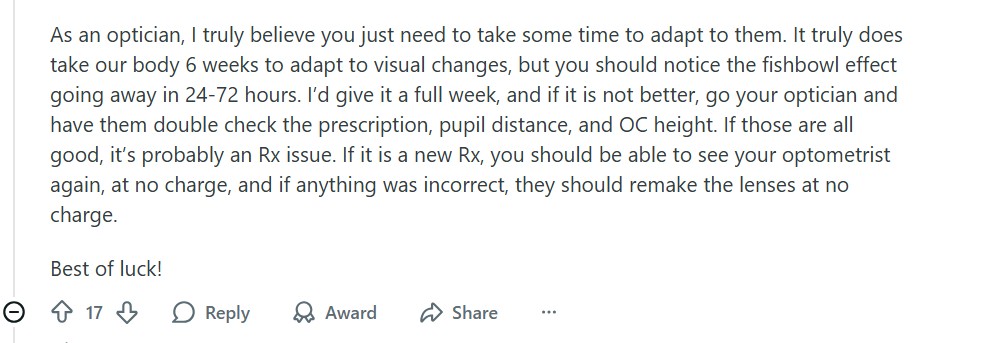
A Redditor named Dasnebr93 quickly chimed in to reassure RoseGoldLeaves that this was normal. They said they were an optician, and they shared:
“As an optician, I truly believe you just need to take some time to adapt to them. It truly does take our body 6 weeks to adapt to visual changes, but you should notice the fishbowl effect going away in 24-72 hours. I’d give it a full week, and if it is not better, go your optician and have them double check the prescription, pupil distance, and OC height. If those are all good, it’s probably an Rx issue. If it is a new Rx, you should be able to see your optometrist again, at no charge, and if anything was incorrect, they should remake the lenses at no charge.”
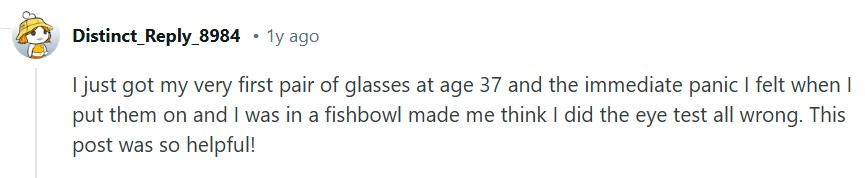
Other Redditors shared the issues they’d also had with their new glasses. They said this Reddit thread made them feel better. Distinct_Reply_8984 wrote:
“I just got my very first pair of glasses at age 37 and the immediate panic I felt when I put them on and I was in a fishbowl made me think I did the eye test all wrong. This post was so helpful!”
As you can see, an adjustment period is very normal for new glasses. Let’s get into why this is and what you can do to make the adjustment period easier!
The Adjustment Timeline
With new glasses, adjustment periods can range from a few days to around two weeks. There are several possible reasons for this time range.
Prescription Changes
If your prescription changed, you’re more likely to experience a period of adjustment. Your eyes and brain need to get used to looking through different-powered lenses.
Minor optical power changes: If the optical power change is small, the adjustment period might be quicker.
Significant optical power changes: If you needed a substantial change in lens prescription, say correction for astigmatism was added to your lenses, then expect a longer adjustment period. Such changes require a lot more from your eyes. They have to work harder to get used to the significant lens changes.
Age
Age plays a role in the speed of adjustment. Younger people adapt more quickly because their visual systems are more flexible. As you get older, your eyes become less adaptable.
Type of Lenses
Your lens type can also affect the adjustment period. The adjustment period can be even longer if you switch types of glasses (i.e., from single vision lenses to progressives).
Single Vision Lenses: Because the entire surface of these lenses has one optical power, it is typically easier to adjust to them.
Progressive Lenses (Multifocals): These lenses have multiple optical zones on their surface, which can take longer to adjust to. Your eyes and brain need to learn to use different parts of the lens correctly for different distances.
Eye Conditions
If you are dealing with a pre-existing eye condition, like astigmatism, expect it to have some impact on your adjustment period.
Individual Sensitivity
Everyone’s eyes are unique. Some people may just be more sensitive to visual changes than others.
Common Experiences During the Adjustment Period
A Woman in Glasses Rubs Her Temples
When you’re adjusting to your new glasses, you may experience some of these symptoms:
Eye strain: Your eyes have to work harder as they try to adjust to new lenses, which could lead to some eye strain.
Headaches: You might also experience some headaches. These headaches will typically be mild.
Blurred Vision: In some cases, blurry vision can happen. Don’t panic. Your eyes might just be adjusting to your new glasses.
Dizziness or Lightheadedness: You might also feel dizzy or lightheaded as your eyes and brain adjust to your new glasses.
Nausea: In rare cases, you might feel nauseous, especially with significant prescription changes.
Distortion: Objects might appear warped or curved, especially when seen from the periphery.
Depth perception problems: You might have difficulty judging distances, or the ground may suddenly seem uneven. This should subside as soon as you’ve adjusted to your glasses.
Make Your Adjustment Period Easier
Man Examines His Eyeglasses in Library
There are some ways to make the adjustment period easier. Here are some tips to try out:
Wear your glasses as much as possible: One of the best ways to adjust is to wear your new glasses as often as you can. Get used to looking through them. This helps your eyes and brain adapt faster.
Start slowly: This contradicts the first piece of advice, but, hey, each person is different. If wearing your glasses often is causing discomfort, try wearing them for shorter periods and gradually increasing the wear time.
Give yourself breaks: If you’re experiencing eyestrain or headaches, take visual breaks. Follow the 20-20-20 rule. Every 20 minutes, take a break from what you’re working on. Focus on an object 20 feet away for 20 seconds.
Avoid activities that require precise vision during your adjustment period: Tasks like driving or operating machinery require sharp, precise vision. Avoid them while you’re still adjusting to your glasses. These demand a lot of work from your eyes.
Stay hydrated: Dehydration can make headaches and eye strain feel worse. Drink lots of water.
Consider taking NSAID drugs: If you experience headaches, over-the-counter pain relievers might help. Of course, consult with your doctor first if you’re not used to NSAIDs (nonsteroidal anti-inflammatory drugs).
Be patient: Remember that it takes time for your eyes and brain to adapt. Be patient with yourself.
Ensure proper fit: The frames that you choose should fit your face and style preferences. Before buying glasses, get measured by your optician. Have your precise measurements, including your PD (pupillary distance), ready when ordering your glasses. Ill-fitting glasses can worsen adjustment symptoms.
Follow up with your optician: If your symptoms become severe, persistent, or worsen after a few weeks, contact your optician or eye doctor. They can reassess your prescription, including your face measurements, to make sure your new glasses are perfect!
Adjusting to Progressive Lenses
As I mentioned earlier, adjusting to progressive lenses may take longer. Here are additional tips to ease your multifocal glasses adjustment:
Look through the correct part of the lens: Progressive lenses have different zones for distance, intermediate, and near vision. Practice looking through the correct part of the lens for the task at hand.
Move your head, not just your eyes: To see clearly at different distances, you might need to move your head up or down rather than just moving your eyes.
Practice: Practice reading, watching TV, and doing other activities to help your eyes and brain learn to use the different zones of the lenses.
Give yourself time: Adjusting to progressive lenses can take longer than adjusting to single-vision lenses. Give yourself time.
Remember: adjusting to new glasses is a process, not an event. People adjust differently, so be patient with yourself.
TL;DR
A Reddit user named RoseGoldLeaves asked how long it takes to adjust to new glasses. Other Redditors chimed in with advice and shared their own experiences with adjusting to glasses.
Adjustment periods differ for each person and may be affected by certain factors, such as prescription changes, age, lens type, eye conditions, and individual sensitivity.
Common symptoms during the adjustment period include headaches, eye strains, blurred vision, dizziness, nausea, depth perception issues, and distortion.
You can make your adjustment period go by more easily by wearing your new glasses often or for gradually increased periods, taking visual breaks, staying hydrated, and being patient.
People with new multifocal glasses may have a harder time adjusting because of the different optical zones on their lenses.
See your doctor if your symptoms become worse and do not go away after a few weeks. They might need to adjust your prescription or the fit of your glasses.
I’m a Florida-based lifestyle and content creator who writes about the latest in eyewear, from smart lenses to sustainable frames. I have a Bachelor’s degree from Fairleigh Dickinson University and a Master’s Degree from the University of Edinburgh. I’ve previously worked for Gemini Literary Magazine, Featured, Brainfall, Shareably, and The Feed. When I’m not writing, you’ll find me exploring museums, hiking new trails, or soaking up the sun at the beach (always with great sunglasses, of course).