


Soft lenses may dominate the shelves, but hard contacts haven’t gone extinct. They’ve become more specialized. And in some cases, that’s exactly what makes them superior. For certain eye conditions, they’re not just an option; they’re the gold standard.
Could hard contacts be the best option for you? Let’s find out!
The History of Hard Contacts
Call these the OG of contact lenses. It’s thought they originated in the imagination of Leonardo da Vinci. As early as 1508, he was sketching ideas for altering vision through direct contact with water and lenses.
It was only in the 1940s that hard lenses became a reality. They were made from polymethyl methacrylate (PMMA), a thermoplastic commonly known as acrylic or acrylic glass.
While PMMA lenses provided clear vision, they didn’t allow oxygen to pass through to the cornea, causing wearers discomfort and worse. So, over the next few decades, the industry worked to perfect the material choices and technology.
By the late 1970s, Rigid Gas Permeable (RGP) lenses were all the rage. These lenses maintained the crisp optics of PMMA lenses but allowed oxygen to reach the eye, solving a significant health issue.
Since then, RGP technology has continued to evolve, improving in material strength, oxygen permeability, and design for complex vision correction. Sure, soft lenses were introduced as a more flexible, comfortable, and widely accessible alternative, but for many, hard lenses still hold the edge.
When Are Hard Contacts the Best Option?
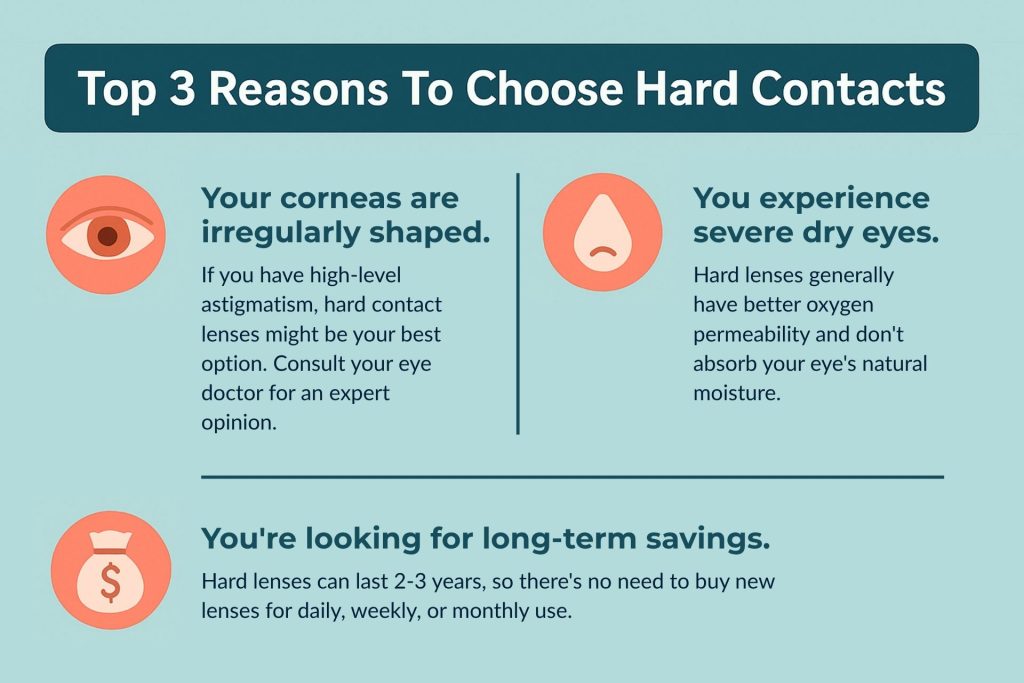
Hard contacts aren’t for everyone, but under the right circumstances, they outperform soft lenses. Here are three key cases where they shine:
- You have irregularly shaped corneas.
Conditions like keratoconus (a cone-shaped cornea) or severe astigmatism (irregular curvature) require the precise fit and optical clarity that only rigid lenses can provide. - You suffer from severe dry eyes.
Certain types of hard lenses, especially scleral lenses, vault over the cornea and hold a reservoir of fluid, offering relief and moisture throughout the day. - You want long-term durability and cost savings.
Hard contacts maintain their shape, don’t dry out like soft lenses, and can last years with proper care, making them a wise investment.
Irregularly Shaped Corneas
Soft contact lenses are often ineffective for correcting vision when the cornea is irregularly shaped. While toric lenses (a type of soft lens for astigmatism) can help in mild to moderate cases, their ability to correct more complex or severe irregularities is limited.
Hard contact lenses, specifically rigid gas permeable or specialty options like scleral lenses, provide the stable, customized fit needed for these conditions. They create a smooth refractive surface over the irregular cornea, significantly improving visual clarity.
This is especially important for individuals with advanced astigmatism, keratoconus (a condition characterized by a thinning and bulging of the cornea into a cone shape), or other corneal irregularities.
For example, in cases of severe or mixed astigmatism, where the cornea has different power requirements across multiple meridians, rigid lenses offer the precision and stability that soft lenses can’t.
Dry Eyes
Dry eyes, surprisingly, can also benefit from using hard contacts. Rigid lenses (specifically, the scleral type of RGP lenses) are designed to allow oxygen to pass through more effectively. Likewise, they don’t absorb the eye’s natural moisture, unlike some soft lenses.
Scleral lenses create a space between the lens and the eye, which becomes a reservoir for saline solution. This provides all-day moisture.
Long-Term Cost Savings
And, finally, hard contacts are best for people who value long-term savings. These contacts are corrective eyewear that does not require daily, bi-weekly, or monthly replacement. You do not need to keep a countdown calendar.
Just be sure your lifestyle allows you to maintain a regular cleaning, disinfecting, and storage routine. Invest in proper storage cases, and you’re all good!
But What Are the Downsides?

One of the main disadvantages of hard contact lenses is that there is a transition period. Hard contacts aren’t as comfortable as soft contact lenses at first. There’s a learning curve to comfortably putting them on and removing them, and you need to get used to how they feel resting against your corneas.
And, similar to extended-use soft contacts, hard contacts need meticulous care. You have to be diligent in cleaning, disinfecting, and storing your lenses every day. You can use regular lens cleaners for this. Also, there are specialized disinfecting solutions made specifically for RGP hard contacts.
Also, like soft lenses, you might need to rewet the lenses while wearing them. There are RGP-specific rewetting drops for this purpose.
Final Verdict
| Feature | Hard Contacts | Soft Contacts |
|---|---|---|
| Vision Clarity | Sharper, especially for patients with astigmatism | Suitable for most, but may not correct complex issues |
| Astigmatism Correction | Excellent | Available but not as precise |
| Customization | Highly customizable for corneal shape | Less customizable, more standardized fits |
| Oxygen Permeability | Key Advantage | Catching Up |
| Time To Adjust | Uncomfortable at first, longer adaptation period | Immediate comfort or short adaptation period |
| Replacement Schedule | One year or more | Daily, biweekly, or monthly |
Hard contacts are the best option when your eyes need precision correction that soft lenses can’t deliver. They’re ideal for irregular corneas, severe dry eyes, or anyone seeking a long-lasting, cost-effective solution.
If comfort isn’t your top priority but clarity and durability are, rigid lenses may be worth the adjustment.
Remember: Before buying your contact lenses, you should talk to your eye doctor. They will require you to do a comprehensive eye exam. You’ll get a prescription, which will include your lens specifications.
TL;DR Summary
Although soft contacts sell better in 2025, hard lenses are a viable (and sometimes more reliable) solution for many patients requiring complex vision correction.
- The concept of hard contact lenses dates back to Leonardo da Vinci.
- The first hard contacts became a reality in the 1940s, but they did not allow oxygen to pass through, causing discomfort and health issues for many wearers.
- Rigid Gas Permeable (RGP) lenses emerged in the ‘70s, solving the issue of oxygen permeation.
- Hard contacts may be your best option if you have irregularly shaped corneas or dry eyes.
- These lenses also offer cost savings, as the rigid material is more durable, allowing each pair to last a year or more.
- The downsides of hard contact lenses include initial discomfort and the need for rewetting drops and meticulous care.
The Bottom Line: Hard contacts can be game-changers, but only if they’re best suited for your needs. Consult your eye doctor for more information.

