
Game-changing lenses are giving hope to children (and their parents!) with early-onset myopia. Myopia glasses for children will never be the same again!
Essilor Stellest lenses were developed by Essilor International, the world’s largest manufacturer of ophthalmic lenses. They’ve been in the news recently, as they received the go-ahead for commercial release from the FDA in late September 2025. These lenses have been shown to successfully slow the progression of myopia in children.
This is huge! Let’s get to know Essilor Stellest lenses and see what all the excitement’s about.
Why This Is a Big Deal
Myopia, or nearsightedness, is a progressive eye condition. It’s where you can’t see distant objects clearly. Once you develop it, it will likely get worse with time, unless there’s some sort of intervention (such as surgery).
Early-onset myopia can develop anywhere from ages six to 14. A child with myopic parents has a higher chance of having the condition. Likewise, too many near-vision tasks, such as digital screen time and reading, are said to contribute to the rising number of myopic children.
The earlier myopia develops and progresses, the worse it can be for the child as they grow older. They’re more likely to develop severe nearsightedness as an adult. At the same time, it also increases their risks of other eye conditions, like glaucoma and cataracts.
Management is key to slowing myopia’s progression. This can be something as simple as limiting the child’s near-vision tasks and increasing outdoor activities. It can also be through myopia management therapies. These therapies have been used for children aged eight and older.
The new Essilor Stellest is positioned to bridge the gap in myopia management for children as young as six.
How Essilor Stellest Lenses Work
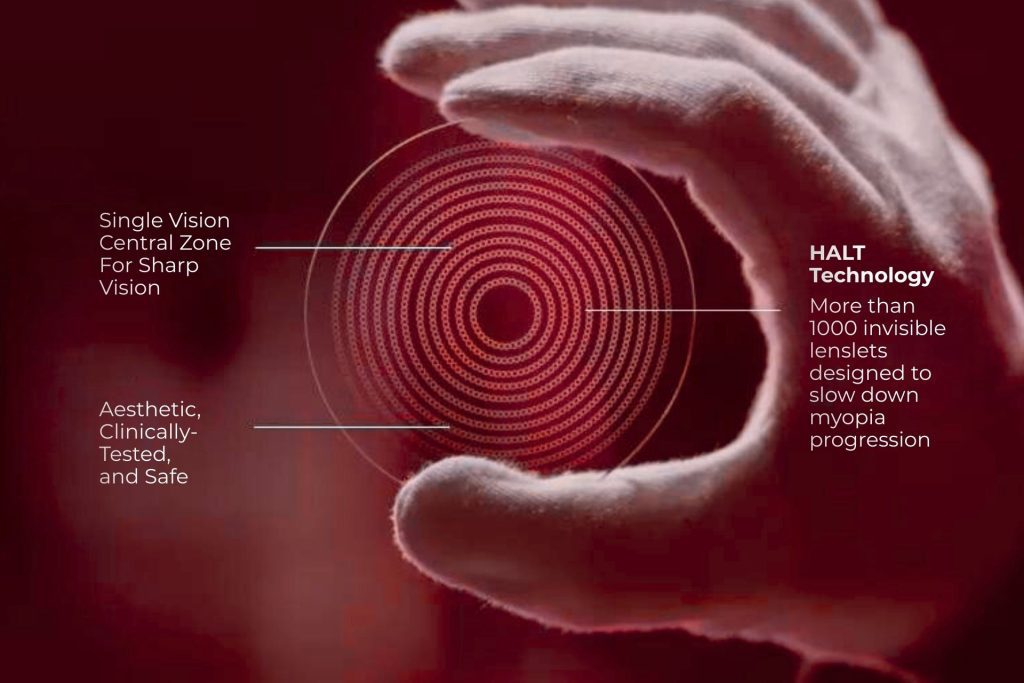
The Essilor Stellest lenses use Highly Aspherical Lenslet Target (H.A.L.T.) technology to manage myopia in children. The lenses feature multiple concentric rings of small, aspherical lenslets strategically laid out on the lens surface. This creates a specific light focus pattern.
You get a clear central area while the peripheral lenslets create a light defocus or myopic defocus. This defocus is designed to slow the eyeball’s elongation, which is the main cause of myopia progression.
The big plus with Stellest lenses is that they can slow down the progression while providing myopia correction and clear vision.
Clinical Evidence Supporting Stellest Lenses
The efficacy of Essilor Stellest lenses is supported by peer-reviewed clinical evidence. Several studies were conducted over extended periods of time. These studies involved children with myopia, from ages eight to 13.
They found that these lenses work to slow the progression of myopia by 67% (on average) when used for over two years. The progression reduces by 57% when used over five years. The reason progression slows down is likely due to the natural slowing of eye growth as children get older. Axial elongation, the main culprit in myopia progression, was reduced by 53% over two years and 52% over five years on average.
What’s more impressive is that nine out of 10 children who wore Stellest lenses had eye growth that was the same or slower than those without myopia. (Slower growth is best.) Two out of three children were able to maintain myopia correction after their first year of using the product.
Some side effects were observed, such as seeing halos and mild vision blurring. However, these side effects disappeared once the user adjusted to the glasses.
These results moved the FDA to change the designation of Essilor Stellest lenses. After receiving Breakthrough Device designation in 2021, Essilor Stellest lenses can now be sold in the U.S. and used to manage myopia in children aged six and older.
What FDA Authorization Means for Essilor Stellest Lenses
The FDA’s authorization ushers in a new era in myopia management. With Essilor Stellest now available on the market, parents of children with myopia can take proactive steps toward reducing the negative impact of the eye condition. These new myopia management lenses join a very limited list of options for children.
Other Myopia Management Options for Children
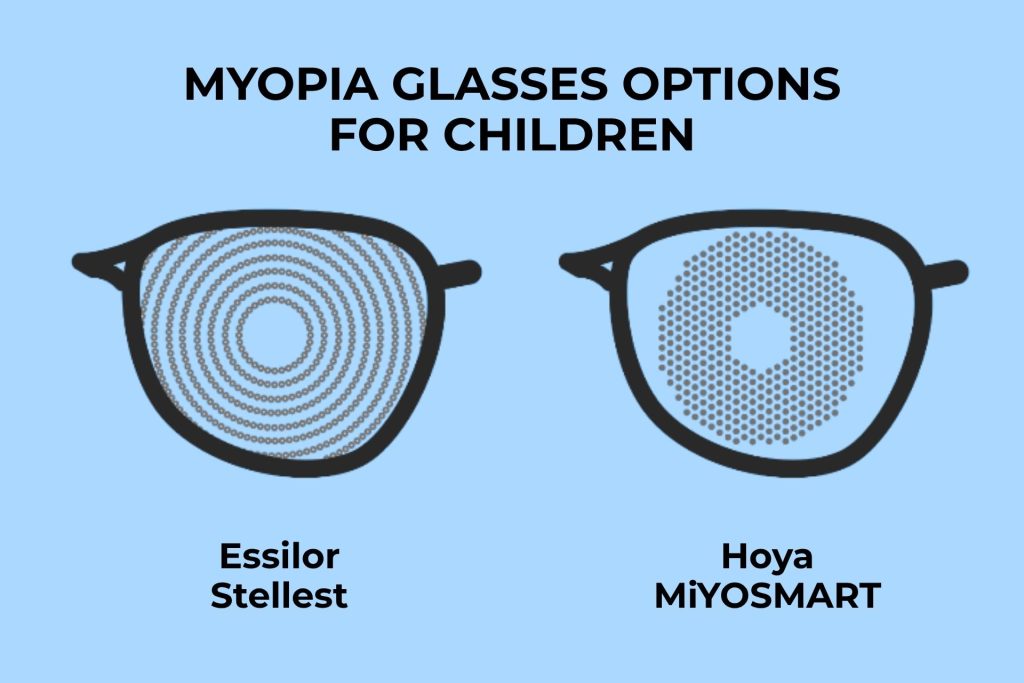
Myopia management for children isn’t really new. There is compelling evidence that supports the use of special lenses, contact lenses, ortho-k lenses, and atropine eye drops to slow down the progression of myopia.
Among myopia management glasses, only Hoya MiYOSMART lenses have an on-par success rate with Stellest lenses. These lenses have a success rate of about 60% in slowing down myopia progression in children. However, they haven’t acquired authorization from the FDA for sale in the U.S. The brand is currently available in the U.K. and 40 other countries.
In Hoya MiYOSMART clinical studies, they found that one out of five children who wore these glasses experienced zero myopia progression with consistent daily use. This was sustained for two years. Long-term follow-up studies likewise support effective myopia control over six years.
Hoya MiYOSMART makes use of Defocus Incorporated Multiple Segments (D.I.M.S.) technology. Like Stellest lenses, there is a central clear zone on the lens surface. This zone is surrounded by micro-segments that create a myopic defocus projection along the periphery. This then signals the eye to slow down its growth.
The big plus with MiYOSMART is that most children accept and tolerate the MiYOSMART lenses well, and many adapt to the new lenses within a week. In fact, many now prefer these lenses to standard single-vision lenses.
How to Try Myopia Glasses for Children
With Hoya MiYOSMART still awaiting FDA authorization, Essilor Stellest lenses are your go-to option for effective myopia glasses for children in the U.S.
Talk to your child’s eye doctor about these myopia glasses. Your child’s eye doctor can see if these lenses will be suitable for your child, and they’ll be able to tell you what prescription they need.
TL;DR
- The FDA has recently authorized Essilor Stellest lenses, the first approved device specifically designed to slow myopia progression in children aged six to 12.
- These myopia glasses lenses use Highly Aspherical Lenslet Target (H.A.L.T.) technology to create myopic defocus.
- Clinical trials show that Stellest lenses significantly reduce myopia progression by up to 57% over five years and lower the risk of developing severe myopia compared to traditional lenses.
- Myopia management for children is not new. Of all myopia glasses options, Hoya MiYOSMART lenses have a success rate that compares to Stellest lenses. Unfortunately, the brand has not received authorization from the FDA. It is currently available in the U.K. and 40 other countries.

